
Cab Driver: Where to?
Passenger: Carnegie Hall, please.
[music]
Box office: Okay, here are your tickets. Enjoy the show.
Usher: Your tickets, please. Follow me.
[background conversation]
[music]
John Schaefer: In New York City, there are lots of ways to get to Carnegie Hall: a subway, a taxi, a walk down 57th Street. You've just found another way to get to America's most famous home for classical music. Welcome to Carnegie Hall Live, the broadcast series that gives you a front-row seat to concerts by some of the greatest artists in the world. You hear the performances exactly as they happen. You are part of the audience, sharing the experience of music-making at Carnegie Hall. We're starting a brand-new season here, and things may sound just a little different because my longtime co-host, Jeff Spurgeon, has retired, but not to worry. Joining me here backstage, in a very crowded backstage area at Carnegie Hall, is Paul Cavalconte. I'm John Schaefer. Paul, welcome.
Paul Cavalconte: Thank you, John. It's great to be here in this exciting start of the season. We're starting with a performance by the Berliner Philharmoniker, known to Western audiences as the Berlin Philharmonic, an orchestra with a long history dating back to 1882. They have been led by some of the great conductors: Herbert von Karajan, Claudio Abbado, Sir Simon Rattle. Their current chief conductor is Kirill Petrenko. This concert is the second of four in New York. Just last night, they opened Carnegie Hall's season. There's a long connection between Carnegie Hall and the Berlin Philharmonic. They first performed at the hall in 1955. Since then, they've appeared more than 80 times.
John Schaefer: In addition to kicking off the new season here at Carnegie, they're also starting a month-long tour, which will take them to South America. They've got performances in Bogotá, Colombia; São Paulo, Brazil; and Buenos Aires, Argentina. That marks a return to South America for the Berlin Philharmonic over a quarter-century in the making. Eva-Maria Tomasi, violinist and member of the orchestra's board, told us just how excited the musicians were for this opportunity.
Eva-Maria Tomasi: We're very looking forward to this tour. We're also very excited going to New York. We go there regularly, but to perform in Carnegie Hall is something very, very special. You think of all those incredible musicians who stood on the stage of Carnegie Hall, so it's always exciting for us to be there and to feel the atmosphere. Going back to South America is, after 26 years, also very special. The orchestra's changed in these 25, 26 years, and we remember this incredible warm welcome we got from the public, from the audience. It's also our duty not only to play the concerts in Berlin, but also being cultural ambassadors. We like going also places, and I hope until the next time, it won't be another 25 years, but maybe earlier.
Paul Cavalconte: Eva-Maria Tomasi, violinist and member of the Berlin Philharmonic Orchestra's board, speaking about their tour in New York and South America. Now, that trip from New York to their next destination, Bogotá, will have a major adjustment for the musicians. The capital city of Colombia has an altitude of about 8,600 feet. That would be 1.6 miles. That's a lot of work if you play a wind instrument.
John Schaefer: Yes. On the other hand, when they get back to sea level, they'll all feel like superheroes.
Paul Cavalconte: [laughs] Right.
John Schaefer: There were just two pieces on the program tonight, but both of them are major works. After intermission, we'll hear Richard Strauss's Also sprach Zarathustra. In a few minutes, we'll begin the concert with the Brahms Piano Concerto No. 1. Now, when this program was drawn up, Daniil Trifonov was originally expected to perform that Brahms concerto with the orchestra. Unfortunately, he's had to bow out.
Fortunately, stepping in for him is the acclaimed Icelandic pianist Víkingur Ólafsson. He's been a frequent collaborator with the Berlin Philharmonic, debuting with them in 2022. He also has an astonishing discography, including everything from early music to contemporary works, and a Grammy-winning album of the Bach Goldberg Variations. He won a Grammy for Best Classical Instrumental Solo last year. We'll hear a little bit of that recording. Here is some of the Bach Goldberg Variations, performed by tonight's soloist, Víkingur Ólafsson.
[music]
John Schaefer: That is the Icelandic pianist Víkingur Ólafsson and a little bit from his Grammy-winning recording of the Bach Goldberg Variations. He is about to join the Berlin Philharmonic on stage here at Carnegie Hall to play a work by Brahms, his Piano Concerto No. 1 in D minor. We are expecting to have a chance to speak with Víkingur Ólafsson at intermission of this concert here at Carnegie Hall as well. Paul, the Brahms Piano Concerto No. 1, D minor, it's a big work. D minor, a kind of a dark key, and there's a little bit of a dark story to this piece.
Paul Cavalconte: Oh, very much so. It's the complicated relationships Robert and Clara Schumann, early supporters of Brahms. Robert Schumann in particular was a vocal supporter, describing him as a true apostle who will write revelations, which many Pharisees will be unable to explain even after centuries. Well, I think we're doing a pretty good job.
John Schaefer: I'm not sure I understand that. [laughs]
Paul Cavalconte: We're cracking the nut. Not a problem. Brahms speaks to us from the heart, as always.
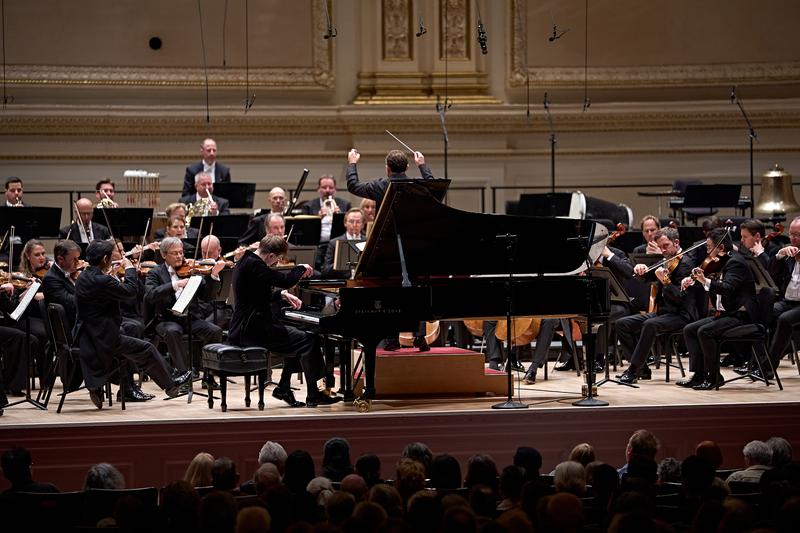
John Schaefer: The members of the orchestra now taking their places on stage here at Carnegie Hall. Again, they opened the new season here at Carnegie just last night, and we'll be joined momentarily by their conductor, Kirill Petrenko, and the pianist, Víkingur Ólafsson. Stage door opens, and out strides the concertmaster of the Berlin Philharmonic, Noah Bendix-Balgley, who, by the way, has an interesting project of his own that we'll find out a little bit about later on in the program. A little bit of tuning.
Paul, you mentioned the orchestra's been around since 1882. They started when a group of disaffected musicians left Benjamin Bilse's very popular ensemble in Berlin and formed their own group. Their original name was the Former Bilse's Ensemble, which is, by any objective measure, the worst band name in the history of band names. [laughs]
Paul Cavalconte: You don't want to be a former anything in show business.
John Schaefer: In 1887, they rechristened themselves the Berliner Philharmoniker, and here they are, the Berlin Philharmonic on stage at Carnegie Hall and about to give us a performance of the Brahms Piano Concerto No. 1.
[applause]
John Schaefer: Stage door opens again, and out comes Víkingur Ólafsson, who would tower over these musicians even if they weren't sitting down on stage. Very tall pianist from Iceland. Kirill Petrenko, the conductor of the Berlin Philharmonic at the podium. Here now, this performance of the Brahms Piano Concerto No. 1 from Carnegie Hall Live.
[music]
[applause]
John Schaefer: The Brahms Piano Concerto No. 1 in D minor, performed live at Carnegie Hall by the pianist Víkingur Ólafsson with the Berliner Philharmoniker, the Berlin Philharmonic, conducted by Kirill Petrenko. Víkingur Ólafsson at center stage, taking the bow of a very appreciative, sold-out crowd here at Carnegie Hall tonight as the Berlin Philharmonic opened the new season of Carnegie Hall with a set of four programs. Backstage at Carnegie Hall, I'm John Schaefer alongside Paul Cavalconte. That's a very different response to this piece from the one that Brahms got when he first performed the work in 1859.
Paul Cavalconte: So much of the personal backstory, the triangle of Robert, Clara, and Johannes, is invested in this music. That very internal, middle movement is the Brahms reveal. Then he comes back swinging for that magnificent third movement with all of its motifs. The classical form, just barely containing his romanticism. There was a push-pull between those two times in music.
John Schaefer: Right, and if you look on stage, the back of the stage is pretty bare. This is a very classical orchestra. It's a full complement of strings, but a modest selection of winds. Only two trumpeters representing the brass, and a lone timpani player. Now when the Berlin Philharmonic come back in the second half to play the Strauss key, Also sprach Zarathustra, it's going to be all hands on deck. Huge wind section. Enormous brass complement. Whole section of percussionists. Two harps. Of course, the organ, which provides the famous drone for that familiar opening. That will be a much more rounded out version of the Berlin Philharmonic.
Víkingur Ólafsson, meanwhile, has taken a seat back at the piano and will have an encore.
[music]
[applause]
John Schaefer: It's Víkingur Ólafsson center stage at Carnegie Hall with an encore. The slow movement of the Bach Keyboard Concerto No. 5 in F Minor. Paul, we were talking a moment ago about the difference between a classical orchestra and a romantic orchestra. Here we got the Berlin Philharmonic scale down to a baroque ensemble.
Paul Cavalconte: Right, and such a sweet piece, such a lovely chaser for the romantic, emotional power of Brahms, and the audience is responding in kind. Víkingur is just radiating sweetness. He is so in his element here. A man who discovered his gift at a very, very tender young age.
John Schaefer: They say he was playing piano before he could even talk.
Paul Cavalconte: Exactly. Apparently, there was a [chuckles] very early connection. We'll talk to him in a moment about just where the music gift first visited him. Víkingur Ólafsson.
John Schaefer: The Berlin Philharmonic vacating the stage for intermission here at Carnegie Hall. I'm John Schaefer, alongside Paul Cavalconte. We are joined by Víkingur Ólafsson. Welcome.
Víkingur Ólafsson: Thank you so much. Greetings.
John Schaefer: That was an interesting choice of encore for a couple of reasons, not least of which is it doesn't really end. It's kind of an ambivalent or an ambiguous conclusion to that piece.
Víkingur Ólafsson: Right. It's the great delusion of life; we think it doesn't end. That's a perfect metaphor for it. No, I thought, yes, it's an amazing end to the movement actually, to go into arco, to actually draw the string finely on the bow-- the bow on the string. Why not play this encore here? We have the Berlin Philharmonic and these incredible players. It's so sweet to have this little thing.
John Schaefer: Well, it's also interesting that an encore would involve the orchestra when you just finished playing this massive concerto where the orchestra-- I mean, Brahms, the debut of that piece was a disaster because people felt there was too much orchestra, not enough piano.
Víkingur Ólafsson: Right.
John Schaefer: Is there a special challenge?
Víkingur Ólafsson: The piano of the 1850s is a very different beast from the piano of what I just played here in 2026. It's a considerably different piano. I think Brahms was writing this certainly for the future. Yes, it's a piano concerto very much, and it's incredible concerto, but it's also very much a piano symphony. It's a new way of thinking about piece of piano and orchestra, I think, the way he blends it into the texture, but the way he also draws it out. It feels very appropriate, after such a piece, to actually play something with the orchestra as an encore because it's such a team effort.
I thought also, Bach-- because this piece here, the Brahms, it's full of Bach influence. You have this little fugato in the third movement. Basically, the way the third movement is written, it's a continuation of the Beethoven tradition, but it's also very much in the spirit of Bach. The great grand cadenza there at the end, it feels almost like a baroque improvisation. You could almost imagine this being Johann Sebastian Bach himself improvising something on an organ.
John Schaefer: Well, you mentioned that Brahms's piano in 1859 would be very different from the one you just played here at Carnegie Hall. Bach didn't have a piano at all. That keyboard concerto in F minor, that key of F minor would have had a very distinct tone color to it.
Víkingur Ólafsson: That's right. Well, colors change with the years, but for me, F minor, A-flat major, yes, it's extraordinarily specific. The beautiful thing as well, for the people with synesthesia who connect-
John Schaefer: People who see color with tones, yes.
Víkingur Ólafsson: -keys with color. I think many composers have their own color scheme for different keys, but nobody has the same color scheme, and that's the beauty of it. Yes, it would have been different, but so would society. You have to think that when this was written, a horse was the fastest way of getting around. [laughter] We could go on with that.
John Schaefer: What color is F minor for you?
Víkingur Ólafsson: For me, F minor-- Oh my God, they're just going to crush me with a piano here [laughter] when taking it off stage [unintelligible 01:08:17].
John Schaefer: Incoming.
Víkingur Ólafsson: F minor for me is blue, but this wasn't very much in F minor, was it? It was A-flat major, which is more like a beautiful blue-greenish for me.
Paul Cavalconte: Víkingur, you're about to release the fruit of recent labor in deep contemplation of Bach. The Continuum II is arriving soon, and original keyboard works of Bach alongside your own new arrangements and transcriptions, so picking the locks of Bach a little more. What have you discovered in preparing it?
Víkingur Ólafsson: Oh my God, so many things. Actually, what I've just played as an encore, this movement, is actually on the album, but with a string quintet. Bach is my-- he's my one constant in an ever-changing world. I play his music every day. I need it to center myself and to understand the world around me.
Continuum II is the second installment of my Continuum project, which is basically going to be my dialogue and my journal with Bach for, hopefully, as long as I continue making recordings. This one has, I think, an incredible selection. You have chorales that I'm playing on an upright piano. Chorales, they're usually sang, and they're some of the most glorious music he ever wrote. I don't know if they ever have been recorded on a piano, but it really-- the ones I chose, I think take on a different life in that setting.
I have some of the lesser played preludes. I have my own new arrangements, including one solo violin sonata, and all sorts of things. It's, I don't know, 20 tracks or something like that. It's a little bit in the spirit of my 2018 album, in case you guys know that, which mixes a lot of original Bach, but also with new arrangements and sometimes old arrangements.
John Schaefer: There's also Bach reworks and remixes. You're a 21st-century musician looking back at this older music, and you've done so much championing of contemporary music, from Thomas Adès, to Philip Glass, to Ryuichi Sakamoto, to Daníel Bjarnason. What does that do for you when you come back to Bach, Beethoven, and Brahms?
Víkingur Ólafsson: Well, Glenn Gould said once that the worst moment in classical music was when the composer ceased to be a performer and when the performer ceased to be a composer. I used to compose more when I was younger. My father is a composer, my mother a piano teacher, and so I always have those two elements in me.
For me to champion modern music is extraordinarily normal for me because I actually like to play old music feeling the same as if I would be playing the world premiere. I would like to play world premieres with the same feeling that I might have with the Brahms D Minor Concerto, having known it and played it for so many years. I think sometimes we separate those two worlds too much.
I think very much some of my favorite performers, let's say pianists in history, they have very much thought like composers. Think about Vladimir Horowitz. We're in Carnegie Hall; it's his house. Think about Sergei Rachmaninoff. Think about many of the great-- Artur Schnabel. Three of my absolute favorites. They would always approach the music from a composer's perspective and take composer's freedom in some of it. I'm interested in that. I think that is an interesting meeting place, but everyone has to find their own way with that.
I think also when people say that you can just take the score of a piece of music and that everything is in the score; I think sometimes when people say that, they haven't really tried writing a score. Once you write a melody, and then you're going to confine that melody for all ages to come to that particular hairpin that has to start there and end there or that mezzo forte, but mezzo forte in Carnegie Hall is different from mezzo forte in the Philharmonic in Berlin. There is no [unintelligible 01:11:53]
I think the score is gorgeous and sometimes it's almost sacred, but at the same time, would we expect, let's say, Johannes Brahms, if he was here today living, would we expect him to play this piece twice the same? Would you? Do you think he would play exactly the same tempo, exactly the same dynamic, and here starts the hairpin? I don't think so.
John Schaefer: Yes. Well, hence the title, Continuum. All of these things are connected and you lop them off at your peril. Víkingur Ólafsson, thank you so much for stopping by at intermission here at Carnegie Hall. Congratulations on a great performance of the Brahms.
Víkingur Ólafsson: Thanks WQXR for amazing programming as always.
John Schaefer: We are at Carnegie Hall. Carnegie Hall Live. Our first broadcast of the new season, and we are at intermission. The Berlin Philharmonic. I mentioned earlier this evening that they have a first concertmaster named Noah Bendix-Balgley with an interesting project. They also have another first concertmaster, Daishin Kashimoto.
It turns out that the two of them have swapped places tonight, and Mr. Kashimoto is acting as concertmaster for this program that we are hearing. You'll hear him tuning the orchestra again before the Richard Strauss in the second half. Just a little bit of housekeeping before we get on to our next bit of business, Paul.
Paul Cavalconte: Which is intermission time at this concert. In a few minutes, we are going to hear Richard Strauss's Also sprach Zarathustra, an iconic tone poem that you might recognize, of course, it's a pop culture cliche at this point, from Stanley Kubrick's 1968 film 2001: A Space Odyssey. There's more than three minutes to it. It just keeps on going for a while.
Before we get to this monumental piece, let's hear a little music from the first concertmaster of the Berlin Philharmonic. He has just released an album of klezmer music. Earlier this week, we sat down with him, and he told us about his new recording.
[music]
Noah Bendix-Balgley: I'm Noah Bendix-Balgley, and I'm first concertmaster of the Berlin Philharmonic. I joined in Berlin in 2014. Before that, I was concertmaster of the Pittsburgh Symphony.
[music]
Noah Bendix-Balgley: I grew up hearing a lot of classical music. My parents, although not musicians themselves, love classical music, so I heard a lot of that. I also heard a lot of Eastern European folk music because my father, professionally, is a dancer and a dance teacher and specializes in these folk traditions. I heard a lot of the music he was dancing to. I went to the workshops and camps that he was instructing at. Of course, as a young violinist, I wanted to try to play the music too.
[music]
Noah Bendix-Balgley: I learned some of these different styles in Greek and Bulgarian, but also from the Yiddish tradition, and that was klezmer music. I have had an amazing opportunity to work with the best klezmer musicians around at those workshops.
[music]
Noah Bendix-Balgley: I've been playing klezmer music since a young age, and that was always a complement to my classical playing because it offers different things. It's very free. There's a lot of improvisation. You get to jam in a band and everything. At some point, as my career started to develop and I got more active performing recitals and concertos, I had this desire to bring these two worlds together.
I started to look for repertoire based on Yiddish and klezmer music that was already there. There's some wonderful stuff, especially in small settings, violin and piano, small chamber music, but the one thing I really dreamed of was a concerto to play with an orchestra. After looking around for somebody else to compose it, eventually I came to the conclusion and was encouraged to do it myself.
When I got down to work, I decided to compose basically my own klezmer melodies rather than using existing ones. I used different dance forms, which is very important in klezmer tradition. I worked to come up with a version, violin and piano, of it. Then I would send sections of the piece to my orchestrator, Samuel Adler, and he would then flesh it out in a very colorful, virtuosic orchestration for ensemble. The album is called Klezmer Concerto, and the main work on it is my own composition. It was called Fidl-Fantazye, which is a klezmer violin concerto that I composed 10 years ago now.
[music]
Noah Bendix-Balgley: For me, I always really get into it in the end of the second movement where things get a little more wild, and then the last movement is just a series of fast dances. That one is more upbeat and excited than the other, and that's always a lot of fun. I think as we get to that last moment of the concerto, it's always a party.
This was a very special project for me to be able to play klezmer music in the Berlin Philharmonie with the Berlin Philharmonic. Not only musically, but also because of my family history. My father's family, they were German Jews, and they had lived in Berlin. They had to leave in the late '30s, were lucky to get out. I've made my family and musical home in Berlin now, so there's a bit of a circle there. To be able to celebrate it in Berlin with my colleagues who are brilliant and inspire me every day is a real joyous occasion.
[music]
John Schaefer: That is a little bit of the Fidl-Fantazye, a klezmer violin concerto composed by the Berlin Philharmonic's first concertmaster, Noah Bendix-Balgley, that's just been released on an album called Klezmer Concerto. This is Classical New York, WQXR, 105.9 FM and HD, Newark; 90.3 FM, WQXW, Ossining; and WNYC-FM HD2, New York.
Well, Noah Bendix-Balgley and the rest of the Berlin Philharmonic are- well, they're all gathered around us, Paul.
Paul Cavalconte: We're in it. [chuckles]
John Schaefer: Waiting for the stage door to open so they can get back out on stage here at Carnegie Hall to perform the piece that will take up the second half of the program tonight. It's Richard Strauss's tone poem, Also sprach Zarathustra, a work in eight parts, one of which you will certainly recognize because it was used in Kubrick's film 2001: A Space Odyssey, loosely based actually on the Friedrich Nietzsche poem of the same name.
Paul Cavalconte: It's such a canny way in the film because it represents the dawn of enlightenment. At various moments in the confusing storyline, we realize mankind has just made a huge leap. It is the music that propels us into this work that now requires a fairly large ensemble. John and I have been treated to some rich backstage entertainment as a lot of big instruments have been rolled out onto it. You'll hear an extended range, piccolo, contrabassoon, bass clarinet, trombones, and tubas. Also, six horns, two harps, an organ. It's quite a setup.
John Schaefer: That familiar rising three-note theme that you hear at the very beginning, the kind of sunrise theme; once you know to listen for it, you will hear it in various configurations throughout the rest of the piece. The work was composed in 1896. That was the same year that Strauss became the chief conductor at the Bavarian State Opera in Munich. They were very happy to have him as a conductor. They seem to have been less impressed by his compositions and because of that, Also sprach Zarathustra actually premiered in Frankfurt before going on to global fame some 70 years later thanks to Stanley Kubrick.
The members of the Berlin Philharmonic, the full complement who were here for the Brahms earlier, plus reinforcements, are now making their way back out on stage here at Carnegie Hall. We will hear a performance of this eight-part piece. Paul, as you said earlier, there's more than three minutes to this piece.
Paul Cavalconte: Oh, there certainly is, and it's quite a sonic showpiece. As a matter of fact, in 1954, the very first stereo record was made by RCA, eventually released on the Living Stereo series of the Chicago Symphony conducted by Fritz Reiner. They chose this piece perfectly. Two mics captured it all, and to this day it is one of the great recordings.
John Schaefer: There have been many, many others. I can remember a kind of Brazilian jazz version of 2001: A Space Odyssey theme-
Paul Cavalconte: Then there's disco.
John Schaefer: -by Eumir Deodato.
Paul Cavalconte: Right.
John Schaefer: Then, yes, there was the disco version in the late '70s. The beginning of this piece, and again we have to keep saying, just the beginning of the piece, the way it has infiltrated pop culture is really astonishing and goes to show that when you get down to it, people respond to music, not to genre. Nobody tells you, "Hey, this is classical music." You're watching a film. It's not making any sense. This glorious music is propelling you through the story. Nobody cares what it is. They just love the music.
Paul Cavalconte: It pushes the buttons.
John Schaefer: Well, there are lots of buttons to be pushed in the next half hour, and strings to be bowed, and percussion to be struck, and lots of sounds to fill Carnegie Hall. The Berlin Philharmonic, the second of four concerts that they are doing to open the new season here at Carnegie Hall.
Conductor Kirill Petrenko now mounting the podium once again at center stage to perform Also sprach Zarathustra, Thus Spoke Zarathustra, by Richard Strauss from Carnegie Hall Live.
[music] [applause]
John Schaefer: The Berlin Philharmonic and conductor Kirill Petrenko on stage at Carnegie Hall performing Richard Strauss's tone poem Also sprach Zarathustra. The familiar opening and then that enigmatic ending of a work that revels in color, but not too much at once. One of the beauties of the piece is how Strauss doles out the huge musical forces that he amasses during the course of the work.
Paul Cavalconte: There are more than just a few winks at Der Rosenkavalier, which is about 15 years upstream from this 1896 work. So the churn is on. Recycling of ideas and motifs, but a distinctly Strauss palette for sure.
John Schaefer: It's a sold out Carnegie Hall and the audience is on its feet, and so is Kirill Petrenko. Back out on stage after briefly walking off, and he's signaling to the various members of the orchestra to rise. I must say, he cut a remarkably calm and relaxed figure during the performance there. From our vantage point, we could see he was smiling throughout the work. He did seem to be reining in the lower brass at one point a few minutes before the end. Aside from that, it seemed to be kind of like a guy driving a gleaming sports car where you just need to tap the accelerator a little bit to get it to go.
Paul Cavalconte: That's the finely tuned Berlin.
John Schaefer: Absolutely.
Paul Cavalconte: They made their first appearance here in 1955. It's been 80 more appearances since then in the history of Carnegie Hall and a very fine entry in tonight's program.
John Schaefer: Kirill Petrenko back out at center stage now and gesturing for the entire orchestra to stand as they bask in the applause of this sold out crowd here at Carnegie Hall tonight. Well, it was only two pieces on the program, but this audience certainly got its money's worth with the Brahms's Piano Concerto No. 1 in the first half, and then this resplendent performance by the Berlin Philharmonic of Strauss's Also sprach Zarathustra. Another curtain call for Kirill Petrenko, who again, insists on sharing the applause with the members of the orchestra. All on their feet.
It is quite a crowded stage out there now, with all of the strings and the huge brass section, triple winds, lots of percussion, two harps, and an organ, which will all now need to be moved off of that stage as we wrap up this broadcast of Carnegie Hall Live. This is Classical New York, WQXR 105.9 FM and HD, Newark 90.3 FM, WQXW Ossining, and WNYC FM HD2 New York. Our thanks to Clive Gillinson and the staff here at Carnegie Hall.
Paul Cavalconte: WQXR's team includes engineers George Wellington, Duke Marcos, Bill Siegmund, and Neil Shaw. Our production team, Eileen Delahunty, Laura Boyman, Lauren Purcell-Joiner, and Christine Herskovits. I'm Paul Cavalconte.
John Schaefer: I'm John Schaefer. Carnegie Hall Live is a co-production of Carnegie Hall and WQXR in New York.
[02:06:05] [END OF AUDIO]
Copyright © 2026 New York Public Radio. All rights reserved. Visit our website terms of use at www.wnyc.org for further information.
New York Public Radio transcripts are created on a rush deadline, often by contractors. This text may not be in its final form and may be updated or revised in the future. Accuracy and availability may vary. The authoritative record of New York Public Radio’s programming is the audio record.