
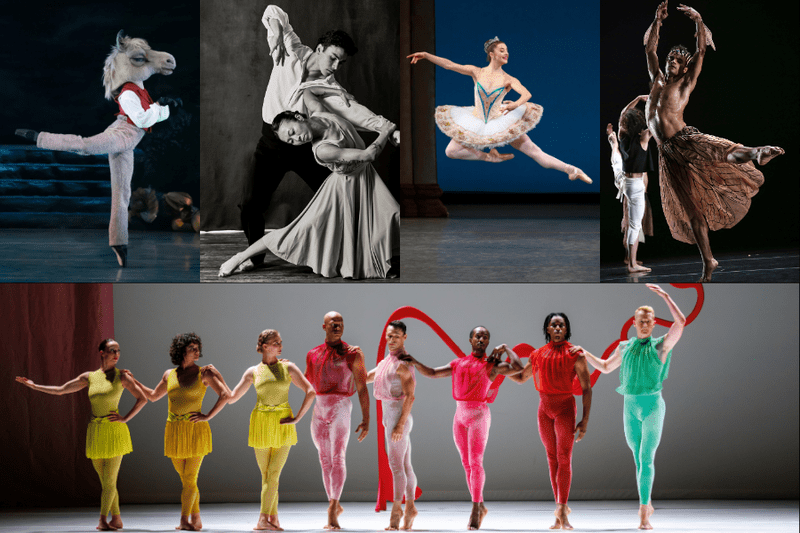
Monday: Clinton Luckett on Sir Frederick Ashton’s The Dream
I'm Clinton Luckett, the Associate Artistic Director of American Ballet Theatre. The ballet “The Dream,” based on Shakespeare's “A Midsummer Night's Dream,” was choreographed by Sir Frederick Ashton in 1964 for the Royal Ballet in London. The great challenge of dance is that we don't have words to tell our stories. Instead, we have to use the movement of the body, and Ashton was a consummate master of using our language of classical dance to that end. In Mendelssohn's music, he had the perfect vehicle to tell the story because Mendelssohn's music quintessentially captures the essence of Shakespeare's play. Mendelssohn, I would guess, probably never dreamt that his music would become the basis of a dance, but it is extremely danceable music.
Oberon and Titania are the king and queen of the fairies, and they start out having a great argument. Titania storms off and Oberon is enraged. He summons Puck, his sprite, to mess with things. We eventually see Bottom, who's famously turned into a donkey, and then Titania, through Puck's mischief, falls in love with the donkey, and they have a very charming duet together. The choreography that Ashton gives to the corps de ballet of the fairies has a lot of light, fast jumps to give you the sensation that they're kind of hovering over the floor - very quick, darting changes of direction, sort of quicksilvery movements. And then Puck, of course, is really airborne. He's usually performed by a virtuoso dancer with a great jumping ability who can really hang in the air, as almost all of Puck's choreography is comprised of jumps. So we basically just see him sort of suspended in the air the entire time.
When Bottom is turned into the donkey, Ashton very cleverly asked the male dancer to dance on pointe, which is very unusual. The pointe shoes, which are painted black, sort of stand in for the hooves of the donkey and so that was very clever to have a man on pointe with this donkey's head and then the feet encased in the pointe shoes giving the illusion of hooves. Ashton had a tremendous sense of humor and he really mined the humor that Shakespeare instilled in “A Midsummer Night's Dream.”
The climax of the ballet is the nocturne, which is the final pas de deux of Oberon and Titania after they've reconciled. The music that Mendelssohn wrote for the nocturne is transcendental, and Ashton met Mendelssohn with absolutely transcendental choreography for the two lovers. That pas de deux encapsulates all the different layers and aspects of love in a true marriage. It's a very, very deep and profound statement.
As a ballet student, you spend most of your time trying to master technique and learning how to do all the steps. But then when you come to a work like The Dream, you realize there's a lot more to it than just doing classical ballet steps. There's a whole universe of theatricality. Rehearsing it is like taking a clock apart and looking at all the different parts and starting to understand how they all work together to make the whole thing function. And of course, as with any great work, there's always something new to notice. Or some understanding of the music that you never heard before. That's what makes it a classic. It's rich in that it eternally offers the chance for discovery.
Tuesday: Joey Columbus on José Limón’s Mazurkas
My name is Joey Columbus, and I am currently a dancer for the Limón Dance Company. "Mazurkas" was choreographed by José Limón, and it premiered in 1958. It's all danced to Chopin Mazurkas. In 1957, the company did a tour of both Western and Eastern Europe. The trip ended with them going to Poland. And if you think about that time in history, following the Second World War, Poland was still kind of struggling, especially when you compare it to the other countries maybe more in Western Europe that José and his company visited. So he writes a lot about how when they were in Poland, the people there were the most positive and happy of any other country that he went, even though their churches, their schools, and their buildings were basically gone. So that was something that really stuck with him as he left that tour and came back to the States and continued his choreography. "Mazurkas" he made as a gift to his dancers. He was really inspired and just proud of the work that they did on this tour. They were performing constantly, sometimes to crowds who maybe weren't so receptive. And then when they got to Poland, the people were just incredible, and his dancers were really giving a lot of themselves. So each section was really a love letter to the strengths of the specific people that he was working with. I do know a little bit about them, based on his diaries, but also the tone of each solo.
The Chester solo is kind of the emotional center of the piece. Chester was of Polish descent. One can imagine that he had a lot of feelings and emotions being in this place that was torn up by the war, but he's there performing for a community of people that he has a deeper connection to. There's these elements of reaching towards the ground, connecting to some type of land, but knowing that you can't stay there, knowing that maybe you once were of this place and you no longer are. The tone is, I don't wanna say sad, but it, it has more weight. So when I'm dancing these works and trying to grapple with who's done this before me and how I can bring myself to it, I always think about this technique that I live and breathe every day. The Limón technique is all about fall and recovery. It's all about experiencing gravity in our limbs and how we can give into that but also resist that. The resilience of the human spirit is something that is powerful and that is spoken about in Limón work constantly. So if I'm dancing this solo, I'm trying to think about those things, like, "How do I personally stand up every day, even in the face of great challenge? When is a time when I felt that I wish I was maybe at home, right? When is a time when I've been missing that sense of familiarity?” And so if I can connect to those basic human ideas and then tie them into my personal experiences, I think that that lets the solo resonate in a way that hopefully somebody in the audience can connect to.
Wednesday: Indiana Woodward on George Balanchine’s Theme and Variations
My name is Indiana Woodward and I'm a principal dancer with the New York City Ballet. Theme and Variations was choreographed by George Balanchine in 1947 and the music is Tchaikovsky. Balanchine's choreography is very special because it has a very unique relationship to the music. It feels like it's just movement that is showing what the music is. So it's not always about a story. It's usually about the steps and the music. So Theme and Variations was intended to evoke that great period in classical dancing when Russian ballet flourished with the aid of Tchaikovsky's music. It was an ode to this beautiful, classic, regal form of movement, and Tchaikovsky's music.
The first time I got to see Theme and Variations, I was a student studying at the School of American Ballet, and I saw this work, and immediately I was like, "One day I hope to do this." It was a dream. The solos that the principal dancer gets to do, I mean, it's just the coolest steps. There's a lot of things that you wouldn't necessarily think you would get to do in a tutu in a classical ballet. Like it feels like you have to go to the edge every time with the music and with the steps.
I got to perform it for the first time last year, so it was a lot of anticipation because I was wanting to make sure I just gave it my absolute all to honor the steps, the choreographer, and the music. It is an exhilarating, exciting, high energy, extremely thrilling, ballet because you get that feeling of, like, the bubbles in your tummy kind of at all times, that excitement and nerves because it is so hard as well, and that music. You just can't forget what you're doing because that music, it just carries you through. So even if you have a moment of, like, being terrified, if you just dive into that music, everything would be okay.
In the pas de deux, you're dancing with a partner. There's a gentleness, a softness, it's this beautiful singing of the strings that comes out, and it's like pulling on the heartstrings. And that music just enters your soul, and your heart just, like, sings the music with the steps. It becomes so quiet on stage and you're kind of assessing each other and seeing how we're gonna dance together. You look at each other. You’re present with each other onstage and you're exchanging a really wonderful moment of movement and music.
Theme and Variations doesn't necessarily have a narrative, but it does have a feeling. Whenever I step into the role, I do step into this feeling of being a real ballerina. Like, it's just the epitome of a ballerina role between the costume, the crown, the pointe shoes that you're wearing, the music, the steps that you're dancing. You just kind of go into the history of what this ballet has brought to dance and whoever has danced it in the world. I felt all of that history when I got to dance it. I feel that even though it doesn't have a character or a persona, it does feel like the music really takes you where you need to go.
Thursday: Pam Tanowitz on Messengers, Maidens, and the End of Something Else
I’m Pam Tanowitz and I'm a choreographer. My dance is choreographed to Schubert's “Death and the Maiden” and the title of the dance is called “Messengers, Maidens, and the End of Something Else.” The Paul Taylor Dance Company has commissioned me to create this work. So I've always loved Shubert. I have been thinking about this music for years. You know, it's in movies, it's like part of the consciousness. It's very dramatic. I played around with this music when I was, much younger, like 1999. And it's just been sitting with me, and then when Michael Novak from the Paul Taylor company asked me to make something, it just kind of felt like the right collaboration. Once I realized that I wanted to do this piece - I knew I couldn't do the whole thing 'cause it was too long - but then I was like, bookends make sense to me. The first movement, the fourth movement. Like, that is something I can, like, hang my hat on and, like, figure out what this dance is.
The beginning is a quartet, men, and they come on, and in my head, they're messengers. They're saying something. They're announcing something. They're performing the thesis of the dance in a way. And then there's a moment in the music that the women come out, and they're the maidens in my head, but it doesn't mean that they're maidens throughout, 'cause then they start switching movement and things happen. So it's in play but I don't adhere to a narrative or story. When I started, the first movement was my favorite. I mean, I just wanted to see the beginning over and over again. Dun, dun, dun, dun, dun. You know, that's what gets your blood, like, pumping, right? And I was really, really scared of the fourth movement, 'cause it felt really, like, overwhelming. But, as I worked on it, I was able to delve into it and kind of, like, crack the case on what the relationship to the first movement was.
I have a dancer named Lee. He's in the quartet. I had a rehearsal with him, just to go over his steps for the first section, and I said, "You know what? Let's do an experiment. Let's just do this movement to the fourth." And so he did it as a solo. It just happened. I was like, "This is it." He's the through line. He sews everything together. So he repeats everything from the first section as a solo, but also against new movement layered, and he's doing the same steps to different music. So it brings out different things in the movement. I'm very much an intuitive artist, so I'm in the room with the dancers and I let that guide the process. I'm a process queen. I love process, and I love having the process kind of dictate the meaning of the dance as well. I didn't really wanna play with images of death so I kind of counteract that, and I think I respond to the music, again, in an intuitive, passionate way, but not with literal images. It's really like, how do I wanna create a world? It's definitely their own world, and it's dark, but the costumes are bright. So you don't think really death when you're looking at it. There's moments of sad, and there's also really great moments of fun and wit. You want sad and you want funny, and you want everything to be everything all at once. That's kind of how I create things.
Friday: Christopher WIlliams on Spectre de la Rose
My name is Christopher Williams and I'm a dancer, choreographer, and puppeteer. I'm kind of a firm believer that storytelling has to evolve. The society I was born into has excluded queerness in its storytelling, often. And I've spent the last five years reimagining a series of ballets in order to make my own queer-inclusive contribution. So I've made five pieces in the series so far and this will be the sixth work. The name of the piece is “Spectre de la Rose,” The Spirit of the Rose, and it will be premiering at the 92nd Street Y. The music is Carl Maria von Weber's “Invitation to the Dance.” The original “Spectre de la Rose,” uh, was choreographed for the Ballets Russes by Michel Fokine in 1911. It had a really simple and sweet scenario, kind of romantic. It took the form of a pas de deux, presenting a young woman dreaming that the rose from her first ball comes to life and dances with her. I think that my work engages with the original only in small ways, uh, such as that it's set to Berlioz's 1841 orchestration of the von Weber and includes reimagined versions of the two main characters in the scenario.
I tend to create steps directly to melodic lines that I hear in music. When I teach the phrases to the dancers, I often kind of sing the melodies to them as I'm teaching it. I want the marriage of the music and dance to be so integrated, to be so closely knit that it's almost as if the movements of the dancers are generating the sonic world and vice versa.
There's this abrupt shift that happens in the middle of the piece and we're kind of lulled into a sweet and almost demure little repetitive section. There's this moment where it's like, “yum, bum, bum, bum, bum, bum, bum, ba, ya, da, da, da, da, da, da, dum, bum, bum. YON, DA, DA, DUN, DA, DA, DUN, DA, DA, DUN.” And then it really just bursts out, so that... I think that's one of my favorite little moments. [laughs] The music suddenly becomes almost wild and unhinged with huge swooping gestures. And we named it the loose horses section, uh, because it reminds me of horses breaking out of, of a corral.
I am most excited about seeing how all the elements, the choreography, the costumes, the lighting, the sonic designs, and Berlioz's orchestration of the von Weber score will all come together in front of a live audience in my signature queer mythopoetic spirit, hearkening back to the Ballet Russes era. Lavish spectacles combining groundbreaking music and bold visual design, and cutting-edge choreography kind of became the hallmark of the Ballets Russes style. And their performances ended up significantly influencing the fields of music, visual art, even fashion, and really ushered dance into the age of modernism. Recontextualizing the Ballets Russes style through my queer lens has become especially important to me not only to pay homage to the birth of modernism and dance, but as a kind of activism, promoting inclusivity.
Copyright © 2026 New York Public Radio. All rights reserved. Visit our website terms of use at www.wnyc.org for further information.
New York Public Radio transcripts are created on a rush deadline, often by contractors. This text may not be in its final form and may be updated or revised in the future. Accuracy and availability may vary. The authoritative record of New York Public Radio’s programming is the audio record.