
Taxi Driver: Where to?
Passenger: Carnegie Hall, please.
[music]
[tires screech]
[car honks]
Ticketing Agent: Okay, here are your tickets. Enjoy the show.
Usher: Your tickets, please. Follow me.
[background conversations]
[music]
Jeff Spurgeon: In New York City, there are lots of ways to get to Carnegie Hall. A subway, a taxi, a walk down 57th Street. You have just found another way to get to America's most famous home for classical music. Welcome to Carnegie Hall Live, the broadcast series that gives you a front-row seat to concerts by some of the greatest artists in the world. And you hear the performances exactly as they happen. You are part of the audience sharing the experience of music-making at Carnegie Hall. Backstage at Carnegie Hall, I'm Jeff Spurgeon alongside John Schaefer.
John Schaefer: Bedlam, Jeff. [laughter] It is sheer bedlam backstage here at Carnegie Hall tonight. Musicians scurrying back and forth. And when I say musicians, I mean some of the foremost-
Jeff Spurgeon: Oh.
John Schaefer: -most famous names in-
John Schaefer and Jeff Spurgeon: classical music.
John Schaefer: -of our time.
Jeff Spurgeon: Mm-hmm.
John Schaefer: Gathered here for an amazing occasion. It is the 50th anniversary of the so-called "Concert of the Century" that took place here at Carnegie Hall, and by happy coincidence, also the 135th anniversary of the opening of this institution of Carnegie Hall. And our orchestra tonight, most of them are already out on stage. Uh, they are members of the NYO-USA All-Stars, the National Youth Orchestra of the USA. So these are young musicians who have participated in this annual program at Carnegie Hall that brings together the best young players around the country. And over the past 13 years, Jeff, many of them have gone on to positions with some of the leading orchestras-
Jeff Spurgeon: Yep.
John Schaefer: -here in the country.
Jeff Spurgeon: That's right. These are all professional musicians on stage, all part of the NYO program. And the conductor tonight is Yannick Nézet-Séguin, whose current roster includes music directorships at the Philadelphia Orchestra and the Metropolitan O-- uh, Opera and his hometown orchestra, Orchestre Métropolitain, in Montreal. Tonight's concert is modeled after the so-called "Concert of the Century", which happened almost, not quite, exactly 50 years ago here at Carnegie Hall, organized by Isaac Stern, who organized saving this building from being demolished and replaced with an apartment building or two in the year 1960.
The challenges of running the place after Stern had saved it became quite something. And so this concert was organized in 1976 to raise money to support the institution. And that's how this program began. On that original concert 50 years ago, we don't even need to say their first names, Bernstein, Horowitz, Rostropovich, Menuhin, Fischer-Dieskau, all performing on stage alongside one of the acts that was here on opening night 135 years ago. And that doesn't happen very often, [laughter] the Oratorio Society of New York.
John Schaefer: Yes.
Jeff Spurgeon: Who also performed on the very first concert at Carnegie Hall. They're here tonight, not the original members, as far as we know.
John Schaefer: [laughs] But the Oratorio Society will be, uh, doing more than just making up the numbers tonight.
Jeff Spurgeon: Mm-hmm.
John Schaefer: They, uh, they have some heavy lifting musically to do, but so do the pianists Emanuel Ax and, uh, Lang Lang and Daniil Trifonov, singers like Renée Fleming, Joyce DiDonato, Michael Feinstein, will be along to dip into the great American songbook, um, and Audra McDonald as well. Yannick Nézet-Séguin, as Jeff mentioned, will conduct the whole affair.
It is a gala performance in support of Carnegie Hall's extensive artistic, education, and social impact programs. And throughout the concert, uh, Renée Fleming, in addition to singing Mozart's Laudate Dominum, will do a little bit of onstage hosting. And, uh, we understand there are some photo collages and video of Carnegie Hall's remarkable history, and through the magic of radio, we'll see what we can do to paint that picture for you.
Jeff Spurgeon: In-indeed. One of the participants tonight is mezzo-soprano Joyce DiDonato. She's going to be singing Mahler's songs tonight, and for the first time performing on the stage of Carnegie Hall, first time performing with pianist Emanuel Ax.
Joyce DiDonato: Emanuel Ax is, of course, a legend and an extraordinary pianist, and so I just knew that it would be something really special to be with him, and then I thought, what do we do? Oftentimes, galas are big and loud and boisterous and festive, as they should be, but I think you also, every once in a while, need a moment of repose and quiet.
And so I chose two of the Rückert-Lieders of Mahler, and, um, not only Mahler's, of course, affiliation with Carnegie Hall as well, but Carnegie is the pinnacle, and I think bringing a pinnacle art song to this amazing stage, it's a good moment to do that and remind people of the heart and the soul of what this place can-can do.
John Schaefer: Mezzo-soprano Joyce DiDonato. Another performer you'll hear tonight is the superstar pianist Lang Lang. He'll be playing a movement of the Tchaikovsky Piano Concerto No. 1.
Lang Lang: This concerto is one of my lucky pieces, which, uh, brings my career to the international stage when I was a-a teenager, and to come back with this special gala, 50 years after this gala of the century, and this is the perfect piece to play. This piece is really this, you know, this building up, this-- You have to plan for this huge ending, you know, and-and it's always kind of climbing the Himalaya or something. All quite exciting to-to play this, uh, concerto. And so, yeah, I hope you will enjoy this concert as much as we do.
Jeff Spurgeon: There's Lang Lang speaking of some of the music he'll play and of the auspicious occasion that he's been asked to join so many of the great artists with here at Carnegie Hall for this double celebration, a 50th anniversary of the "Concert of the Century" in the 1970s and the 135th anniversary of the opening night concert of Carnegie Hall, which also was on a Tuesday, the 5th of May, in the year 1891.
John Schaefer: The next day, The New York Times trumpeted that the acoustic properties of the hall were found to be adequate.
[laughter]
Jeff Spurgeon: And the New York Tribune, on the day after this, uh, gala concert in 1891, described the evening as "a brilliantly lighted hall packed with people. There were present beautiful women in attractive gowns and men well known in New York. All the boxes were occupied, and in the other part of the hall, not a seat was vacant." In other words, it's just like tonight.
John Schaefer: [laughs] Men who are well known in New York, though, has a certain [laughter] disreputable ring to it, I think. [laughs]
Jeff Spurgeon: There were- there were, uh, quite a number of famous people from the financial community. People came up from Pittsburgh, too, from Pennsylvania, because this was Andrew Carnegie's baby-
John Schaefer: Right.
Jeff Spurgeon: -this building.
John Schaefer: Right.
Jeff Spurgeon: And he had a lot of business in Pennsylvania. So he had a lot of the-the-the good friends from PA who came out for this concert as well back in 1891, and they had quite a celebrity on that bill that night, too. Tchaikovsky.
John Schaefer: Yes, who, according to The Times, was warmly greeted. [laughter] Russian composer. No name, just Russian composer-
Jeff Spurgeon: Mm-hmm.
John Schaefer: -warmly greeted.
Jeff Spurgeon: Mm-hmm.
John Schaefer: Uh, but he did perform-- uh, he did lead the orchestra in performing one of his overtures, festive overture, for the opening of Carnegie Hall on that auspicious occasion back in 1891. And, um, we should say that, uh, this-this concert will begin with some music by Leonard Bernstein, The Overture to Candide. And Bernstein, of course, was a big part of the original-
Jeff Spurgeon: Yes.
John Schaefer: -"Concert of the Century".
Jeff Spurgeon: Members of the New York Philharmonic were the orchestra in that, uh, performance 50 years ago, and Bernstein was an enormous part of it, and his spirit is also going to be evoked, as you will hear onstage from Renée Fleming, the onstage host. She will talk about the Bernstein connection to this concert this evening.
And now onstage, our concertmaster tonight from the NYO-USA All-Stars. His name is Matthew Hakkarainen, and he, in 2018, was a member of the NYO-USA. And today, well, on other days at least, he's the associate concertmaster of the Toronto Symphony. And tonight, here with Yannick Nézet-Séguin and the rest of the NYO All-Stars.
[music]
John Schaefer: So this will be the opening work, and, uh, it will be a concert full of relatively short pieces. There's no intermission. It's gonna move right along, and by the end of the evening, you'll be exhausted. No, it'll be-- [laughter] you'll have a-a really great kind of tasting menu.
Jeff Spurgeon: Oh, for sure.
John Schaefer: Some of the-the wonderful music you can hear on the stage and some of the amazing musicians who perform it. And we're-
Jeff Spurgeon: And the stage door opens, and out goes Yannick Nézet-Séguin. [applause] And we are ready to begin this 50th anniversary celebration of the "Concert of the Century" that took place in 1976 here to raise money to help Carnegie Hall stay strong and operate. And tonight, we celebrate that anniversary and the 135th anniversary of the opening of this great hall. From Carnegie Hall Live, it comes to you now.
[music]
[applause]
Jeff Spurgeon: The NYO-USA All-Stars, an orchestra of young professional musicians. Nobody in that orchestra is 35 years old yet. The only one over 35 is Yannick Nézet-Séguin, the conductor, to open this "Concert of the Century", celebrating the anniversary of Carnegie Hall.
Matthew Hakkarainen: And now, please welcome Renée Fleming.
[applause]
Renée Fleming: Thank you so much. Wow, that was fantastic. I am ready to go for this evening. In 1887, Andrew Carnegie was inspired to build an institution that would intertwine itself with the history of our country. Carnegie Hall was conceived as a platform not only for performers, but for physicists, poets, philosophers, and politicians. But it is, above all, a home for music, for the most celebrated artists of every generation.
A 25-year-old Leonard Bernstein made his Carnegie Hall debut in 1943 and soon became a near-constant presence. And 50 years ago tonight, he joined a galaxy of stars for the "Concert of the Century". The quintessential artist-citizen, Bernstein worked to create a better world through art. In a time when the country was fiercely divided, Bernstein began work on Candide, Voltaire's satirical critique of optimism. That sparkling overture we just heard soon gives way to scenes of terrible injustice and suffering, leading Candide to ask, "Can this really be the best of all possible worlds?" But even in times when the limits of blithe optimism are laid bare, we can surely agree that this is the best of all possible concert halls.
[laughter]
Yes.
[applause]
Absolutely.
[applause]
135 years ago tonight, Carnegie Hall opened its doors. Tchaikovsky made his American debut that night, but central to the hall was the Oratorio Society of New York. I love this story. When Louis--
[applause]
Yes. Bravo. When Louise Whitfield married Andrew Carnegie, New York's most eligible bachelor, there was no appropriate hall for the Oratorio Society, of which Louise was an ardent supporter. As the two sailed on their honeymoon in Scotland, she convinced her new husband that the great ensemble deserved a home. Now, we can't be sure if she ever sang with the Oratorio Society, but something tells me she was a soprano.
[laughter]
The choral tradition makes a fitting metaphor for Carnegie's other great cause, the quest for world peace. Tonight, as we touch on some of the milestones of our shared history, we celebrate not only the headlining soloists but all those who have come together to make music on this stage. Now, please welcome back Yannick Nézet-Séguin and the National Youth Orchestra-USA All-Stars.
[applause]
[music]
[applause]
John Schaefer: Music by Tchaikovsky, the third movement of his Symphony No. 6, commonly known as the "Pathétique," played at a brisk pace [laughter] by the NYO-USA All-Stars. The NYO is the National Youth Orchestra of the US, conducted by Yannick Nézet-Séguin. 135 years ago, Tchaikovsky made his American debut on this very stage at Carnegie Hall, and now his music represented in this 50th anniversary of the so-called "Concert of the Century".
Jeff Spurgeon: Now the stage door opens.
Matthew Hakkarainen: Ladies and gentlemen, the Oratorio Society of New York, and welcome back, Renée Fleming.
[applause]
Jeff Spurgeon: Quick change backstage. Yannick Nézet-Séguin heads back out with Renée Fleming. And this is the first appearance now in this concert-
[applause]
-of the act that, as we mentioned earlier, was on this bill 135 years ago. The Oratorio Society of New York joining the NYO-USA All-Stars and Yannick Nézet-Séguin in Mozart's Laudate Dominum. Great big applause for Renée Fleming as she takes a bow.
[music]
Laudate Dominum omnes gentes
Laudate eum, omnes populiQuoniam confirmata est
Super nos misericordia eius Et veritas, veritas Domini manet, manet in aeternum
Gloria Patri et Filio
Et Spiritui Sancto
Sicut erat in principio
Et nunc, et semper
Et in saecula saeculorum
Amen, Amen, Amen, Amen
[applause]
Jeff Spurgeon: Renée Fleming singing Mozart's Laudate Dominum with the NYO-USA All-Stars Orchestra and Yannick Nézet-Séguin-
Renée Fleming: Thank you.
Jeff Spurgeon: -and the Oratorio Society of New York.
[applause]
Renée Fleming: Thank you so much.
Jeff Spurgeon: And now Renée changes jobs. She's the host again.
[applause]
Renée Fleming: Little double duty tonight. [laughs] "So everywhere in the world, music enhances a hall with one exception," said Isaac Stern. "Carnegie Hall enhances the music." The acoustic created by architect William Burnet Tuthill attracts great artists from all over the world. But Carnegie Hall is much more than the world's greatest concert hall. It is a community gathered around the pursuit of excellence, and this includes the professionals who labor behind the scenes, working evenings, weekends, and holidays. Thank you, guys.
[applause]
At least they don't have to wear gowns.
[laughter]
So they're always juggling countless last-minute challenges. Just this afternoon, Evgeny Kissin let us know he was ill and unable to perform tonight.
[audience groans]
I know. I'm really disappointed, too, and I know you all join me in wishing him a quick recovery. Meanwhile, the show must go on. Please welcome to the stage Joyce DiDonato and Emanuel Ax.
[applause]
[music]
Ich atmet' einen linden Duft!
Im Zimmer stand
Ein Zweig der Linde,
Ein Angebinde
Von lieber Hand.
Wie lieblich war der Lindenduft!
Wie lieblich ist der Lindenduft!
Das Lindenreis
Brachst du Gelinde!
Ich atme leis
Im Duft der Linde
Der liebe linden Duft.
[pause 00:36:41]
[music]
Ich bin der Welt abhanden gekommen,
Mit der ich sonst viel Zeit verdorben,
Sie hat so lange nichts von mir vernommen,
Sie mag wohl glauben, ich sei gestorben!
Es ist mir auch gar nichts daran gelegen,
Ob sie mich für gestorben hält,
Ich kann auch gar nichts sagen dagegen,
Denn wirklich bin ich gestorben der Welt. Ich bin gestorben dem Weltgetümmel,
Und ruh’ in einem stillen Gebiet!
Ich leb’ allein in meinem Himmel,
In meinem Lieben, in meinem Lied!
[music]
[applause]
Jeff Spurgeon: From Carnegie Hall, live, the very first collaboration on this stage by Joyce DiDonato, the mezzo-soprano, and Emanuel Ax, the pianist, offering what Joyce DiDonato told us earlier was something that she felt was useful in a concert like this, a gala concert, a moment of repose and quiet, and so she chose two of Gustav Mahler’s Rückert-Lieder, songs by Friedrich Rückert, to sing for us. Backstage at Carnegie Hall, I'm Jeff Spurgeon. John Schaefer's here, and well, we're gonna have, uh-uh, quite a switch-up now.
John Schaefer: Right, although I should say, before we leave entirely, what, uh, Joyce DiDonato and Manny Ax have done for us, that the twilight mood of those songs was accompanied on stage by a beautiful shot of a late evening sky. We've also been treated to various, uh, images from Carnegie's history, both musical and political.
Jeff Spurgeon: Yes.
John Schaefer: The, uh, the-the poster for women's suffrage-
Jeff Spurgeon: Yeah.
John Schaefer: -from the early 20th century-
Jeff Spurgeon: Right.
John Schaefer: -for example. Uh, but as you say, Jeff, uh-uh, a very different sound approaching as the members of the NYO-USA All-Stars, the National Youth Orchestra All-Stars, uh, retune and get ready to perform with conductor Yannick Nézet-Séguin.
Matthew Hakkarainen: Ladies and gentlemen, Daniil Trifonov, and once again, Yannick Nézet-Séguin.
[applause]
[laughter]
John Schaefer: Daniil Trifonov, uh, the pianist who by our count has performed 31 times on the Carnegie Hall stage, three times this season alone, and he will now perform the third movement of Gershwin's Piano Concerto in F. Yannick Nézet-Séguin, conducting NYO-USA All-Stars.
[music]
[applause]
John Schaefer: The rousing finale of Gershwin's Piano Concerto in F, played by pianist Daniil Trifonov, with Yannick Nézet-Séguin conducting the NYO, the Nat-National Youth Orchestra of USA All-Stars. Again, uh, some of the finest musicians to come through this 13-year program here at Carnegie Hall. Taking part in this gala event, celebrating the 50th anniversary of the so-called "Concert of the Century", and Gershwin's combination of classical and popular music gets us into a different part of the show.
Jeff Spurgeon: Yeah, uh, that's right. Uh, John, we're going to now hear, uh, a performance by-- well, she's honored beyond belief, six Tony Awards and two Grammys, and an Emmy. Audra McDonald is here tonight to choose some selections from the music that came about in America in the 20th century and reached Carnegie Hall in some of its greatest forms through those years.
Matthew Hakkarainen: Now, please welcome Audra McDonald and Andy Einhorn.
[applause]
Audra McDonald: Good evening. I'm so happy to be here in this most beautiful space, this most beautiful music happening, the sacred home of music. So I'm reading this so that I don't get the dates wrong, because it's live on radio, and I don't want to get it wrong. Duke Ellington made his Carnegie Hall debut on January 23rd, 1943, and the concert featured the premiere of his ambitious 45-minute orchestra-- suite for orchestra and vocalist, Black, Brown & Beige, which I've actually had the great opportunity and fortune to perform.
He and his ensemble, already world-famous, of course, visited Carnegie Hall annually throughout the '40s, uh, with their signature dance tunes and timeless songs, including this enduring standard that I'm going to sing for you, that a jazz musician once raised his glass and said, "Here's to all the musicians who have died going out of the bridge of Sophisticated Lady."
[music]
They say into your early life, romance came
And in this heart of yours burned a flame
A flame that flickered one day and died away
Then, with disillusion deep in your eyes
You learned that fools in love soon grow wise
The years have changed you, somehow
I see you now
Smoking, drinking, never thinking of tomorrow, nonchalant
Diamonds shining, dancing, dining with some man in a restaurant
Is that all you really want?
No, sophisticated lady
I know, you miss the love you lost long ago
And when nobody is nigh, you cry
Smoking, drinking, never thinking of tomorrow, nonchalant
Diamonds shining, dancing, dining with some man in a restaurant
Is that all you really want?
No, sophisticated lady
I know, you miss the love you lost long ago
And when nobody is nigh, you cry
[applause]
Audra McDonald: Thank you. Thank you so much. So, Gershwin. George Gershwin made his Carnegie Hall debut April 21st, 1924, 102 years ago, with Rhapsody in Blue in its original version for piano and jazz band, and Gershwin improvising the piano part. An American in Paris also premiered here in December of 1928. Pretty amazing. 70 years later, in September of 1998, I made my Carnegie Hall debut on opening night of the Hall's 108th season in celebration of Gershwin's 100th birthday. [chuckles]
[applause]
And, um, the band that evening was the visiting San Francisco Symphony, and its conductor was the one and only Michael Tilson Thomas, our beloved MTT.
[applause]
He was already- he was already a legend of American music and culture, and he appeared at Carnegie Hall here over 100 times over the span of 50 years. Michael Tilson Thomas invited me to come and sing here at Carnegie Hall in 1998, and he was the one who gave me my concert career. It started because of him. I love him dearly. I miss him so much.
[applause]
And as you all know, we lost him two weeks ago. So, with much love, I dedicate the following number that he orchestrated. This is his arrangement. I dedicate this to MTT and his beloved Joshua.
[applause]
[music]
Got a little rhythm, a rhythm, a rhythm
That pit-a-pats in my brain;
So darn persistent,
The day isn't distant, When it'll drive me insane
Comes in the morning without any warning
And hangs around me all day
I'll have to sneak up to it someday and speak up to it
I hope it listens when I say
Fascinating rhythm, you've got me on the go
Fascinating rhythm, I'm all a-quiver
What a mess you're making, the neighbors want to know
Why I'm always shaking, just like a flivver
Each morning, I get up with the sun
Start a-hopping, never stopping
To find at night, no work has been done
I know that once it didn't matter, but now you're doing wrong
When you start to patter, I'm so unhappy
Won't you take a day off, decide to run along
Somewhere far away off, and make it snappy
Oh, how I long to be the girl I used to be
Fascinating rhythm, oh, won't you stop picking on me?
Each morning, I get up with the sun
Ah, to find at night, no work has been done
I know that fascinating rhythm, fascinating rhythm, fascinating rhythm, you've got me on the go
Fascinating rhythm, I'm all a-quiver
Fascinating rhythm, fascinating rhythm, fascinating rhythm
And I just want to know why I'm always shaking just like a flivver
Oh, how I long to be the girl I used to be
Oh, fascinating rhythm
Oh, fascinating rhythm
Oh, fascinating rhythm, oh, won't you stop picking on me?
[cheers and applause]
Jeff Spurgeon: Audra McDonald and pianist Andy Einhorn. A little tribute to Gershwin, to Ellington, to Carnegie Hall history, to Michael Tilson Thomas. A lot packed into those numbers at this concert, celebrating the 50th anniversary of the concert of the century.
John Schaefer: And up next, sticking with the Great American Songbook, we'll hear a performance by Michael Feinstein, who is the champion of the Great American Songbook, and in fact, the founder of the Great American Songbook Foundation. And he'll be doing one song solo and another with the NYO USA All-Star Orchestra.
Jeff Spurgeon: And, again, there's so much heritage in this concert, and, uh, well, who better to be an ambassador for this music than a man who worked with Ira Gershwin-
John Schaefer: Mm-hmm.
Jeff Spurgeon: -and soaked it up from the source, and who has been a great champion of all kinds of music of this kind.
Matthew Hakkarainen: Ladies and gentlemen, please welcome Michael Feinstein.
[applause]
John Schaefer: We'll hear Michael at the piano, singing from the piano, and a special version of Arthur Schwartz's That's Entertainment! with, um, lyrics and arrangement by Jerry Herman.
Michael Feinstein: Good evening, ladies and gentlemen. I am so thrilled to be part of this wonderful evening, and it is extraordinary to me to think that 67 years ago, this hall was almost destroyed. And thanks to Isaac Stern, it still exists. So aren't we lucky to be here?
[applause]
I've been asked to sing a couple of songs celebrating two legends who performed at Carnegie Hall, making their debuts in 1960 and 1961. Uh, I first want to speak briefly about Judy Garland, uh, briefly because there's so much to say about Judy Garland. Uh-- Go ahead. She-she won't mind. [chuckles] I'll accept anyone's applause.
[laughter]
Michael Feinstein: Judy Garland made her debut here April 23rd, 1961, and then returned to Carnegie Hall shortly thereafter and recorded a live album that was a Grammy-winning, uh, recording, her only Grammy, and one that became legendary, that it was 73 weeks on the, uh, bestseller list. And, um, after her second Carnegie Hall show, she went out drinking with a friend of mine, Elaine Stritch. Uh, those were the days when bars were open all night, you know.
And, um, Elaine told me the story that she and Judy went out drinking, they were sitting at a bar, and it got to be, uh, daylight, they were still sitting at the bar. And she said Judy turned to her and said, "Elaine, I'm going to say something I've never said before." Elaine said, "What is that, Judy?" And she said, "Good night."
[laughter]
Michael Feinstein: This song that, uh, I'm going to sing for you is one that was included in Ms. Garland's Carnegie Hall show. It's by Arthur Schwartz and Howard Dietz. And yet, I'm not going to sing the Dietz lyric; I'm going to sing a lyric that was created by Jerry Herman when he paid tribute on this stage in 1998 to Judy Garland. And so That's Entertainment! tonight becomes That's Judy Garland.
[applause]
Michael Feinstein: [sings]
[music]
A note that is really a note, makes the song that the songwriter wrote,
Sounds so fly when it comes from the throat of Judy Garland,
And how we loved watching her grow when she had Mickey Rooney in tow,
And she said, "We can put on a show." That's Judy Garland.
She sang on a trolley and danced with a stare,
And Judy and Gene were a hell of a pair,
But then she topped it, I swear,
When she played a girl named Esther, who turned into Vicki Lester,
And then there's a night I recall when she proved she was queen of them all,
And the roof shook at Carnegie Hall, for nobody will compare to the thrill of Judy Garland.
For years, there's a debt we have owed to the girl from the yellow brick road,
Who could make our emotions explode
So thanks to the gods above for letting us fall in love with Judy Garland.
[cheers and applause]
Michael Feinstein: Thank you. Now, uh, another remembrance of a man who was very close to Judy Garland, and his name is Tony Bennett.
[applause]
Michael Feinstein: Tony Bennett won 18 Grammy Awards and sold over 20 million albums, and made his debut at Carnegie Hall in 1960, recorded a live album here in 1962. And this is a song that I know was, uh, special to Tony because he sang it in every single one of his shows for the last 20 years of his performing career. It has lyrics by Marilyn and Alan Bergman and music by Michel Legrand, and it's a song that is about the endurance of a relationship. So, uh, you have to have a few years on you to sing it. And Marilyn and Alan Bergman knew from whence they spoke when they wrote this song because they were married for over 60 years. Not happily, but they were--
[applause]
Michael Feinstein: That is an absolute lie; they were very, very happily married. So I apologize, Marilyn and Alan, uh, for that cheap joke. Uh, it is now my, uh, pleasure to, uh, uh, ask our wonderful maestro, Maestro Yannick, to return to the stage with this beautiful orchestra. Maestro.
[applause]
Michael Feinstein: [sings]
[music]
How do you keep the music playing?
How do you make it last?
How do you keep the song from fading too fast? How do you lose yourself to someone?
And never lose your way?
How do you not run out of new things to say?
And since we know we're always changing
How can it be the same?
And tell me how year after year
You're sure your heart will fall apart
Each time you hear her name?
I know the way I feel for you, it's now or never
The more I love, the more that I'm afraid
That in your eyes I may not see forever, forever
If we can be the best of lovers
Yet be the best of friends
If we can try with every day to make it better as it grows
With any luck, then I suppose
The music never ends
I know the way I feel for you
It's now or never
The more that I love, the more that I'm afraid
That in your eyes I may not see forever, forever
If we can be the best of lovers
Yet be the best of friends
If we can try with every day to make it better as it grows
With any luck, then I suppose
The music never ends
[applause]
John Schaefer: Michael Feinstein at the piano singing How Do You Keep the Music Playing by Michel Legrand from the, uh, musical Best Friends. He also did That's Entertainment!, a version of it, uh, the Arthur Schwartz song. And commemorating the year 1960 on this gala concert, looking at, uh, Carnegie Hall's long history. The year 1960, the year Isaac Stern helped save the hall, and the year of the debuts of Judy Garland and Tony Bennett.
Jeff Spurgeon: And backstage at Carnegie Hall, I'm Jeff Spurgeon. John Schaefer's here. Little pause now. We're-- Th-th-these pauses happen in the show because they need to move speakers, microphones, pianos a couple of times. And we're getting ready for another great orchestral workout. And in fact, one of the performers playing in this next work is doing a small workout himself. A little bit of backstage calisthenics.
John Schaefer: [chuckles] A little bit of jumping jacks from-
Jeff Spurgeon: But it's okay.
John Schaefer: -uh- from Lang Lang. [laughs]
Jeff Spurgeon: You need to get worked up. You get-- gotta get ready for the Tchaikovsky. Lang Lang is here, and he's ready to bring us a part of the, uh, Tchaikovsky Piano Concerto No.1 from the NYO All-Stars, the NYO-USA All-Stars, and Maestro Nézet-Séguin. Love the Tchaikovsky on this program. Important.
Matthew Hakkarainen: Ladies and gentlemen, Lang Lang.
[cheers and applause]
Jeff Spurgeon: Tchaikovsky represented here tonight because he was here on Carnegie Hall's opening night exactly 135 years ago. Now, with as he says it his signature piece, Lang Lang.
[applause]
[silence]
[music] [cheers and applause]
Jeff Spurgeon: And that's how Tchaikovsky goes at Carnegie Hall in the hands of Pianist Lang Lang and the NYO-USA All-Stars Orchestra conducted by Yannick Nézet-Séguin. Another great performance from a great musician of the world. Lang Lang made his Carnegie Hall debut in April of 2001, more than 25 years ago, playing the Grieg Concerto and a little [unintelligible 01:22:24] with Yuri Temirkanov from the Baltimore Symphony. Now, of course, he's been all over the world establishing music education programs, and, of course, delighting audiences [unintelligible 01:22:35].
John Schaefer: And that was the finale of the Tchaikovsky Piano Concerto Number 1. It's the last time that we need the piano tonight. So there'll be a little set change, and you'll hear the voice of Leonard Bernstein.
Leonard Bernstein: [crosstalk] and some of those feelings are so special and so deep that they can't even be described in words. You see, we can't always name the things we feel. Sometimes we can. We can say we feel joy, pleasure, peacefulness, whatever, love, hate. But every once in a while, we have feelings that are so deep and so special that we have no words for them, and that's where music is so marvelous, because music names them for us only in notes instead of in words. It's all in the way music moves. You must never forget that music is movement, always going somewhere, shifting, and changing, and flowing from one note to another. And that movement can tell us more about the way we feel than a million words can.
[pause 01:23:37]
[applause]
Renée Fleming: Andrew Carnegie's visionary spirit is a key part of this great institution's DNA. With education programs like the National Youth Orchestra, Carnegie Hall is ensuring that talented young artists from any background have a shot at the big time. Fun fact: a stint in the National Youth Orchestra of Great Britain was a transformational experience for a certain young cellist who went on to land a spot in the London Symphony Orchestra, and then, to his amazement, found himself leading it.
His next stop was right here, where he founded our National Youth Orchestra in 2013. You've probably guessed, I'm talking about the man who was celebrating 20 years as executive and artistic director of Carnegie Hall, Sir Clive Gillinson.
[cheers and applause]
Renée Fleming: Bravo. Yes. For 135 years, Carnegie Hall has been intertwined with the life of this city. Composer Valerie Coleman wrote Seven O'Clock Shout during the recent pandemic, inspired by the nightly cheers for frontline workers. When the hall reopened in October '21, Seven O'Clock Shout kicked off the gala, symbolizing the resilience and hope of New Yorkers.
[applause]
[silence]
[music] [cheers and applause]
[music]
[applause]
John Schaefer: Music by the contemporary American composer, Valerie Coleman, her Seven O'Clock Shout. You may remember Seven O'Clock during the COVID times when we would go to our windows and doors, and bang on pots and pans, and offer up a cheer to the frontline workers. And you heard the members of the NYO-USA All-Stars, conductor Yannick Nézet-Séguin, and the orchestra here at Carnegie Hall doing just that.
Renée Fleming: So, is this the best of all possible nights or what?
[cheers and applause]
Renée Fleming: Carnegie Hall has been many things to many people, and it is the people who have passed through this space who continue to make it a vital cultural force. All of you are part of that legacy, and we thank you all for what you have done to lay the groundwork for the future. For I truly believe-- Yes, let's applaud you.
[applause]
Renée Fleming: Woo. I feel a high note coming on. 'Cause I truly believe, despite the incredible historical journey we've taken tonight, that the best is yet to come.
[applause]
Renée Fleming: When Candide comes to the end of his travels, he's no more certain of the best than he was at the beginning. "All I know," he says, "Is that we must make our garden grow."
[applause]
[silence]
[music]
You've been a fool, and so have I
But come and be my wife
And let us try before we die
To make some sense of life
We're neither pure nor wise nor good
We'll do the best we know
We'll our build house, and chop our wood
And make our garden grow
And make our garden grow
I thought the world was sugar cake
For so our master said
But now I'll teach my hands to bake
Our loaf of daily bread
We're neither pure nor wise nor good
We'll do the best we know
We'll build our house, and chop our wood
And make our garden grow
And make our garden grow
Let dreamers dream
What worlds they please
Those Edens can't be found.
The sweetest flowers,
The fairest trees
Are grown in solid ground.
We're neither pure, nor wise, nor good
We'll do the best we know.
We'll build our house and chop our wood
And make our garden grow
And make our garden grow
Yannick Nézet-Séguin: Any questions?
[music]
[cheers and applause]
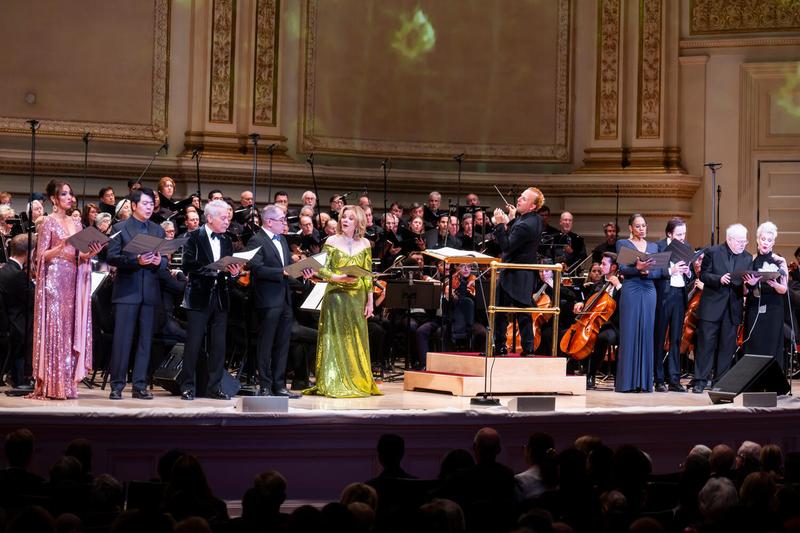
Jeff Spurgeon: An All-Star cast on stage to conclude this 50th anniversary celebration of the Concert of the Century, held in 1976, and the 135th anniversary to the day of the opening night concert at Carnegie Hall. You heard the NYO-USA All-Stars, conducted by Yannick Nézet-Séguin. And in that, uh, end work choir, Lang Lang, Renée Fleming, Emanuel Ax, Joyce DiDonato, Daniil Trifonov, Audra McDonald. And the pianist who worked with her, Andy Einhorn, Michael Feinstein, Isabel Leonard, and the Oratorio Society of New York, Music Director Kent Tritle, the act that was here on Carnegie Hall's opening night. A standing ovation from this Carnegie Hall audience and the NYO-USA All-Stars Orchestra on its feet as well, with all of the performers on stage.
John Schaefer: And what an All-Star lineup that is. And to hear all of those great singers, Isabel Leonard, and Renée Fleming, Joyce DiDonato, Audra McDonald, and Michael Feinstein, to hear them all singing Leonard Bernstein's Make Our Garden Grow is one thing. But to he-- [chuckles] to hear Lang Lang and Daniil Trifonov, and-and Emanuel Ax, and Andy Einhorn up there belting it out, too.
Jeff Spurgeon: Well, in 1976, the concert closed with the Hallelujah chorus-
John Schaefer: Right.
Jeff Spurgeon: -with-with Horowitz and Isaac Stern and--
John Schaefer: Rostropovich.
Jeff Spurgeon: [laughs] Not the usual. And they had trouble reading the scores too, so--
John Schaefer: And nobody cared a bit. [laughs]
Jeff Spurgeon: Absolutely not. They'd come off stage, but back they go now. Joyce DiDonato, Emanuel Ax, Audra McDonald, Isabel Leonard, Andy Einhorn, Daniil Trifonov, Renée Fleming, Lang Lang, Michael Feinstein and Yannick Nézet-Séguin. And Kent Tritle, who now is the music director of the Oratorio Society of New York, an organization even older than Carnegie Hall. Started up in 1873.
John Schaefer: '70s, yes, yeah. By, uh, one of the Damrosches.
Jeff Spurgeon: Yes.
John Schaefer: It might have been Walter Damrosch.
Jeff Spurgeon: It was-- Walter was the son. It was Leopold--
John Schaefer: Okay.
Jeff Spurgeon: -who started the Oratorio Society. Walter was the conductor at opening night at Carnegie Hall.
John Schaefer: A lot of history baked into these walls here at, uh, Carnegie Hall. That history being celebrated in this gala concert tonight. And really just a remarkable, uh, conglomeration of talent out on stage. The next generation represented by the NYO-USA All-Stars. And some of the brightest stars in the classical music firmament and the popular music-- I mean, Audra McDonald-
Jeff Spurgeon: Yes.
John Schaefer: -Michael Feinstein-
Jeff Spurgeon: Mm-hmm.
John Schaefer: -you know, these are--
Jeff Spurgeon: Celebrating--
John Schaefer: -classic America-American voices.
Jeff Spurgeon: Celebrating all of the musical-- And-and this isn't by any means all of the musical legacy of Carnegie Hall, but it is, uh, beyond the classical world, and that's what this building was created for, was for the Oratorio Society. There's a quotation of Andrew Carnegie on the wall right now, uh, at Carnegie Hall. "Perhaps the most tragic thing about mankind is that we are all dreaming about some magical garden over the horizon instead of enjoying the roses that are right outside." Well, tonight the roses are in Carnegie Hall. Well, it's mostly orchids, actually, in the hands of all the performers. And some incredibly bright flowering of music on this historic stage.
The celebration of the 135th anniversary of Carnegie Hall, and more specifically of that Concert of the Century, uh, in 1976. There was a great kickoff for the fundraising to make Carnegie Hall a more secure institution. That is part of what the-the proceeds from tonight's concert are going to be used for, too, to continue the mission of not only presenting performances, but the amazing education work done in the Weill Music Institute that reaches people not only in New York City, but all around the country with amazing educational materials.
Joyce DiDonato: Thanks for listening, everybody.
[laughter]
Joyce DiDonato: Thanks for tuning in. Come to Carnegie Hall.
[laughter]
Jeff Spurgeon: That was Joyce DiDonato dropping by on her way home.
John Schaefer: The audio version of a photobomb from Joyce DiDonato.
[laughter]
Jeff Spurgeon: Just exactly right.
John Schaefer: But--
Jeff Spurgeon: All right. And, uh, Yannick Nézet-Seguin is with us now here at mic number two.
John Schaefer: [laughs]
Jeff Spurgeon: Congratulations, maestro. You've-you've given us encouragement to make the garden grow a little more tonight.
Yannick Nézet-Séguin: Well, I think this music is just so special, and we were all-all artists on that stage, and hopefully, everyone in the hall and everyone listening now, uh, thanks to you, um, are feeling the privilege of having this opportunity to revisit this moment that was, of course, part of the DNA of the hall but also speaks to our time so beautifully.
John Schaefer: You know, over the years that we've been broadcasting these events from Carnegie Hall, I-I know that you're-- you know, you're associated with Philadelphia, Philadelphia Orchestra, Crosstown, the Metropolitan Orchestra, your hometown band, uh, up in Montreal. But we see and hear a lot of you here at Carnegie Hall-
Yannick Nézet-Séguin: [chuckles]
John Schaefer: -I think more than any other--
Yannick Nézet-Séguin: Mm.
John Schaefer: -performer. What is it about this place that-that it means so much to you?
Yannick Nézet-Séguin: Well, first, I think I'm just the luckiest person--
Jeff Spurgeon: [chuckles]
Yannick Nézet-Séguin: -to be here so often. And, uh, I-- you know, I-I all the time think, you know, at some point they're gonna get, you know, tired of me, and, uh-- But as-as long as people want me here, it's-it's a combination of really, truly, um, acoustical qualities which--
John Schaefer: Mm.
Yannick Nézet-Séguin: -are undeniable. You know, it's for me, there's room to do something, but there's-- it's-it's one of those very f-- rare halls where you have to actually use it as another instrument.
John Schaefer: Mm-hmm.
Yannick Nézet-Séguin: That actually is something that goes with you if you're able. And I've been telling the young musicians, the fabulous musicians of NYO, this-this week, been telling them, "Use the hall. Use the hall." And I think the other aspect, and everybody is talking about this, but there-there are ghosts here in the best possible way. There is an energy. We do feel s-- everybody who's come on that stage is just staying. Their soul is staying for some reason. And that makes it extra special when we're here. And sometimes it can p-- make people even more nervous.
Jeff Spurgeon: [chuckles]
Yannick Nézet-Séguin: But on the night like tonight, I just felt like it ju-- um, I, uh, it just enhanced in a way the performance of everyone.
John Schaefer: Did you feel the ghost of Bernstein-
Yannick Nézet-Séguin: Oh, my god.
John Schaefer: -and that 50-year-- 50-year ago concert?
Yannick Nézet-Séguin: Absolutely. And now, you know, uh, I'm sure you-you've-- you-you-you s-said that to your listeners, but there were some beautiful images while we were playing.
John Schaefer: Yes.
Yannick Nézet-Séguin: And that, of course, became very emotional. Um, of course, lately, a few years ago, I was associated with the wonderful film, uh, the Bradley Cooper film, Maestro. And, of course, he conducts the garden grow there. So I had also these images. And, uh, just thinking, this is a very New York moment. And New York-- may New York, through places like Carnegie Hall, still be the beacon of freedom of speech, of expression, of creativity, of diversity, of opening our hearts to each other.
John Schaefer: Well said.
Jeff Spurgeon: Yannick Nézet-Séguin, who conducted the NYO-USA All-Stars and an amazing cast of stars tonight. Thank you so much. Congratulations. Wonderful to be with you once again. Thank you.
Yannick Nézet-Séguin: Well, wonderful to talk to you, and thank you for being here to, uh, relay this, uh, to all the listeners.
Jeff Spurgeon: We are hearing from people all around the country--
Yannick Nézet-Séguin: Thank you.
Jeff Spurgeon: -who are appreciating your work tonight. Thank you so much. Yannick Nézet-Séguin, with us as members of the Oratorio Society of New York, uh, and, uh, our solo artists and some of the orchestra members continue to file offstage on this Gala Night, 135 years to the day and the date that Carnegie Hall was first opened to the public. And that will wrap up this broadcast of Carnegie Hall Live, with thanks to the staff of Carnegie Hall and Clive Gillinson, executive and artistic director, celebrating his 20th year of leading this organization.
John Schaefer: WQXR's team includes engineers George Wellington, Bill Siegmund, Neal Shaw, Edward Haber, and Noriko Okabe. Our production team, Lauren Purcell-Joiner, Eileen Delahunty, Laura Boyman, Nicole Nelson, and Christine Herskovits. I'm John Schaefer.
Jeff Spurgeon: And I'm Jeff Spurgeon. Carnegie Hall Live is a co-production of Carnegie Hall and WQXR.
[01:47:22] [END OF AUDIO]
Copyright © 2026 New York Public Radio. All rights reserved. Visit our website terms of use at www.wqxr.org for further information.
New York Public Radio transcripts are created on a rush deadline, often by contractors. This text may not be in its final form and may be updated or revised in the future. Accuracy and availability may vary. The authoritative record of New York Public Radio’s programming is the audio record.