
Taxi Driver: Where to?
Passenger: Carnegie Hall, please. [car honks]
[tires screech]
[sirens]
[music]
Box office: Okay, here are your tickets. Enjoy the show.
Usher: Your tickets, please. Follow me.
[background chatter]
[music]
Jeff Spurgeon: In New York City, there are lots of ways to get to Carnegie Hall. A subway, a taxi, a walk down 57th Street. You've just found another way to get to America's most famous home for classical music. Welcome to Carnegie Hall Live, the broadcast series that gives you a front row seat to concerts by some of the greatest artists in the world. You hear the performances exactly as they happen. You are part of the audience sharing the experience of music-making at Carnegie Hall. I'm Jeff Spurgeon, backstage with John Schaefer.
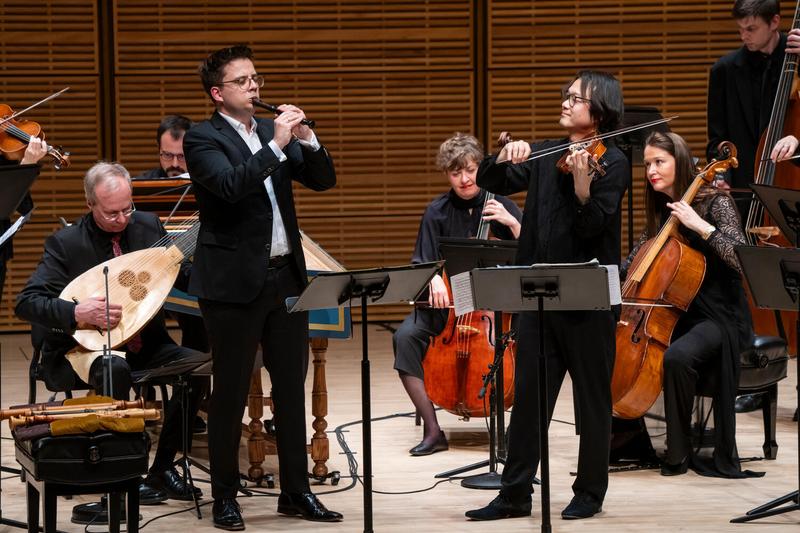
John Schaefer: We are backstage at Zankel Hall, which is Carnegie's mid-sized venue. A subterranean space that is the perfect size for the intimacy of Baroque music brought to us by the Concerto Köln, an ensemble that, as their name suggests, is based in the German city of Cologne. While they have a pretty wide repertoire, actually their bread and butter is the music of people like Bach, Handel, Telemann, and Vivaldi. You'll hear all of them, plus some lesser-known Baroque composers, Giuseppe Sammartini and the mysterious Mrs Philarmonica. We'll tell you more about both of them in just a bit.
Jeff Spurgeon: Carnegie Hall Live is supported by Viking, committed to exploring the world in comfort, offering small ship experiences with a shore excursion included in every port, and programs designed for cultural enrichment. More at viking.com
John Schaefer: Concerto Köln was formed in Europe, in Germany, 41 years ago. They specialize in music from the 18th and 19th centuries, but they have a surprisingly broad repertoire that includes Turkish music, contemporary music, and even Wagner operas. They have an extensive recording catalog. They perform in festivals throughout Europe and here in the States.
Jeff Spurgeon: One of the cellists in the ensemble is Hannah Freienstein. She talked with us earlier today and told us more about the growing legacy of Concerto Köln.
Hannah Freienstein: I think the ensemble really shaped history in a form because it has shaped the idea of people what they think about early music and historical informed practice. I think it still does. It's evolving. The mission is to keep tradition going, but every tradition is just as good as how many changes you place to the tradition. To keep the core, but to have it modern still.
Jeff Spurgeon: Now, in both halves of this concert, we're going to hear selections by Georg Philipp Telemann, chosen from a grouping of his works put together by a German musicologist in the 1950s. Through this series of musical movements, Telemann will take us on a trip around various parts of Europe, showing off the musical characteristics of a number of cultures and regions. It's an idea of travel that is the theme of tonight's concert.
Hannah Freienstein: Actually, the whole night is like a road trip through Europe. It's something that the aristocrats back then did. It was called Grand Tour. They would go especially from England to all the parts of Europe, which we do now too. We start off with Telemann. There's Klingende Geographie. It's about different countries. We hear French elegance, we hear England very groovy. In the second part of the program, we even go to Turkey, and we listen to what people in that time experienced the world like. We can do a whole trip to Europe without the jet lag, of course.
John Schaefer: That again, Concerto Köln cellist Hannah Freienstein. I love the idea of England being groovy back in the 1620s. [laughs]
Jeff Spurgeon: Yes, I noticed that too.
John Schaefer: 1720s, I guess. Concerto Köln will start us off with some of the so-called Klingende Geographie, the musical geography that was put together in the 1950s out of bits and pieces of his other works. We'll get to hear melodic and harmonic and rhythmic features from parts of Europe that include Spain, England, Scotland, and Ireland, France, and a couple of parts of Telemann's native Germany.
Jeff Spurgeon: Then we have a work in the first half by a composer who is known to us only as Mrs Philarmonica. Hannah Freienstein told us a little bit more about this enigma of a composer.
Hannah Freienstein: Mystery Woman. Mystery woman is-- We don't know who she was. I found her pieces in the British Library. It's two sets of trio sonatas. We play it today as a concerto grosso. We know it must have been a woman. It must have been published around 1715. We can hear in the music she must have read Corelli. She was probably well educated. This is one of the questions, like who gets to be part of musical history and who doesn't. Why is she forgotten for 300 years? Now there's people playing her music, but she was forgotten for 300 years.
Jeff Spurgeon: Music of Mrs Philarmonica. Her name, of course, means lover of melody in Greek. We'll also have in this concert a Violin Concerto by Bach featuring soloist Shunske Sato, with whom we'll speak at intermission about his demanding work with Concerto Köln. Just as John was talking to you at one point, we have the members of the ensemble on two sides of the stage, backstage. You can hear them a little bit in the background. They waved bye-bye to the other people on the other side of the stage. I guess they're going out together, and then they'll reunite on the stage in just a minute.
John Schaefer: Around the harpsichord, which has pride of place in the center of Zankel Hall stage. Some of the members of Concerto Köln now out on stage. It is a conductorless ensemble, and they're going to perform some of this musical confection put together in 1959 out of pre existing works by Telemann under the title Klingende Geographie, musical Geography. From Carnegie Hall Live.
[silence]
[MUSIC - TELEMANN: Selections from Klingende Geographie]
[applause]
Jeff Spurgeon: From Carnegie Hall Live, Concerto Köln with violinist Shunske Sato and recorder player Max Volbers, and a suite of music by Georg Philipp Telemann.
John Schaefer: Musical Geography, the name of that piece. Up next, a work by the anonymous composer we know only as Mrs Philarmonica. The set of six sonatas. We'll hear the sonata number six, the last of them. This composer, clearly influenced by the Italian music of the day, but probably from London herself.
Jeff Spurgeon: We don't know who she was. In fact, it's even possibly suspected she might have been a man pretending to be a woman in order to capitalize on the notoriety of the idea, but this was long before any music was published in woman by a composer whose name we knew.
John Schaefer: It's also possible that it genuinely was a woman.
Jeff Spurgeon: Oh, certainly.
John Schaefer: She would have had to have been educated, cultured, and in no position to besmirch the family name with anything as uncouth as writing music. [laughs]
Jeff Spurgeon: Writing music. Good heavens, what a shame. That would have necessitated her anonymity. Here's her music now.
[MUSIC - MRS PHILARMONICA: Sonata sesta in G Major (arr. for string orchestra)]
[applause]
Jeff Spurgeon: A sonata by Mrs Philarmonica, as this anonymous composer from the early 18th century in London was known. One of her six known sonatas. Now it's time for Bach from Concerto Köln.
John Schaefer: Slightly less mysterious figure. Of course, there's always the great mystery of how did one man compose all of this wonderful music. The piece we'll hear is a Violin Concerto in D Minor featuring Violinist Shunske Sato. It's a reconstruction of a Bach Concerto. He most likely wrote this for the violin, but that original version didn't survive. What we had instead was a harpsichord arrangement of the piece from 1738. The most likely reason that it didn't survive, what do you think?
Jeff Spurgeon: It was just too hard. It's too hard. Let's play it on something else.
[MUSIC - J. S. BACH: Violin Concerto in D Minor, BWV 1052R]
[applause]
John Schaefer: That is music by Bach, the Violin Concerto in D Minor played live on stage at Carnegie's Zankel Hall by Concerto Köln and the violinist Shunske Sato, who clearly knows his way around the fiddle. A concerto rather that in his own day, Bach thought was unplayable on the violin and so he wrote out a version for harpsichord instead. That's the version that's come down to us, but we have recovered the violin original through that harpsichord version. That is the work that we hear pretty commonly these days.
Jeff Spurgeon: Yes, but still, it's a workout for a violinist and a wonderful test of technique. This is an interesting ensemble because their techniques are very specific. They are trying to play this music in as far as scholarship can allow us to understand, in the same way that it was played in the time when it was written by these composers. We'll talk with Shunske Sato a little bit about that shortly.
John Schaefer: Yes, and probably worth mentioning when we talk about performance practice, that most of the members of Concerto Köln play standing.
Jeff Spurgeon: Yes, that's right. The cellists really make the good choice early in life, but they don't realize it until later that they've done a smart thing by using an instrument that you pretty much have to sit down in order to play, unless you want to hang it around your neck, which has been done a time or two, but it's usually, usually a seated spot. Yes, it does make the music more alive. That was a brisk and not aggressive but full-throated reading of that Bach concerto came out very assertively.
John Schaefer: You're listening to Carnegie Hall Live. We are at Zankel Hall. This music really comes alive in a somewhat smaller place like this, and we still have a second half to get to that will bring us some more music by Telemann as we continue the theme of musical traveling. Speaking of traveling, Carnegie Hall Live is supported by Viking, dedicated to creating travel experiences for the thinking person with programs designed for cultural enrichment on board and onshore. More at viking.com.
Jeff Spurgeon: This is Classical New York, WQXR, 105.9 FM and HD Newark, 90.3 FM WQXW Ossining, and WNYC FM HD2 New York. Backstage at Carnegie's Zankel Hall, I'm Jeff Spurgeon. John Schaefer's here, and in the back, you're hearing, I think a few of the members of Concerto Köln reflecting on the first half of this program. Out on stage, you can hear some instruments being moved, and chairs, and things to configure things for the second part of this concert.
It is a 15-person ensemble, 16 if we count our featured recorder player tonight. That gives you a sense of the size of the ensemble that's on stage. I'm happy to say that we're able to talk at intermission with one of them now. Shunske Sato, welcome to the Carnegie Hall Live microphone. Congratulations on that performance of the Bach in the first half of this concert. You were born in Tokyo, but you came to the United States at age 4, and then you actually were here in New York for a while.
Shunske Sato: I was going to Juilliard pre-college on a weekly basis. Yes, always a little bit of nostalgia sets in when I go through Lincoln Tunnel. I know that's not the emotion that one associates with-
John Schaefer: No, no.
Shunske Sato: -specifically.
John Schaefer: Not for native New Yorkers.
Shunske Sato: No, no, no. Once every so often, it brings that up, I think.
John Schaefer: We were just talking about the theme of travel that's woven through this program.
Shunske Sato: That's right.
John Schaefer: You've done a lot. Japan, then the States, now you live in the Netherlands.
Shunske Sato: Netherlands.
John Schaefer: You work with this German-based ensemble. Travel is pretty much what you do, isn't it?
Shunske Sato: That's right, yeah. Also, I lived in France and Germany for a number of years as well, to study.
John Schaefer: Yes. Before we get too far from the Bach, whose cadenza did you play in that third movement?
Shunske Sato: Yes. In fact, the cadenza is written. It's one of Bach-- Obviously, he must have improvised when the piece was fresh and then came up with a version. I don't know, I'm hypothesizing here. Maybe he came up with a particularly satisfying one. Although that being said, in both movements, actually, there are big bits that descend, let's say, into chords. He doesn't write out notes anymore, but just pure chords. What you do with them, it's basically anyone's guess, but--
Jeff Spurgeon: You have some cadenza direction from Bach, but you also then can take it in the direction you want?
Shunske Sato: As far as cadenzas go, this one is very prescribed, I think. For example, the Mozart violin concertos, you literally get nothing. You get a dot. With Bach, you get at least half a cadenza. Yes, he was very considerate.
John Schaefer: How did you find the world of period performance? How did you find this particular world? I don't know that anybody says, when I grow up, I want to play period performance, Baroque literature.
Shunske Sato: It's interesting. I think, actually, that what you just said is happening more and more in my time. I'm only 41ish, but certainly it was not yet part of-- As far as I could see from my perspective, part of the regular upbringing. Precisely because of that, actually, because it was exotic, because it was a little bit far from me. I always did kind of. I don't know. If I think about it now, I wasn't really sure, to be honest, what drew me specifically. I just knew that it sounded different, it sounded great, it sounded energetic, and I didn't think much of it.
Then, when I went to Europe when I was 19, then the doors started opening up a lot because you could go to basically any violin shop, for example, and pick up a baroque violin, see a gamba, try out baroque oboes, and go to concerts, obviously, and then take master classes. It's a lot closer. Anyway, there was also for me another kind of way in, and that was, namely, historical recordings. Old recordings, pre-war, beginning of the last century, the really sizzling surface noise kind of recordings from Chrysler and what have you.
Also for the same reasons, a little bit kind of, that's the sound that I don't hear around me. What is it? Also, what fascinated me and also in those recordings, which are arguably more recent than the music that we just played, they felt free most of the time to depart from the text, to change the rhythm, really personalize it. In a way, so I came at it from two angles, as it were, from the really early stuff that I really wanted to get to know, but also this childhood fascination for early recordings.
John Schaefer: Jeff and I have been, during the first half, fascinated by some of the instruments behind you on stage. Michael Freimuth is playing a lute with two necks.
Shunske Sato: Yes.
John Schaefer: Kinnon Church is playing what we thought was a double bass, but it has frets. It's either a member of the viol family or violone. Can you enlighten us?
Shunske Sato: Sure. To start with the double bass, Kinnon's double bass, I think putting on frets was actually quite standard. Indeed, as you pointed out, it does have a-- Yes, suspiciously close, at least appearance-wise--
John Schaefer: It's a bass in disguise.
Shunske Sato: In disguise a little bit. Also, just from the terminology, you see violone basso, and you basically get very little specifics beyond that. Also, from what I understand, is that if you have frets, you basically have a clearer sound, in fact, which, in the lower end of the frequency, is very helpful.
John Schaefer: The lute?
Shunske Sato: The lute-- It's an interesting, and I think-- I'm certainly not the most qualified person to talk about it, but they kept on adding strings. Basically, they had the basic lute with one neck, and they thought, "Well, why not add a few more strings, lower ones, to get more lower pitches?" You needed more string length for this. They added the second neck. It is truly Frankenstein instruments that they-- Which also tells you how creative they were. They took basically an existing thing, they just patched on something else, and they created something new.
John Schaefer: Almost 300 years before Jimmy Page and Led Zeppelin.
Shunske Sato: Yes, exactly. Yes, yes, absolutely.
Jeff Spurgeon: Shunske, thank you so much for spending time, but you need to rest because you've got a couple other things coming up in the second half, but thank you. It's such a pleasure to talk to you.
Shunske Sato: Most welcome. It's my pleasure.
Jeff Spurgeon: Shunske Sato, who is a member of Concerto Köln, and you heard him as a soloist in the Bach concerto just before intermission. He'll be back in the second half of this program along with the rest of Concerto Köln and their special guest recorder player, Max Volbers.
John Schaefer: That second half will feature works by Telemann, Handel, Vivaldi, and Giuseppe Sammartini. Now, earlier in this concert, we heard a work by the anonymous composer known to us only as Mrs Philarmonica. By the way, I'm not mispronouncing that there is no H. It's just Philarmonica.
Jeff Spurgeon: Also, it's one word. Phil is not the first name of the husband, just to be clear.
John Schaefer: We thought going back to 1715, where this apparently female composer wanted to have her work published and had to do so with this pseudonym, we thought it might be fun to take a quick trip through women composers over the centuries.
Jeff Spurgeon: If we want to go back to the beginning of the record, almost as far as we can go, we find ourselves in the company of Hildegard von Bingen, German composer. She was a nun, she was a healer, a writer, a scientist, an amazing human being. She had visions at a young age. Her family sent her to a nunnery. She took her vows when she was 15 and eventually became prioress of the nunnery. Here is just a sample of one of her musical works, Ordo Virtutum. This is O nos Peregrine Sumus performed by the ensemble called Sequentia.
[MUSIC - Sequentia: O nos Peregrine Sumus]
John Schaefer: Music here from the 12th-century German composer and abbess Hildegard von Bingen, from the Ordo Virtutum, the Play of the Virtues, which some might say was the first ever Western opera. You heard an excerpt sung by the group known as Sequentia, conducted by Benjamin Bagby. Our next composer on this tour through the history of women in classical composition is Italy's Barbara Strozzi. Barbara Strozzi was born in Venice in 1619 into a society filled with writers, and artists, and all kinds of creative people.
Strozzi herself made her reputation as a singer, and then as a composer, she published eight collections of songs and is sometimes credited with inventing the cantata. Her music found its way throughout Europe. Here is a sample. This is Che si può fare performed by the Parels Ensemble.
[MUSIC - Parels Ensemble: Che si può fare]
Jeff Spurgeon: The melody by Barbara Strozzi. Now, as we make a quick survey during this intermission of this Concerto Köln concert, we're sampling some great women composers through history. How about Fanny Mendelssohn? Born in 1805, German composer, pianist, wrote more than 450 compositions in her lifetime. Lots of piano music, some chamber works, more than 250 lieder.
Most of her music was unpublished during her lifetime. Though she was acknowledged to be talented, there just wasn't a place for a woman composer in her society in her time. She was somewhat discouraged from making too much of this music business. She and her brother were very close. Fanny died in her early 40s in Felix within six months of her. This is one of her Songs without Words, performed by pianist Matthias Kirschnereit.
[MUSIC - Matthias Kirschnereit: Songs without Words]
John Schaefer: A little bit of music by Fanny Mendelssohn. Like her brother Felix, she wrote a number of Songs without Words. That's one of them. Our next composer is from America. Florence Price was born in Little Rock, Arkansas, in 1887. In 1933, she became the first Black woman to have a composition performed by a major American orchestra. When the Chicago Symphony premiered her Symphony in E Minor, she wrote more than 300 works, and her symphonies-- Now, as you may know, third movements of symphonies in the European tradition would be like a minuet, a scherzo, a trio, a dance form. The third movement of her symphonies was usually a Juba dance, hambone being another word for that dance form in African American form. Here is the Juba dance from that Symphony No. 1.
[MUSIC - Florence Price: Juba dance]
Jeff Spurgeon: Some of the music of Florence Price. The Juba dance from her Symphony No. 1. Our final composer in this sampling of female composers through history is Caroline Shaw, the only living composer on our list tonight. A violinist and a singer. She's won the Pulitzer Prize, four Grammys. She has an honorary doctorate from Yale. She's written for Renee Fleming and Yo Yo Ma and for the Los Angeles and New York Philharmonic orchestras as well. Here is a little bit of her music. Some of the music that she wrote for the Ken Burns Public television special about Leonardo da Vinci. A performance here by The Attacca Quartet and Sō Percussion.
[MUSIC - The Attacca Quartet and Sō Percussion: Leonardo da Vinci]
John Schaefer: A little bit of music from Caroline Shaw. You'll hear a lot more of her music at Carnegie Hall next season when she takes her position as the Debs Composer's Chair here at Carnegie Hall. We are nearing the end of intermission. We're at Carnegie's Zankel Hall for this performance by Concerto Köln. There are four more works scheduled in the second half, more music by Telemann, Handel, and Vivaldi. We'll start the second half with a flute concerto by the Italian composer Giuseppe Sammartini. Jeff, we mentioned earlier when talking about Mrs Philarmonica that there was certainly the influence of Italian music in London in the 17th century.
Jeff Spurgeon: Oh, it certainly was a flavor, and it was really all through Europe. We've heard that in this concert as well. The influence of Italian style, but also French sensibilities and forms, and certainly a respect for the German ideas of counterpoint and structure. This work we're about to hear by Sammartini is a work by a fellow who certainly knew how to make music this way. He was a great woodwind player. We're going to hear the young recorder player Max Volbers as the soloist in this recorder concerto by Giuseppe Sammartini, performed with Concerto Köln from Carnegie Hall live.
[MUSIC - Concerto Köln ft Max Volbers: Recorder Concerto in F by Sammartini]
[applause]
Jeff Spurgeon: Recorder virtuoso Max Volbers featured in that concerto by Giuseppe Sammartini performed for you by Concerto Köln from Carnegie Hall live. Backstage, I'm Jeff Spurgeon with John Schaefer. I love a recorder. I do. To hear a dance like that is just such a thrill.
John Schaefer: I might have heard one or two recorder players not up to that level in my lifetime.
Jeff Spurgeon: Pretty amazing.
John Schaefer: Yes, that was pretty great. Max Volbers playing the recorder Concerto in F by Sammartini, Italian composer who spent much of his career in London, actually. Now we continue travels with Telemann. The Concerto Köln opened this concert with excerpts from this 20th-century suite called Klingende Geographie, Musical Geography. Now here's more from Carnegie Hall Live.
[MUSIC - Concerto Köln: Klingende Geographie]
[applause]
Jeff Spurgeon: Concerto Köln with music of Telemann. That last work, a clear reflection of the sound of the Janissary bands that were an exotic sound in Europe in the 18th century and 17th, a little bit too, clearly imitated in that particular work. Now, on this concert from Carnegie Hall live, we turn to a work by Handel.
John Schaefer: A Concerto Grosso in F Major, Op. 6, No. 9. Just as that Telemann piece was taken from bits and pieces of various Telemann works, this Concerto Grosso includes excerpts from an organ concerto, a couple of opera excerpts, and some music written specially for the occasion. Handel, like Sammartini and Corelli and others before him, made his way to London, where this piece would have had its premiere. Here is the Concerto Köln performing the Concerto Grosso by Handel on stage at Zankel Hall. We'll have a little bit of tuning for a moment first, and then this performance. [chuckles]
Jeff Spurgeon: Tuning is a very important part of early music performances.
John Schaefer: Lots of old strings out there. Concerto Köln is an ensemble that has a wide repertoire. As we mentioned earlier, they know their way around contemporary music, but this really is what they're known for. Here is the Handel Concerto Grosso in F.
[MUSIC - Concerto Köln: Concerto Grosso in F Major, Op. 6, No. 9]
[applause]
John Schaefer: Handel's Concerto Grosso in F Major, Op. 6, No. 9, played live at Zankel Hall by the ensemble known as Concerto Köln. This Carnegie Hall live broadcast has one final piece, and it's a musical firework from Vivaldi, a version of his Concerto in A Minor for Two Violins that will feature both of our soloists, Shunske Sato on violin and Max Volbers playing the recorder. Concerto Köln cellist, Hannah Freienstein, says this is a great concert ending because it's a flashy closer for everybody, but especially the two soloists.
Hannah Freienstein: Italian showing off in the best way possible and looking who's the better one. Originally, for Two Violins, we do it with violin and flute. I think the two boys are having great fun up there on the stage. We too.
John Schaefer: Concerto Köln.
[MUSIC - Concerto Köln: Concerto in A Minor for Two Violins] [applause]
Jeff Spurgeon: Well, they certainly know how to finish a concert, don't they? Concerto Köln, violinist Shunske Sato, and the recorder player Max Volbers. They're bringing you that concerto for two violins, at least as Antonio Vivaldi wrote it, but one of the violins switched out for Max Volbers' recorder. In this broadcast, concert by Concerto Köln from Carnegie Hall Live. All the musicians on their feet. Most of them were, actually, except the cellist and the harpsichordist, but now all standing to receive the appreciation of this audience at Carnegie's Zankel Hall. Backstage, I'm Jeff Spurgeon, alongside John Schaefer.
John Schaefer: It turns out a couple of the pieces on the program tonight have been kind of reworking.
Jeff Spurgeon: You bet.
John Schaefer: The Bach Violin Concerto, reworked from a harpsichord version of what was originally a violin concerto by Bach, and now this version of Vivaldi's concerto for two violins, with one violin and a recorder. Vivaldi didn't stand on ceremony. If you could get the job done, get the job done. Violin, flute, recorder, all interchangeable, lute, mandolin, guitar, if you could get your way through these--
Jeff Spurgeon: Rolling pin, whatever you happen to have lying around, Vivaldi could write a concerto with that instrument. Well, exceptionally exciting playing from Max Volbers in this particular concerto that we just heard. Now, back on stage are Shunske Sato and Max Volbers, with the members of Concerto Köln.
John Schaefer: This is an ensemble, Jeff, that we mentioned this earlier, they don't have a conductor.
Jeff Spurgeon: That's right.
John Schaefer: There's a lot of visual cueing happening between them. The two soloists have had to be de facto conductors while they're on stage. They are still on stage and thumbing through their scores.
Jeff Spurgeon: Conferring with one another. It looks like we'll have an encore.
Max Volbers: Thank you so much for being with us here tonight. You know that early music is always about doing research and finding things. We just found a piece by Johann Sebastian Bach, a very special arrangement. Maybe you might know this one. Let's see. [laughter]
[MUSIC - Max Volbers, Shunske Sato, and Concerto Köln: Bach Violin Concerto in E Major]
[applause and cheers]
John Schaefer: That's music by Bach in an arrangement by Max Volbers, who you heard playing the recorder. That's the third and final movement of the Bach Violin Concerto in E Major in which Max has rearranged the, or reassigned the solo part and split it up between his instrument and the violin. Sharing the plaudits and the music with Shunske Sato and Concerto Köln, an encore performance on stage at Zankel Hall here at Carnegie.
Jeff Spurgeon: An ensemble of 16 players that you've heard tonight from the stage of Zankel Hall, 15 of them mentioned in the program. Volbers is something of a guest artist. As John mentioned, this is a conductorless ensemble, and all of the performances and all of what they've created here has been a collaborative effort among all the musicians, offering suggestions and sharing their thoughts. That's how good tight chamber groups work.
John Schaefer: There it was, something very collegial I felt-
Jeff Spurgeon: Oh, very much so.
John Schaefer: -about this arrangement. It's like, "I'm not going to arrange this just for my instrument. No, I'll share it with you. It's originally for your instrument. We'll do 50/50." Yes, they seem to really be enjoying themselves. I'm sure the audience, as much as they're enjoying the music, it adds something to see musicians beaming the way Shunske Sato and Max Volbers are as they come back out on stage one more time, another bow for this Zankel Hall audience. Again, the subterranean mid-size hall here at Carnegie. Just the perfect setting for this sort of ensemble and the intimacy and the exuberance of baroque music. No one has left the stage yet, so it looks like we are not done with music from Concerto Köln.
Max Volbers: Clearly, you surprised us. Thank you so much.
[MUSIC - Max Volbers, Shunske Sato, and Concerto Köln: Niedersachsen]
[applause]
Jeff Spurgeon: Niedersachsen, a piece of music by Georg Philipp Telemann, which is actually a genuine encore in this concert, for they played this movement in the first half of the program. Violinist Shunske Sato and recorder player Max Volbers, and the ensemble Concerto Köln, with a second encore in this concert that has had a travel theme in it because of all these works of Telemann, who did really appreciate the idea of assigning geographical locations or ethnic ideas to his music, most of which are completely lost on us today.
Nonetheless, they have been an excuse for Concerto Köln to create this program that has brought a lot of these traveling ideas and shared the admixture of styles that was happening in Europe in the 18th century. The Italian form, the fast, slow, fast concerto idea that Vivaldi kind of set up and the world ran with, the German love of counterpoint, the richness of harmony, and the dance forms that are so often reflected in French titles in these suites.
Lots of cultural admixture from Telemann, who really got around in his time. Concerto Köln gets around, too. In fact, the recorder player has found his way to our microphones now. It's a delight to welcome you, Max Volbers, to the Carnegie Hall microphone and congratulate you on a great performance.
Max Volbers: Thank you so much.
Jeff Spurgeon: This was an amazing pleasure to hear you. How long have you guys worked together, you and Shunske and Concerto Köln? Because you all have a wonderful rapport on stage.
Max Volbers: Well, thank you so much. Actually, this is just my second project with Shunske.
Jeff Spurgeon: Like we said, it's a brand new experience for you.
John Schaefer: [laughs]
Max Volbers: Yes. I've been working with Concerto Köln since 2022, I think. We have done many projects, and it's always a great pleasure. It's an ensemble with a great flexibility and an ensemble where every voice counts, if you know what I mean. Also, rehearsing is a very fun and intense process because everybody gives his ideas, and so everyone's ideas come together and form something unique.
Jeff Spurgeon: It looks like you had as much fun tonight, too, backstage and on stage as well.
Max Volbers: Yes, we had. We also had a fun tour, actually. This was the fourth concert already, and we have grown to a very good team, I think.
Jeff Spurgeon: That's great.
John Schaefer: We've been saying all evening that you play the recorder, but nobody plays the recorder. Unlike everybody else in the group, you have to bring a whole bag of instruments with you.
Max Volbers: That's true. It's a family of instruments comparable to the viola da gamba, for example, where you also would have to carry around, like five or six instruments. Today I was playing, I think, eight or so. I didn't count. As a recorder player, you're pretty used to that, like switching between instruments, even between the movements.
John Schaefer: Even between movements of the same piece, because they're keyed, they're set to different keys.
Max Volbers: Yes. Especially when you play a transcription. Like just now in the Vivaldi concerto, I switched to a different instrument, to a lower instrument in the middle movement.
John Schaefer: You also play the harpsichord.
Max Volbers: Yes, but not today.
John Schaefer: No, no. Is that an unusual thing for early music?
Max Volbers: I would say it was a usual thing in the, let's say, 17th, 18th century. In the Baroque era, that was a very common thing, that the musicians were multi-instrumentalists. This is something that I enjoy very much because the baroque music works from the bass. If you also play a bass instrument, you have a different understanding of the music.
John Schaefer: Now you're a young guy. How did you get into this old music in the first place?
Max Volbers: I think that would be my first recorder teacher's fault. Hi to Brigitte.
Jeff Spurgeon: You were not a flutist.
Max Volbers: Sorry?
Jeff Spurgeon: You never played the flute, the transverse flute?
Max Volbers: No.
Jeff Spurgeon: You started with a recorder and stayed with that?
Max Volbers: Yes. Like so many kids, but I was very lucky to have a very, very good teacher from the beginning, and so I just never stopped. That's how it happened.
Jeff Spurgeon: Do you perform on harpsichord as well, or is it a sort of a rehearsal instrument?
Max Volbers: Yes, sometimes. When I conduct from the instrument, I do that with the harpsichord usually. I also sometimes have programs where I do both, which is something I enjoy a lot. Today was just playing the recorder.
Jeff Spurgeon: You have to keep up two sets of chops, though.
Max Volbers: Yes.
Jeff Spurgeon: You're busy a lot, just to stay in shape.
Max Volbers: True.
John Schaefer: I have a final question. What is the lingua franca? What is the language that you all speak in Concerto Köln?
Max Volbers: Usually, we speak German, but in this project, we are speaking a lot of English because we had a jump in and we had to find somebody with an American passport due to visa reasons. We found wonderful Alyssa. We spoke English with the group.
John Schaefer: Well, of course, out on stage, music is the international language, and you all spoke it quite beautifully and eloquently tonight.
Max Volbers: Thank you so much. Thanks for having us.
John Schaefer: Thank you.
Jeff Spurgeon: Wonderful to have you. Thank you so much. That's going to wrap up this broadcast of Carnegie Hall Live, with our thanks to Clive Gillinson and the staff of Carnegie Hall.
John Schaefer: WQXR's team includes engineers George Wellington, Duke Marcos, Bill Siegmund, Noriko Okabe, and Kelvin Grant. Our production team: Eileen Delahunty, Laura Boyman, Nicole Nelson, and Christine Herskovits. I'm John Schaefer.
Jeff Spurgeon: I'm Jeff Spurgeon. Carnegie Hall Live is supported by Viking, committed to exploring the world in comfort, offering small ship experiences with a shore excursion included in every port and programs designed for cultural enrichment. More at viking.com. Carnegie Hall Live is a co-production of Carnegie Hall and WQXR in New York.
[02:15:06] [END OF AUDIO]
Copyright © 2026 New York Public Radio. All rights reserved. Visit our website terms of use at www.wqxr.org for further information.
New York Public Radio transcripts are created on a rush deadline, often by contractors. This text may not be in its final form and may be updated or revised in the future. Accuracy and availability may vary. The authoritative record of New York Public Radio’s programming is the audio record.