
Taxi Driver: Where to?
Passenger: Carnegie Hall, please. [car screeching]
[car honks]
[sirens]
[music]
[door opens]
Ticket Agent: Okay, here are your tickets. Enjoy the show.
Usher: Your tickets, please. Follow me.
[chatter]
[music]
Jeff Spurgeon: In New York City, there are lots of ways to get to Carnegie Hall. A subway, a taxi, a walk down 57th Street. You've just found another way to get to America's most famous home for classical music. Welcome to Carnegie Hall Live, the broadcast series that gives you a front row seat to concerts by some of the greatest artists in the world. You hear the performances exactly as they happen. You are part of the audience sharing the experience of music making at Cornell Carnegie Hall. Backstage at Carnegie's Zankel Hall, I'm Jeff Spurgeon, and alongside is, as always, John Schaefer.
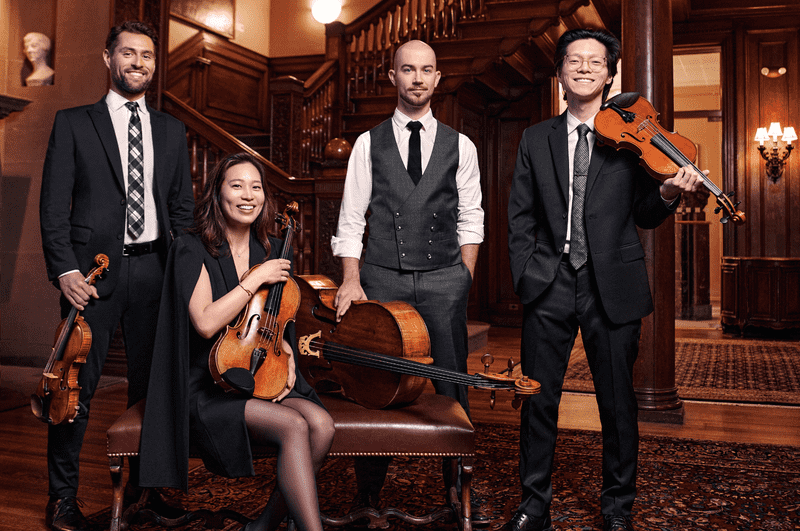
John Schaefer: With us as well, the members of the Dover String Quartet, an ensemble that formed at the Curtis Institute of Music, back almost 20 years ago. Nowadays, the four members are on the faculty at the Curtis. Some of their accolades include winning the Banff International and Wigmore Hall String Quartet competitions. They've also won the Avery Fisher career Grant, and BBC Music Magazine calls the Dover Quartet, "One of the greatest string quartets of the last hundred years." No pressure there, BBC Music Magazine. We are expecting big things from the Dovers on the stage of Zankel tonight.
Jeff Spurgeon: This is a significant concert. This concert is part of Carnegie Hall's festival called United in Sound: America at 250. Throughout the next few months, Carnegie Hall is celebrating America's 250th anniversary of independence with concerts throughout the season that are highlighting American music. Tonight is one of those concerts. There are two pieces on this program, works by Native American composers. One is Pura Fé, the other is Jerod Impichchaachaaha' Tate. Tate is in the house tonight for the New York premiere of his work called Woodland Songs. We'll talk to him during this broadcast, but you'll also hear him speak to you and the rest of the audience from the stage.
John Schaefer: In addition to these two Native American pieces, there are two string quartets from the more familiar European canon, including the Dvořák String Quartet No. 12, which is often called "The American" because it was written while Dvořák was here in the States and was deeply inspired by Native American and African American music. There is a little bit of an outlier on the program, though, and it is the first piece, and that is the Mendelssohn String Quartet in F minor, Opus 80. Mendelssohn wrote this in 1847, the last year of his life. It was also the year that his beloved sister Fanny had died. Many people see this quartet Mendelssohn's expression of grief.
Jeff Spurgeon: Fanny was a great musician herself, a wonderful pianist, wonderful composer. Most of the recognition that has come to her came to her not during her lifetime, but afterward. She had trouble getting her own compositions out into the world. Felix and Fanny were great siblings, great musical partners, made music together all their lives. When Fanny died suddenly from a stroke at age 41, Felix Mendelssohn was just devastated.
John Schaefer: He himself would die just a couple of months after finishing this piece at the age of 38. The two of them, their lives cut short while living in Berlin and making music separately and together. In this case, Felix Mendelssohn referred to the String Quartet in F minor, Opus 80, as a requiem for Fanny. We asked the Dover Quartet cellist, Camden Shaw about how we might hear his response to Fanny's death in this piece.
Camden Shaw: Mendelssohn has always been such an emotional composer, but there is something about Opus 80 that feels different. It feels as though there are a lot of, probably all the stages of grief in that quartet. There's a lot of anger, frankly. Their sadness and acceptance to the slow movement has some of that cathartic acceptance that's really, really heartbreaking.
One of the things that's difficult as a performer or interpreter of the Mendelssohn is that very often we like to add in quite a lot of contrast dynamically. We'll criticize our students like, "Oh, you're just playing loud all the time." In the case of this piece, he wanted it-- It's marked fortissimo, meaning almost as loud as you can play 80% of the time. That's part of the affect of it, is that it's just brutal. It's brutalistic. Actually, for Mendelssohn, it really is an unusual piece. That also sets up the tender heartbreak of the slow movement really well.
John Schaefer: It is unusual for a concert to start with this Mendelssohn piece. It's usually heard as a finale, but Camden Shaw is excited to have it go first.
Camden Shaw: I love the idea of doing the Mendelssohn on this program because it's F minor, it's very, very stormy and dark. It serves as this almost exact counterpoint emotionally to the Dvořák, both in the key F minor versus F major, and also just in the energy of it is so dark. It's going to be a very fiery way to open a program. I've never seen a concert where Mendelssohn Opus 80 was not the last piece. It's going to be a very exciting opening. I'm excited to do the program this way. It's our first time and I think it'll hold together nicely.
Jeff Spurgeon: Something interesting for the players as well, a work that is usually a closer is in fact the opener on this concert. That was Camden Shaw. He's the cellist of the Dover String Quartet. We're just really waiting for the rest of the audience to finally settle in. The players are backstage. We've been hearing them doing a little bit of last minute tuning up.
Perhaps they're just a couple of latecomers. They have to be seated yet. We'll dig into this concert that is part of Carnegie Hall's America at 250 program with interesting connections, well-chosen works that connect to the European canon where the string Quartet came into existence, and then Dvořák, the crossover composer, at least geographically. Then these really fascinating works by composers of American indigenous heritage from the 20th and 21st centuries.
John Schaefer: It's interesting how they've bookended those two big Native American works with string quartets from European composers. The Dvořák is a natural, as we've said, it's deeply inspired by Native American and African American music, but the Mendelssohn is an unusual choice.
Jeff Spurgeon: Funny that it's the most unusual choice on this program, one of the pieces of the core repertoire. That's how it turns out in the way that the Dover Quartet has put this together. The Dover String Quartet now are settling into Carnegie's Zankel Hall, the underground performance space at Carnegie hall to bring you Felix Mendelssohn's final string quartet from Carnegie Hall Live.
[MUSIC - Felix Mendelssohn: String Quartet F minor, Opus 80]
[applause]
John Schaefer: Dark but fiery. That is the String Quartet in F minor, Opus 80, the last major work by Felix Mendelssohn, played live on stage at Carnegie's Zankel Hall by the Dover String Quartet. Joel Link and Brian Lee playing violins, Julianne Lee the viola, and Camden Shaw playing the cello. Jeff, normally after a piece like that, you'd be wondering what do they do for an encore? Because that is usually a concluding piece.
Jeff Spurgeon: Yet they've barely begun. Here's our composers for the next works on the program.
[applause]
Jerod Impichchaachaaha' Tate: Hello, everyone. My name is Jerod Impichchaachaaha' Tate. This is my son, Hiloha Tate.
[applause]
My son's name, Hiloha is the Chickasaw word for thunder. I am a professional classical composer. Hiloha is a ballet dancer and horn player. I'm very proud of him. I like to bring him where I go around the country. It's really, really fun. We have a good time together. First of all, Dovers, you're amazing. That Mendelssohn was incredible. Thank you so much for that. Oh, my gosh.
[applause]
So good. Oh, my gosh. Okay, so Rattle Songs. The composer of the Rattle Songs that you're about to hear is Pura Fé. Pura Fé is Tuscarora from North Carolina. I want to tell you a little bit about the Rattle Songs. You have a little context, and this is really, really fun. Pura Fé, she's an amazing composer and singer. Back in the '90s, she created a new group called Ulali, which was a trio of native singers and included her cousin Jennifer Kreisberg and their dear friend, Mayan Apache, Sonny Moreno.
They came out with an album entitled Mahk Jchi, with all these beautiful vocalizations of traditional tunes, and they absolutely stunned Indian country. When I first heard this album, I was absolutely floored and very, very inspired. The bar was set very, very high for me as a composer. Anyway, so they're going to be playing the Rattle Songs this evening. As Pura Fé was putting these together, she--
In the Rattles songs, she created a suite of music that was an homage to her friends from around North America. What she did is she created a collection of songs that she had learned from her friends, and she couched them in what we call shell shaking or Rattle Songs. Now, Tuscaroras and Chickasaws were shell shaking people, and so she couched them in this.
A really good example of this is like when Tchaikovsky created the national dances and the second movement of The Nutcracker, where he wrote pieces that were couched in orchestral music that were an homage to his ethnic neighbors. Pura Fé did the exact same thing with its Rattle Songs, and they're absolutely stunning. I'd like to play you an example. This is going to be a little dog and pony show for that.
Before that, I got a call from Camden. He happens to be a fan of the same album, and so we had something very much in common. He asked me, would you mind orchestrating the Rattle Songs? I was like, "Oh, my. Are you serious? That would be like a dream come true." Fortunately, got the blessing of Pura Fé. She's actually listening to this broadcast tonight. This is why I'm kind of nervous, because she's listening. Pura Fé, thank you so much for allowing me to do this.
What's interesting about this is that they're rattle songs. This is a string quartet, so no rattles. I want you to think of it like Debussy writing his piece La Mer about the sea, but you can't bring the sea on stage. He wrote a piece about the ocean without the ocean. Tis is the same thing. These are rattle songs without the rattles. What I was able to do was to, in a modern way, make an impressionistic reaction to put a phrase, original music.
I'd like to play an example. In one of the movies, there's seven songs altogether, there's a suite of songs, is Grandmother Easter's Lullaby, which is absolutely gorgeous. I'm going to sing that to you with a shell so you can hear its original form, and we'll play a snippet with a quartet to give you something to anticipate as you're listening.
[MUSIC - Jerod Impichchaachaaha' Tate: Grandmother Easter's Lullaby]
They'll have the quartet play you a little example of that. Go ahead.
[MUSIC - Pura Fé: Grandmother Easter's Lullaby]
Everybody, enjoy Rattle Songs.
[applause]
[MUSIC - Pura Fé: Rattle Songs]
[applause]
Jeff Spurgeon: From Carnegie Hall Live, that was the Dover String Quartet and the New York premiere of a new arrangement of Pura Fé's Rattle Songs, the arrangement for String quartet made by composer Jerod Impichchaachaaha' Tate, who is with us tonight and whom you'll hear speaking in the second half of the program, and a new composition of his you'll hear as well another New York premiere on this concert by the Dover String Quartet. Backstage at Carnegie's Zankel Hall, I'm Jeff Spurgeon. John Schaefer's here too.
John Schaefer: This concert is part of United In Sound: America at 250, a series of concerts here at Carnegie Hall this season celebrating the 250th anniversary of American independence, and this concert featuring Dvořák's American String Quartet and two Native American works. As Jeff just said, we'll hear from Jerod Tate after intermission. We've just heard his arrangement of Pura Fé's Rattle Songs, originally done by Pura Fé for her indigenous vocal trio called Ulali. Jerod, it's a very interesting bit of sonic alchemy that you--
Jerod Impichchaachaaha' Tate: Yes. This was a lot of fun to do. Pura Fé and Jennifer and Sonny are friends of mine. What an honor to be able to bring a different life to their pieces. Like I said on the stage, this work in particular was a great inspiration for me and really raised the bar in my mission and being an American Indian symphonic composer. Along with people like Dvořák or Tchaikovsky or Debussy or Bell, people that really focused on their ethnicity as well in their symphonic music. Tōru Takemitsu is a really good example, Chinary Ung, people like that, who bring all that to their classical compositions. This piece had a tremendous impact on me.
John Schaefer: Everything is related to everything else. That album Mahk Jchi by Ulali, which was-- I remember when that came out, it was a thunderclap. One of those Rattle Songs was dedicated to Jim Pepper, who as far back as the 19, late '60s, early '70s, had an international hit song with which he tied to.
Jerod Impichchaachaaha' Tate: That's right. Jim, he's a legend in Indian country as well. He's a core saxophonist. In fact, I know one of his nephews, James Pepper Henry. He was actually the executive director of the First Americans Museum in Oklahoma City. Jim Pepper has a lot of history. When they're singing the song on the recording, Pura Fé says for the Pepper, she gives that little homage to him when they're singing it, it's really cool.
John Schaefer: They say you cannot be what you cannot see, which is why representation is so important. For you, as an aspiring classical composer of Chickasaw descent, of the Chickasaw Nation, who did you see? Who served that function for you?
Jerod Impichcha̲achaaha' Tate: We have a couple of historic American Indian composers that really had an impact on me. One was Dr. Louis Ballard, who's Quapaw and Cherokee from Oklahoma. In fact, that history is really entangled because he wrote a piece called The Four Moons, and it was a ballet that he composed for four of the five American Indian ballerinas from Oklahoma.
My parents were at that premiere in 1967, the year before I was born. Louis was on his way of a full symphonic career in music. He was doing very much-- He was very much like a native Bartok, basically. He was taking folk music from many different tribes, including his own, and couching those in symphonic repertoire. He was a very, very big influence, but also, just in general, Indian Country has an unbelievable output in all of the genres of the fine arts. One example is Joy Harjo.
She was a poet laureate for the United States three times in a row. Joy expresses her Muskogean identity in English in books. Those are materials that are not aboriginal to our culture, but she mastered those and makes that. Santa Fe Indian Market is a really good example. People from all over the world fly to see all the new modern Native art. Right?
John Schaefer: Yes.
Jerod Impichcha̲achaaha' Tate: Sterlin Harjo is a really good example of that. He's expressing his Muscogee identity in film. Filmmaking is an aboriginal to any culture. That's a brand-new human invention in the artistic realm. Everybody is clamoring to express themselves in film. There's a whole environment that's been going on for thousands of years, that American Indians have been a participant for quite a while.
John Schaefer: Just quickly, Joy Harjo, also a fine sax player and singer. [crosstalk]
Jerod Impichcha̲achaaha' Tate: Yes, of course. She knew Jim Pepper as well.
Jeff Spurgeon: How did the classical music and the Native American music occur to you in your life? Were they there both together from the beginning,-
Jerod Impichcha̲achaaha' Tate: Yes.
Jeff Spurgeon: -or did one come first? How did it work?
Jerod Impichcha̲achaaha' Tate: It was all there because of my parents. My father, Charles, is Chickasaw from Oklahoma, and dad graduated with his Juris Doctorate from the University of Oklahoma and was a tribal judge and an attorney and special district judge. Dad is also the author of our current Chickasaw Constitution, but dad is also a phenomenally trained classical pianist and baritone. I started piano with my Chickasaw father, but my mother, Patricia, was Manx, and so I am Manx and Chickasaw.
My mother was a professional choreographer and dancer. I grew up saturated in American Indian culture and law and history and American theater and dance. A lot of my earlier heroes in the theater were like Martha Graham and Isadora Duncan, Ruth St. Denis and Ted Shawn with their company in Los Angeles back-- I mean, we're talking way back in the day of early dance.
These guys brush against people like Bronislava Nijinska and Nijinsky. They were in that same realm of that artistic explosion going on at the time. Americans were highly affected by that. I'm very influenced by a lot of that, but also Joseph Campbell, the author and the philosopher, had a tremendous impact on me because he was talking about the hero with a thousand faces, showing all the universality of our stories.
American Indian stories also have incredible, deep, universal tales and associations that people can relate to. I really enjoy diving into legend. You'll hear that more in the Woodland Songs, but just really quick, my mother was the one who actually commissioned my very first work. She wanted to do a piece based on American Indian stories from the Northern Plains and Rockies.
She taught at the University of Wyoming, and she wanted to do a piece that was relevant to that area. She worked with her Native colleagues in the area to create a ballet. Then, after she got done putting it together, of course I was aware she was doing it, well, she turned to me, she was like, "Well, you're my Chickasaw kid pianist. You can compose the score." That's when everything all came together.
John Schaefer: How old were you?
Jerod Impichcha̲achaaha' Tate: I realized I was playing music like that already by great composers who were bringing in their ethnicity into classical music. I just took it for granted, basically.
John Schaefer: How old were you then?
Jerod Impichcha̲achaaha' Tate: I was 22.
John Schaefer: Okay.
Jerod Impichcha̲achaaha' Tate: It was late.
John Schaefer: Yes, all right.
Jerod Impichcha̲achaaha' Tate: It didn't even occur to me--
Jeff Spurgeon: But you had an agent, because she was able to negotiate with your mom.
[laughter]
Jerod Impichcha̲achaaha' Tate: Yes, isn't that funny? It didn't even occur to me to mix my Chickasaw identity and my classical life together until then. Then boom, that was it.
John Schaefer: You could have just gone as Jerod Tate and very friendly to people.
?Jeff Spurgeon: No, no.
Jerod Impichcha̲achaaha' Tate: No, that's right.
[laughter]
John Schaefer: Impichcha̲achaaha', what is that? It's a Chickasaw--
Jerod Impichcha̲achaaha' Tate: Yes.
John Schaefer: It must mean something.
Jerod Impichcha̲achaaha' Tate: Yes. Impichcha̲achaaha' is our Chickasaw house name. We have house names and clan names. My clan is Shawi' Iksa', which is the Raccoon Clan, very relevant to the next piece, because our clans are named after animals. We still have our house name and our clan name. The house name Impichcha̲achaaha' means high corncrib.
Jeff Spurgeon: Sounds like prosperity to me.
Jerod Impichcha̲achaaha' Tate: Yes, it is.
Jeff Spurgeon: A hint of prosperity.
Jerod Impichcha̲achaaha' Tate: Yes, it is. Our house names actually were very much like functional names, kind of like Smith or Schumacher or something like that.
John Schaefer: Sure.
Jerod Impichcha̲achaaha' Tate: Impichcha̲achaaha' was a high corncrib. It's literally a place that you store your vegetables in the winter. It's like a raised corn silo.
[laughter]
Jerod Impichcha̲achaaha' Tate: Yes.
John Schaefer: Very nice. Well, I know we're going to hear more from you at the beginning of the second half,-
Jerod Impichcha̲achaaha' Tate: Yes.
John Schaefer: -before your Woodland sketches, but thank you for stopping by. It's been great fun speaking with you.
Jerod Impichcha̲achaaha' Tate: This is a lot of fun. I really appreciate it. [foreign language]
John Schaefer: You do when you clean it up.
[laughter]
[background talk]
Jeff Spurgeon: That's one way to answer it.
Jerod Impichcha̲achaaha' Tate: [laughs]
Jeff Spurgeon: Wonderful conversation with one of the composers whose voice you've heard on stage and just now with us here from Carnegie Hall Live, we're just delighted to have Jerod Tate, Jerod Impichcha̲achaaha' Tate with us tonight. We'll hear his music when the Dover String Quartet returns to the stage for the second half of this program.
John Schaefer: They'll also be playing Antonín Dvořák's String Quartet No. 12, also known as the "American." He wrote that piece while living here in the States. This is Classical New York, WQXR 105.9 FM and HD Newark, 90.3 FM WQXW Ossining, and WNYC FM HD2 New York. Having heard a New York premiere, and another premiere still to come on the Zankel Hall stage this evening as part of this Carnegie Hall Live broadcast, we're going to spend the rest of intermission--
Jeff Spurgeon: With some of the music from Pura Fé's group, Ulali.
John Schaefer: Yes.
Jeff Spurgeon: This is a wonderful chance to hear some of the source material for what the Dover String Quartet just played for you.
John Schaefer: As we mentioned at the beginning of the broadcast, the members of the Dover String Quartet all met while they were studying at the Curtis Institute of Music. They all now teach at that institution, and some of them also have positions in orchestras as well. We asked how quartet playing informs the cellist Camden Shaw's work as a member of the quartet or how it affects his work as a member of an orchestra.
Camden Shaw: I think whatever ways in which we make music mutually inform the other skill sets. Orchestra and quartet have such fascinating through lines and skills. Certainly, I think if you're a chamber player and you're playing an orchestra, you're listening to and treating your colleagues in the wind section as though they were in a quartet, in something much smaller, and perhaps reacting to that more directly than just looking at the conductor, for instance.
One of the things that I do love about ensemble playing that's not as much a part of orchestral playing is the control of the tempo sculpture, and that's actually a little bit more what a conductor does. Also, I think actually chamber musicians can make really good conductors because a big part of what we do is sculpting the plot line of the story, and that's something that I really enjoy witnessing with a great conductor is the way that they think about plot line. They might not use that term, but really it's one of the biggest things that a conductor does.
John Schaefer: From the Dover Quartet, that is cellist Camden Shaw. I'm curious how many conductors agree that chamber musicians would make great conductors. Interesting thought there. We mentioned Pura Fé and her vocal group Ulali. We have a recording of that group, of the piece that we heard a few minutes ago, the Rattle Songs. You heard the Jerod Impichcha̲achaaha' Tate orchestration or arrangement of it for string quartet. Let's hear a little bit of the original version by Ulali of Pura Fé's Rattle Songs.
[MUSIC - Ulali: Pura Fé's Rattle Songs]
Jeff Spurgeon: You were hearing some of the Rattle Songs by the vocal group Ulali. We just heard that music from the string quartet version, but that is the sample of the recording that set off a fire in a lot of places, including, as Jerod Tate told us, in Indian Country. That music written by Pura Fé, a composer who, it's nice to note on this broadcast from New York City's Carnegie Hall, is herself a New York City native and we understand is listening to this broadcast tonight. It's intermission here at Carnegie's Zankel Hall.
The Dover String Quartet takes the stage soon with two more pieces, one from the classical repertoire, one another New York premiere with ties to Native American roots. The Dover Quartet's been together since their days at the Curtis Institute and have a long track record now of making great music together. The next work on the program, as we've said, is by Jerod Tate, who we met at intermission. He'll speak again from the stage.
Then we'll also hear the Dvořák's American String Quartet, written when Dvořák was in this country, particularly in a Czech community with his Native people in Spillville, Iowa. That piece, the American Quartet, is influenced by Native American melodies and African American spirituals as well. The cellist of the Dover Quartet, Camden Shaw, told us how hearing the pieces by Native composers, that you are hearing in this concert, has informed the quartet about the way they hear the Dvořák's work.
Camden Shaw: I think the Native American influences in Dvořák are quite clear, but the piece, the American Quartet, itself has become so familiar-- Actually, we tell this to our students too, "You get so familiar with a piece of music, you forget the surprises." We know it way too well. I think we have forgotten some of those influences. One of the wonderful things about this program is that with some of those threads of influence already in the other music that you'll hear, your brain is primed to pick up on those patterns.
We have heard from audience members throughout the past year that they really listen to the Dvořák differently after this experience. I think that's one of the benefits of this concert, the way that it's put together.
Jeff Spurgeon: Dvořák was not alone in his curiosity of Native American music. There was something called the Indianist movement in the late 19th and early 20th centuries. A number of composers pursued Native American melodies and communities to understand them, understand their music better, and bring their rhythm into art song into classical music. Those composers wanted to create a genuine American sound.
John Schaefer: People like Edward MacDowell had a number of essentially Concert Hits with works that drew on Indian storytelling and Indian melodies and rhythms. One of those composers was Charles Wakefield Cadman, and we're going to hear a little bit of his work called Night Song from his Thunderbird Suite, originally written in 1917 for a play by Norman Bel Geddes about his experiences on an Indian reservation. Now, the play was never produced, but we do have the music played here by the Lansdowne Symphony, with Reuben Blundell conducting.
[MUSIC - Lansdowne Symphony, with Reuben Blundell conducting: Night Song from Thunderbird Suite]
Jeff Spurgeon: Some of Charles Wakefield Cadman's Night Song from his Thunderbird Suite. Cadman, one of those Indianist composers of the late 19th, early 20th centuries, adding elements of Native American culture to the music they were creating. We're just about to see the Dover String Quartet go out on stage, ready for the second half of this concert, part of Carnegie's series of concerts celebrating the 250th anniversary of America.
[applause]
Jeff Spurgeon: The program, including some European string quartet hits and some new American works. Out on the Zankel Hall stage, the Dover String Quartet. Also, now out on stage, composer Jerod Tate and his son by his side.
Jerod Impichcha̲achaaha' Tate: Hey, it's good to see everybody again. I'd like to introduce the next piece. In my conversations with Camden, he also wanted to have a new quartet composed. I said, "Yes, I would love to do that. That'd be great." In our conversations, it just clicked in my mind what I'd really like to do. We are a Woodland culture. The Chickasaw Nation is originally a Woodland culture, and we're originally from the northern part of Mississippi, so deep forests and really, really rich forest culture.
We have lots of forest animals, and we have lots of songs about forest animals. Also, our clans are named after our forest animals. For instance, Hiloha and I are Shawi' Iksa', which means Raccoon Clan. That's pertinent because the last movement of this is raccoons. When I was talking to Camden, I was like, "You know what? I know what I want to do. I'd really love to go ahead and dive in into five character pieces about five of our different Woodland animals."
I could have done like a three-movement string quartet, that's kind of typical, but I was like, "I think I'm going to do this in a way that maybe they could play it out of order if they felt like it or parse it out just kind of like--" Again, I'm very affected by the ballet world that I grew up in, and so there's all kinds of parts that you could extrapolate from. Anyway, I was just kind of thinking about all that.
Then I just started thinking about which animals I'd like to portray. That's what I'd like to talk to you about tonight. Tonight, you're going to hear pieces about squirrel, Fani', which is squirrel. Squirrels, of course, anybody's been-- Joel and I were just talking about squirrels and how they're jerks. They look really cute, but boy, if they bite you, you're sunk. The first is a very squirrely bitey piece.
The second one is about woodpeckers. Woodpeckers are very important to our culture. We have lots of, like, old designs that are woodpeckers as well. That's Bakbak. That'll sound like a very woodpeckery type of a piece. Then the middle one is about the deer. The deer is very important to us. The deer is a very spiritual and rich being in our culture. That's Issi', deer. That's the slow movement.
Then the fourth movement is Nani', which is fish. It's a very aquatic-sounding work, of course. Then the last one is raccoon, and that's about our clan. That's another piece. Raccoons are also, like, they're troublemakers. They're out there, like, getting into garbage and everything like that. I wanted to sing you a little piece of the raccoon because I've got Chickasaw melodies all the way through. When you hear the melody singing, this is going to be pretty obvious.
Then, of course, they're buried in modern orchestrations as well. I'd like to sing you the Fast War Dance Song that I gave the raccoon. This is like his celebration at the very end. It's like a triumphant ending. I couched it in kind of a fiddle style because we have a lot of Native fiddlers all over North America, and one of our cousins, Katie, who is also Raccoon Clan, is a fiddler, so it's kind of like an homage to Katie. There's like a fiddly, triumphant War Dance Song. I'll sing you that War Dance Song, and then we'll do a little sing and play again.
Before that, I wanted to invite you. I love writing about legends. It's just really cool to do emotional and character stories. It's just really, really fun to me, because they've got universal meaning. Those are my impressions. As you're listening to this music, I just encourage you to think of your own movie in your own mind, like what legend or what feeling or what animal or anything that might conjure for you, because that's what music does. We can take it and make it our own.
That's what I love about being a composer, is when it goes to the audience and then it's yours. You can imagine your own balletic stories or anything like that that go with these pieces. I'll sing you this Fast War Dance Song, and then we'll do a little playing, and then we'll enjoy the piece.
[MUSIC - Jerod Impichcha̲achaaha' Tate: Fast War Dance Song]
Jeff Spurgeon: Let's hear it.
[applause]
[MUSIC - Dover Quartet/Jerod Impichcha̲achaaha' Tate: Abokkoli' Taloowa' (Woodland Songs)]
Jerod Impichcha̲achaaha' Tate: Everybody enjoy Woodland Songs. Thank you so much.
[applause]
[MUSIC - Dover Quartet/Jerod Impichcha̲achaaha' Tate: Abokkoli' Taloowa' (Woodland Songs)]
[applause]
John Schaefer: That is the New York premiere of Woodland Songs, a set of five short works by the Chickasaw composer Jerod Impichcha̲achaaha' Tate, written for and played by the Dover String Quartet in Carnegie's Zankel Hall. This is Carnegie Hall Live, and we've been listening to a couple of works from the Native American tradition. Jerod Impichcha̲achaaha' is back out on stage at Zankel Hall to accept the applause from a very enthusiastic audience and some applause from the members of the quartet as well.
Jeff Spurgeon: Quite a collaboration for the String Quartet and this composer. These works have been recorded, the album released last year. Now the Quartet sits down and readies the performance of the final work on this program, the Final String Quartet, the Quartet No. 12 of Antonín Dvořák, known as the American Quartet because it was written when he was living here.
John Schaefer: Same time that he wrote the New World Symphony, and like the New World Symphony, music drawing on Native American and African American music, which he considered the future.
[MUSIC - Dover Quartet: String Quartet No. 12 in F Major, "American," of Antonín Dvořák] [applause]
Jeff Spurgeon: From Carnegie Hall Live, the Dover String Quartet and the String Quartet No. 12 of Antonín Dvořák, his American Quartet, a work he wrote while he was enjoying a stay in Spillville, Iowa, during the time when he was -- well, had come to New York to work at a music conservatory, but his English speaking Czech assistant who came with him to America had relatives in Iowa. That is how Dvořák got out there. That countryside, the friendliness of those people, and the influence that Dvořák had undergone from hearing Native American music and African American music produced two of his great works, the String quartet you just heard, and of course, the New World Symphony.
The Dover String Quartet coming off stage at Carnegie's Zankel Hall, but they'll be back for a curtain call, and backstage at Zankel Hall, I'm Jeff Spurgeon alongside John Schaefer.
John Schaefer: The members of the quartet, Joel Link and Bryan Lee playing violins, Julianne Lee playing viola. Camden Shaw is the cellist. This program is part of the ongoing series this season here at Carnegie Hall called United in Sound: America at 250, celebrating 250 years of American independence. This program, featuring music by the Native American composers Pura Fé and Jerod Impichcha̲achaaha' Tate and the very American-inflected work of the Czech composer Antonín Dvořák with that American String Quartet, as it's known, the String Quartet No. 12 really is just, as with the New World Symphony, full of memorable tunes.
Jeff Spurgeon: Dvořák was one of those composers who was gifted with the talent to produce melody, and it suffuses his music in so, so many rich ways. Doesn't get enough credit for it, in my view.
John Schaefer: The members of the Dover Quartet have recorded three-quarters of the concert that we've heard tonight. I mentioned, at the beginning of the broadcast, The Mendelssohn seemed like a bit of an outlier and it is not on the recording. But the Pura Fé, the Jerod Tate, and the Dvořák American Quartet have all been recorded on a single record by the Dover Quartet, and we are expecting a moment with some of the members of the quartet before we wrap up this broadcast here at Carnegie's [crosstalk] Hall.
Jeff Spurgeon: I think they're deciding where they're going for a drink afterward, but as soon as they get the meeting place down, we'll be able to persuade a couple of them to come over and talk about the adventures that they have had in exploring this music. So with us now are the first violinist of the Dover Quartet, Joel Link, and the group's cellist, Camden Shaw. Congratulations, gentlemen. Camden, this program is apparently all your fault. Is that--
Camden Shaw: Oh.
John Schaefer: That's what Jerod was telling us.
Jeff Spurgeon: That's what Jerod was telling us.
Camden Shaw: Well, it's funny, I did notice that tonight in his comments, we were the point people in a way, for different parts of the project, but the impetus really came from the whole Dover Quartet to do work as well. I did go way back with the Ulali music because of my aunt, actually, who gave me that album when I was a kid.
Jeff Spurgeon: That's really what pulled the rest of you in, is that right, Joel? Had you had exposure to this kind of music, of Native American influence, classical music before this project came out?
Joel Link: Yes, a little bit, mostly actually from Camden, who'd fallen in love with this recording. He would put it on sometimes.
Jeff Spurgeon: As I said, it's Camden's fault.
Joel Link: He's been very nice to include us all, and we were all super excited about the project, but he really was the brain godfather of this situation.
John Schaefer: So, specifically though, of the three related works on the program, and we can talk about how the Mendelssohn fits in in a moment, but the Pura Fé, Jerod Impichcha̲achaaha' Tate and the Dvořák American Quartet, which of those three proved to be the seed for this project? Or was it like all at once?
Joel Link: It's a little hard to say. The Dvořák American is such a ubiquitous piece that I think it was when we started thinking about working with Jerod and what that could look like, I think the pairing with the Dvořák felt like a very natural, not to say that the Mendelssohn doesn't have connections, and it's obviously a really amazing piece, but that was part of our original concept.
John Schaefer: All right, so how does the Mendelssohn connect?
Joel Link: Well, that's a good question.
Camden Shaw: Well, in all honesty, actually, I think this was more a practical situation today. We often perform this program with Jesse Montgomery's Strum, which is another take on American music, but that piece is getting so much airtime, so to speak, these days that I think Carnegie wanted something else on the program tonight, and we're carrying Mendelssohn. It is a cool F-minor, really dark and stormy beginning, and then this really light, joyful F-major at the end, which is a cool dichotomy, but this is the only time that we've performed the program with the Mendelssohn on it. So it feels very different for us too.
Jeff Spurgeon: Well, and I think that audiences who are used to hearing that piece as the closer felt the same way, but again, a wonderful chance to experience it with that slight difference in programming, just as the opener. How has this taken you, or maybe it hasn't, further into the idea of Native American music? Have you done any other listening around, looking around, seeing what else is out there as you've explored understanding these pieces?
Camden Shaw: Yes, absolutely. The journey will go on many, many more years from this, too. I think stylistically we did a lot of listening to Pura Fé and other singers and of course, Ulali, the soundtrack to some movies that had a lot of work from native singers and composers. Smoke Signals is an amazing one if audiences may be familiar with that, but the music to that is incredible.
The style of singing, which it was great to hear Jerod demonstrate some of that tonight, because it's mostly non-vibrato and incorporating that in a really-- you can hear, though, the voice has a different kind of emphasis on the different syllables. So there's a linguistic aspect that is really unique and new to us. For us, it's in our right hand, it's in our bow arms to try to accomplish that.
John Schaefer: Well, it's a very convincing program that you've put together, to weave in this most American-sounding of Czech quartets with two indigenous American pieces as part of a whole series of concerts here at Carnegie this season, Celebrating America at 250. Appropriate and well performed, and thank you both for stopping by.
Joel Link: Thanks so much for having us.
Camden Shaw: It's been a real pleasure.
Jeff Spurgeon: Joel Link, first violinist of the Dover Quartet and Camden Shaw, the group's cellist, with us at the Carnegie Hall Live microphones. That wraps up this broadcast of Carnegie Hall Live, with thanks to Clive Gillinson and the staff of Carnegie Hall.
John Schaefer: WQXR's team includes engineers George Wellington, Duke Markos, Kelvin Grant, Edward Haber and Noriko Okabe. Our production team, Eileen Delahunty, Laura Boyman, Nicole Nelson and Christine Herskovits. I'm John Schaefer.
Jeff Spurgeon: And I'm Jeff Spurgeon. Carnegie Hall Live is a co-production of Carnegie Hall and WQXR in New York.
[02:16:51] [END OF AUDIO]
Copyright © 2026 New York Public Radio. All rights reserved. Visit our website terms of use at www.wqxr.org for further information.
New York Public Radio transcripts are created on a rush deadline, often by contractors. This text may not be in its final form and may be updated or revised in the future. Accuracy and availability may vary. The authoritative record of New York Public Radio’s programming is the audio record.