 Carnegie Hall Live
National Youth Orchestra of the United States of America
Taxi Driver: Where to?
Passenger: Carnegie Hall, please.
[music]
Box office: Okay, here are your tickets. Enjoy the show.
Usher: Your tickets, please. Follow me.
[music]
Jeff Spurgeon: In New York City, there are lots of ways to get to Carnegie Hall. Subway, a taxi, a walk down 57th Street. You've just found another way to get to America's most famous home for classical music. Welcome to Carnegie Hall Live, the broadcast series that gives you a front row seat to concerts by some of the greatest artists in the world. You hear the performances exactly as they happen. You are part of the audience sharing the experience of music-making at Carnegie Hall. Backstage at Carnegie Hall, I'm Jeff Spurgeon alongside John Schaefer.
John Schaefer: We are joined by a huge group of talented young musicians, all age 16 to 19, from around the United States. Every year since 2013, Carnegie Hall has presented the National Youth Orchestra of the United States of America, the NYO-USA for short. That is the group of young musicians who are here tonight to play for us a little bit of Samuel Barber's music, a big Gershwin Piano Concerto, and after intermission, one of Bartók's last and greatest works, his Concerto for Orchestra.
Jeff Spurgeon: The NYO-USA is led each year by a different conductor, and this year it is Karina Canellakis. She is the chief conductor of the Netherlands Radio Philharmonic Orchestra and is also principal guest conductor of the London Philharmonic Orchestra. We spoke with her earlier this week and asked her what is different about working with a younger ensemble like the NYO-USA.
Karina Canellakis: This is a really special program. I'm amazed at the level of playing. These students are age 16 to 19. That is so young, and the technical level is impeccable. They're hungry for it right now. They have feelings about the music. They want to have fun. The other thing is I look at these faces, and I know that many of them will be populating the major orchestras of this country. [chuckles] I will see many of them in the major orchestras the next time I go or within the next decade, let's say. They'll come up to me, and they'll say, "Do you remember me? I was in NYO," and that's incredible. They're the future.
John Schaefer: That is Karina Canellakis, the conductor of tonight's concert at Carnegie Hall, talking about this group of young gifted musicians, the National Youth Orchestra of the United States of America, the NYO-USA. In past years, Gianandrea Noseda, Marin Alsop, Daniel Harding have all been conductors of this ensemble. While it's clear that it affects them, it's also clear that the students are affected as well.
Yoyo Wu: My name is Yoyo Wu. I'm from San Diego, California, and I play percussion. Maestra Karina is incredible as a conductor. Her hands are so clear, and she's very, very expressive and obvious with what she wants us to express as well. Off of the stage, she's also a very friendly and approachable person. I actually walked with her from the PAC to the dining hall yesterday with some of my peers, and she asked us some things about us, and also she shared a lot about her musical history and how her dad was a conductor and how that affected her musical journey as well.
Jeff Spurgeon: NYO-USA percussionist Yoyo Wu speaking about working with Karina Canellakis. The first piece on the program tonight is Samuel Barber's School for Scandal Overture, inspired, at least ostensibly, by the 18th-century play written by Richard Sheridan. Barber wrote this work while he was studying at the Curtis Institute in Philadelphia. Karina Canellakis also studied at Curtis, and she told us how that shared experience informs her emotional connection to this work of Samuel Barber.
Karina Canellakis: I have my own personal story with The School for Scandal Overture because I played it as a violinist in my very first semester at Curtis when I was 18, and Wolfgang Sawallisch was conducting. It was the very end of his life, and it made such an impression on me. I had never played in an orchestra on that level before. Barber's whole sound world really was so wrapped up in sort of autumnal Philadelphia and my Curtis early years and my friends and just everything, the way that the streets smelled and felt and the breeze and carrying my violin from my apartment to the school and the people I was hanging out with and my teacher, Ida Kavafian.
The whole thing is such a special memory, and it's all tied into The School for Scandal Overture.
John Schaefer: That's Karina Canellakis, who momentarily will be heading out to center stage here at Carnegie Hall to conduct the NYO-USA in the aforementioned School for Scandal Overture by Samuel Barber. Did he write more music for or just the overture? It's an unusual thing to just have an overture with nothing else attached to it.
Jeff Spurgeon: Karina Canellakis told me a really interesting story about this piece because she says she went to Curtis, as did Barber. She said, "There were some funny things happening at that school." There have been a few funny things happening at music schools through the years. One of the things that Karina said was that she thinks this piece is Samuel Barber-- At the very beginning, there's this sort of dissonant note in the orchestra.
She says, "That's Barber sticking his tongue out at all of his composition teachers who gave him all of these rules to follow that he then threw aside to make his own music." She said that she thinks this overture is about Barber's experience at Curtis. I think that puts a different note on it from the idea of the Sheridan play.
John Schaefer: Right. Rather than the thumbing your nose at my professor overture, School for Scandal gives it a little-
Jeff Spurgeon: Yes.
John Schaefer: -veneer of respectability.
[laughter]
Jeff Spurgeon: Even though there was some scandal at the school. To answer your question directly, it is simply a concert overture that Barber wrote. I believe it's his Opus 5, so quite an early work.
John Schaefer: From a composer who, of course, would go on to be known for the famed Adagio for Strings, but wrote so much other music that lives in the shadow of that one piece. It's always great to have the opportunity to hear some of Barber's music that is not that beloved Adagio for Strings in any of its numerous arrangements.
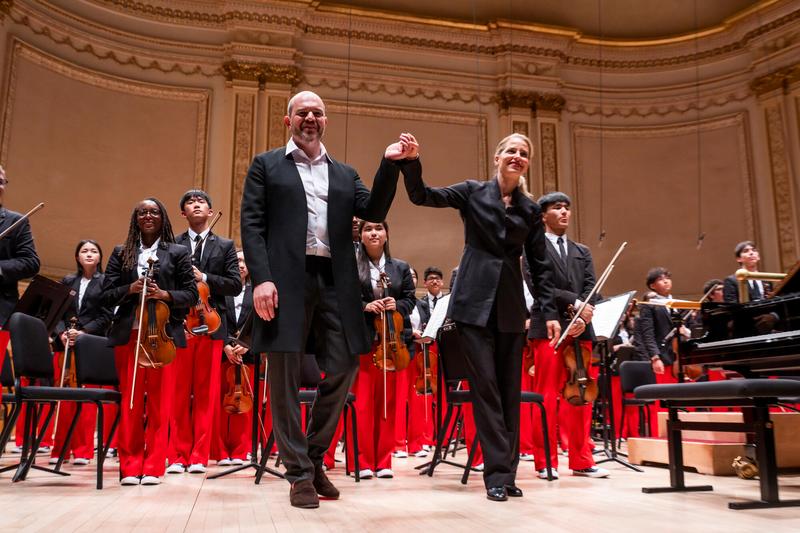
Jeff Spurgeon: Now on stage is the NYO-USA. You've heard the rush of their practice on stage at the beginning of our broadcast. We should just tell you that, once again, the NYO- USA is clad in their trademark bright red slacks with white shirts, black ties, and black jackets, and Converse All-Star sneakers, with which they have--
John Schaefer: [laughs]
[applause]
Jeff Spurgeon: -been shod for many years. Now going out on stage is the concert master for the first half of this program. His name is Euisun Hong, and he is a violinist from Pleasanton, California, in the Bay Area. He's out on stage, and we'll get the orchestra tuned up, and then we'll get ready for the first of the two works on the first half of this program, the Barber School for Scandal Overture. Then the ensemble will be joined by pianist Kirill Gerstein for the Concerto in F of George Gershwin. We hope to have a chance to speak to you a little bit about that between the Barber and the Gershwin. They have to move a couple of seats on the stage and get a big Steinway out there as well.
John Schaefer: Then after intermission, the Concerto for Orchestra, which is a showpiece for any orchestra, but especially for these young musicians to be able to strut their stuff on the grandest of grand concert stages. That'll be a real treat.
Jeff Spurgeon: Yes, I think so too. We should add that in addition to this being the debut Carnegie Hall performance of this year's edition of the NYO-USA, it is also Karina Canellakis' conducting debut on stage at Carnegie Hall. She might have done a student work here or there, been part of an ensemble, but this is her first time conducting a symphony orchestra on the stage of Carnegie Hall.
[applause]
Jeff Spurgeon: The stage door opens, and out she goes. The orchestra is on its feet. About 100 students chosen by audition from across the country. The NYO-USA Edition 2026 with Maestra Karina Canellakis to bring you Samuel Barber's School for Scandal Overture from Carnegie Hall Live.
[music]
[applause]
Jeff Spurgeon: The School for Scandal Overture of Samuel Barber, a performance by the 2026 edition of the National Youth Orchestra of the United States of America, conducted by Karina Canellakis, coming to you from Carnegie Hall Live. The orchestra on its feet now. Now you can see all those red slacks, John.
John Schaefer: [laughs] I'm having trouble unseeing. I'm going to have trouble unseeing that. That will be burned into my retinas tonight. The white sneakers as well. It is a definite look that NYO-USA has. An overture to get us going on a program that is set up almost like the old-style classic concert.
Jeff Spurgeon: Oh, for sure.
John Schaefer: Short opening overture piece, then a concerto, and then a big symphonic work, which is also a concerto, the Concerto for Orchestra by Béla Bartók. The Gershwin Piano Concerto that we're going to hear next is a work that will require a little bit of setup. Literally, they're going to wheel the grand piano right past us and out on stage. For this piece, the orchestra will be joined by pianist Kirill Gerstein, the Russian-American pianist. We spoke to him earlier, and he told us a little bit about some of the musical styles that you'll hear Gershwin drawing from in this piece.
Pianist Kirill Gerstein: There's this very idiomatic and characteristic mix of styles that Gershwin brings. Often I think people think, "Oh, it's jazz and classical." I think often overlooked is the klezmer element and the music of the Lower East Side that he heard growing up. Of course, then there is a kind of the Broadway sound, and very often he reaches for the helping hand of Rachmaninoff.
I think this is clearly the most successful melting pot of styles from almost any composer, and he really manages to combine it in a way that's disarming and sophisticated and innocent at the same time.
John Schaefer: That's the pianist, Kirill Gerstein, speaking about Gershwin's Piano Concerto in F. The piano is now out on stage. This is Gerstein's first time working with this young orchestra, NYO-USA, and so we asked him a little bit about what that experience has been like.
Pianist Kirill Gerstein: Working with the NYO-- and it's my first time. The enthusiasm is contagious. The level of skill and preparation and commitment is very impressive, and it's all directed towards some of the most enjoyable music that we have in the repertoire in Gershwin with a wonderful orchestration, a wonderful piano part, and this very unique representation of the best of the American spirit. Then I think the National Youth Orchestra of America also representing some of that best spirit. I think it resonates, and gives hope, and inspires.
Jeff Spurgeon: Kirill Gerstein talking about working with the NYO-USA. John, I've spoken with the conductor, soloist, some of the Carnegie Hall staff who've been working with these young people. Every one of them, to the person, has said that these young musicians offer such uplift and such a sense of hope and are bringing the best of what America can be to a presentation in a New York audience, to a New York audience, but also to the audience around the world because this group is going on tour to Europe in just another day or so.
John Schaefer: The fact that they have come together as an orchestra in such a condensed period of time-
Jeff Spurgeon: It's amazing.
John Schaefer: -is truly remarkable.
Jeff Spurgeon: Their first rehearsal was on July 20th, 11 days ago. That is the first time that these musicians were in the same room, just 11 days ago. They came from 32 states across the country and their rehearsals and they were in dormitories at Purchase College, which is about 30 minutes north of New York City.
John Schaefer: Part of the SUNY, State University of New York system.
Jeff Spurgeon: Right.
John Schaefer: Here they are on stage at Carnegie Hall, where this piece got its world premiere back in 1925.
Jeff Spurgeon: It was an amazing work by Gershwin. The first time that Gershwin's orchestration had really come into full flower, the Rhapsody in Blue had been orchestrated by Ferde Grofé. Very impressive piece, but the orchestral parts were written by a musician who knew intimately the working of Paul Whiteman's orchestra, which was the band that premiered the piece.
John Schaefer: Which was a jazz band.
Jeff Spurgeon: Yes. Then Gershwin wanted to demonstrate and develop his orchestration powers. You're hearing Gershwin at the keyboard and in front of a great big piece of staff paper as well, writing the parts for the orchestra.
John Schaefer: It is such a New York piece. Kirill Gerstein-
[applause]
John Schaefer: -was right in pointing out the klezmer influence in some of this. You'll hear it in the clarinet writing, et cetera. Kirill Gerstein heading out on stage. He is shaking hands with our concert master, followed by our conductor, Karina Canellakis. They both take a bow. She mounts the podium. He takes his place at the piano, and here is the Gershwin Piano Concerto in F from Carnegie Hall Live.
[music]
[applause]
[music]
[applause]
Jeff Spurgeon: From Carnegie Hall Live, a performance of Gershwin's Piano Concerto in F. The soloist, Kirill Gerstein; the conductor, Karina Canellakis; the orchestra, The National Youth Orchestra of the United States of America. Backstage at Carnegie Hall, I'm Jeff Spurgeon alongside John Schaefer. This was a really special performance of this work, John.
John Schaefer: I don't think I have ever seen a pianist have as much fun playing this piece. Kirill Gerstein spent almost the entirety of that piece looking at the orchestra, beaming at them benevolently, while playing these fiendishly difficult runs up and down the keyboard.
Jeff Spurgeon: It was remarkable to see that, absolutely remarkable. The orchestra. Pretty remarkable as well. These players are all ages 16 to 19 years of age. They've been in orchestra together for 11 days. That is as long as they have been working together. A quick offstage turn by Karina Canellakis and Kirill Gerstein. Now they're both back on stage. It was such a pleasure too to watch the members of the orchestra appreciating Kirill's cadenza, if I guess we can call it that. They were just smiling in delight at what they were hearing.
John Schaefer: The piano has 12 keys. They play 12 notes. There's no flatted third or flatted seventh, the so-called blue notes. Yet he was able to suggest those notes in some of those solo passages in the second movement. Just a really extraordinary performance. The conductor and the soloist, Karina Canellakis, Kirill Gerstein, could not wait for that final chord to finish ringing off before they were embracing and congratulating each other on a job extraordinarily well done.
Geoff Spurgeon: Indeed. They have worked together before. This was, in fact, a work of friends with this orchestra. Now coming back on stage alone, Kirill Gerstein. You hear the applause for him, but I think we're going to get an encore from this amazing pianist.
John Schaefer: There is a little stamping of feet from the members of the orchestra as well.
Kirill Gerstein: Oscar Levant: Blame It on My Youth.
[music] [applause]
John Schaefer: Pianist Kirill Gerstein, live center stage at Carnegie Hall, and his own variations on the Oscar Levant song, Blame It On My Youth. Jeff, I have to think he chose that song with an eye towards the musicians surrounding him on stage here tonight.
Jeff Spurgeon: Most certainly. A wonderful connection, too, for Oscar Levant was George Gershwin's good friend and one of his greatest interpreters as well. We should add, because I don't think we had mentioned it, Kirill Gerstein is an unusual classical pianist because he started off in the jazz world. If you hadn't figured that out already by hearing it, but you know it's true. The idiom of jazz, and thus the idiom of Gershwin, is something that he understands completely.
John Schaefer: Therefore, a perfect fit with Gershwin, who came from the world of song and that Piano Concerto in F. Gershwin was a songwriter.
Jeff Spurgeon: You bet.
John Schaefer: He knew a good tune when he wrote one, and he was not shy about bringing it back later in the same piece, which is how that concerto ended. We should say that it was Gershwin at the piano in the debut performance of that work here at Carnegie Hall just over 100 years ago. A very New York piece with a New York conductor in Karina Canellakis, who is a native New Yorker, and a group of young musicians representing 32 of the 50 states plus the District of Columbia. The NYO-USA now beginning to file offstage and pass us here at Carnegie Hall because it is, after all, intermission. This is Classical New York, WQXR 105.9 FM and HD, Newark; 90.3 FM, WQXW, Ossining, and WNYC FM HD2, New York.
Jeff Spurgeon: Backstage at Carnegie Hall, that's John Schaefer. I'm Jeff Spurgeon. The members of the NYO are filing off. They're going to get a little bit of rest before the second half of this program, which is Béla Bartók's Concerto for Orchestra, another favorite work of conductor Karina Canellakis, who did choose the repertoire that the NYO is playing this year. I think that we should mention, too, that the National Youth Orchestra of the United States of America is a Carnegie Hall creation and, in fact, was created by its executive and artistic director, Clive Gillinson, who realized that this country had no National Youth Orchestra.
Clive had come to prominence and gained experience in the English National Youth Orchestra. He said, "Why isn't there one in the United States?" The answer was pretty simple. There wasn't a way to get everybody together. When Clive came to Carnegie Hall, it was the age of the internet and of being able to make video recordings, and so all of a sudden, you could audition kids from all across the country.
That is how the National Youth Orchestra began. It's grown from a single ensemble now to three: the orchestra you're hearing tonight made of 16- to 19-year-olds; NYO2 for 13- to 17-year-olds, I believe; and NYO Jazz, which this year it's not an ensemble, it's a small orchestra. It has 30 members in it this year, the NYO Jazz ensemble. Each of these orchestras is going on tour. The NYO2 performed last night here at Carnegie Hall. They're headed out to the Dominican Republic and some Central American locations. The NYO Jazz ensemble is going to Asia. This ensemble is headed to Europe in a couple of days.
We should catch up with a couple of these young people who are here before us right now. We're going to meet violinist Leila Warren, who is a Floridian, and bass trombonist Jack Keefe, who is a Texan. Welcome, both of you, to Carnegie Hall Live. Leila, where are you from in Florida?
Leila Warren: I'm from the Beaches. It's near Jacksonville.
Jeff Spurgeon: You are, forgive me, a grizzled veteran of the National Youth Orchestra. Is this your third appearance with these ensembles?
Leila Warren: It is actually my fourth.
Jeff Spurgeon: Good heavens. Did you start out in NYO2, or have you been in NYO all four years?
Leila Warren: I wasn't old enough for NYO-USA my first two years, so I was in NYO2 for those two. Then last year I had the honor of moving up to NYO-USA, and obviously I'm here today, too.
Jeff Spurgeon: How does it feel, fourth time around, to be with this ensemble?
Leila Warren: It feels like home at this point. We have been rehearsing at the same Purchase College all four years, and each tour has been just such an incredible experience. I know kids from four years ago that have been with me all four years. It's really like a family, and I feel at home here.
Jeff Spurgeon: You are in touch with each other through the years because there's a big YouTube and internet family of NYO students, veterans, some who are in professional orchestras now, so it's a big network, right?
Leila Warren: Oh, absolutely. NYO really takes care of their alumni. They organize events and do little online chats. I would say I'm in contact with a good number of my friends through every year.
John Schaefer: What about you, Jack? What's your experience with NYO?
Jack Keefe: Last year I was a member of NYO Jazz.
Jeff Spurgeon: What? What? Wait a minute. Wait a minute. We have to slow down here. Those are different musical worlds. Are you the only person, first person, to be in both ensembles, NYO Jazz and one of the symphony orchestras?
Jack Keefe: I think I'm the second.
Jeff Spurgeon: That's just extraordinary. Are you like Kirill Gerstein? Did you start with jazz first and then get into the classical thing, or what was your trombone experience?
Jack Keefe: No. I started with classical music. Up until my freshman year of high school, that's all I did. I joined my school's jazz band, and then from there, I made Texas All-State Jazz. I really liked playing jazz music. I figured I might want to make a career out of it, so I auditioned for NYO Jazz, and I ended up making it.
John Schaefer: Now, do you audition as a trombonist or specifically as a bass trombonist?
Jack Keefe: I audition as a bass trombonist, which involves some improv pieces and then some excerpts from jazz charts.
John Schaefer: How much symphonic literature is there for bass trombone?
Jack Keefe: For bass trombone specifically, there's not a lot out there. We usually steal stuff from tenor trombones and tubas and write it for bass trombone.
[laughter]
Jeff Spurgeon: I think that's just amazing that you are playing on both sides of these musical styles. Where are you from in Texas, Jack?
Jack Keefe: I'm from Colleyville, Texas, which is just outside of Fort Worth.
Jeff Spurgeon: How big is your school band? Did you start playing bass trombone in high school?
Jack Keefe: I started in middle school, actually.
Jeff Spurgeon: With bass trombone?
Jack Keefe: Yes. I used to be very bad at high notes in middle school.
[laughter]
Jeff Spurgeon: You took refuge.
Jack Keefe: They figured, "Might as well give this kid a bass trombone that we just got, see how he does on it." I've never switched back.
Jeff Spurgeon: That's absolutely amazing. In addition to the musical part of being in NYO, the successful auditionees for the orchestras also are involved in other activities. Leila Warren, you do some really interesting work with refugees. Can you tell us about the JaxTHRIVE organization? What is that?
Leila Warren: It's basically a tutoring organization for refugee children, primarily from Afghanistan. We've had a couple from Central America as well. I speak a little Spanish, so that really comes in handy there when I'm trying to communicate with the kids. I've been part of it since about 7th grade. I would also say that's a nice little family where I am as well. It's really nurturing and sweet to see these kids grow up with this organization because it's often their favorite part of the week is coming to these Super Saturdays that we call them and having time with us.
John Schaefer: What do you teach? What kind of tutoring is it?
Leila Warren: It's math and reading mostly, but we do do a little science, which is mostly just fun little experiments.
Jeff Spurgeon: Jack, you are an Eagle Scout. I always think when I meet an Eagle Scout, of course you're an Eagle Scout. [laughter] When did you reach that? Because it's a big achievement.
Jack Keefe: I reached that just last year over the summer, me and a group of Boy Scouts. We went to this local school, and they have this yard in the middle of the school. It's like a courtyard essentially. It's also their ecological center. It was pretty worn out because this is a very old school. Me and a bunch of people that I invited, including scouts and neighbors and friends, we fixed up all the woodwork around the building. Then a few weeks later, another crew came, and they cleaned up the rest of the ecological center.
Jeff Spurgeon: That's wonderful. I also read in your bio that, Jack, you have a turtle, two snakes, a guinea pig, three cats, and three dogs. How long is it going to take you to get through customs at all the airports you're going to be going to on this trip?
Jack Keefe: It'll be pretty hard to get them to Europe.
Jeff Spurgeon: It's just a remarkable thing. One more question for each of you. How is the orchestra special, different, unusual, interesting this time around?
Leila Warren: May I go first?
Jeff Spurgeon: Yes.
Leila Warren: Okay. I would say primarily the repertoire. Every year the conductor gets to choose the repertoire for NYO-USA, as I'm sure you all know. Last year under Noseda, I was lucky to be comms master for the Rachmaninoff's Symphony No. 2, and Ray Chen performed Mendelssohn, and there was a brass fanfare. All in all, it was a very emotional, very kind of tension-high piece, repertoire concert all around. I think this year is a little more introspective, if that makes sense. The Bartók, learning under Ms. Canellakis, it was really enlightening to hear the story behind why and how he composed it, how it was at the end of his life.
You can really hear some of the pain and struggles, and there isn't necessarily those-- of course, there are emotional moments, but I would say it's less romantic and almost cliché at times. There's no cliché moments at all. I think that's very interesting to play because you have to find the specialties and the subtleties within the music that, for Rachmaninoff, he just played your heart out all the time.
[laughter]
Jeff Spurgeon: Jack, what about you? To say nothing of the adjustment from a jazz ensemble to a symphony orchestra.
Jack Keefe: I would say for NYO at least, the one thing and the biggest thing that I've noticed is there's no shortage of amazing players in the ensemble. Every single person loves music. It seems like they've dedicated their life to it. To perform here with them is just the most amazing opportunity I've ever had.
Jeff Spurgeon: I tell you, it's a privilege to talk to both of you. Leila Warren from Florida, Jack Keefe from Colleyville, Texas. We'll let you spend a few minutes resting before you get ready to help bring us the Bartók in the second half of this concert. Thank you so much for talking with us.
Jack Keefe: Thanks.
Leila Warren: Thank you so much.
John Schaefer: Enjoy your time in Europe.
Jeff Spurgeon: Yes.
Leila Warren: We will.
Jeff Spurgeon: Going to be a great trip. We have more to come on this concert from the National Youth Orchestra of the United States of America. The 2026 edition of this great ensemble. They'll be back on stage here at Carnegie Hall in a few minutes with Bartók’s Concerto for Orchestra. First of all, Leila brought up last year's repertoire. Let's turn to that concert, last year's NYO concert at Carnegie Hall, Mendelssohn's Violin Concerto, and conductor Gianandrea Noseda and the soloist, Ray Chen.
[music]
John Schaefer: Some music from Mendelssohn from last year's performance by the NYO-USA here at Carnegie Hall. Gianandrea Noseda conducting the youth orchestra with Ray Chen playing the violin, Mendelssohn's Violin Concerto in E-minor. Again, that's from last year's Carnegie Hall Live broadcast of the National Youth Orchestra of the USA. These concerts have traditionally marked the end of our broadcast season of Carnegie Hall Live, and that is the case with this year's concert.
It also marks really the end of an era because tonight is my co-host, Jeff Spurgeon's final broadcast from Carnegie Hall Live. Jeff, over the years, we have heard you interview globetrotting conductors, star pianists, and other soloists, and as we heard just a few minutes ago, teenagers just getting their start in the world of classical performance. I wanted to take just a couple of minutes here at Intermission to turn the tables on you-
Jeff Spurgeon: All right.
John Schaefer: -and ask you a few questions about-
Jeff Spurgeon: Sure.
John Schaefer: -your experience with Carnegie Hall Live. What, if anything, do you remember of your first Carnegie Hall Live broadcast?
Jeff Spurgeon: The first time that I was part of a broadcast from Carnegie Hall, we were not backstage where you and I have been. I was actually out in the lobby, and there's a little part-tier section that overlooks the entrance where people --
John Schaefer: A little mezzanine.
Jeff Spurgeon: Yes, thank you. Walks in. I was there. We were doing something with Carnegie Hall, and Isaac Stern popped up, and he said, "Well, I'm very happy to be spending a moment with Jeff Spurgeon from WQXR. That was an astonishing moment to think that Isaac Stern knew who this little upshot radio announcer was. That was a remarkable moment and one of the very first broadcasts that I recall.
\In the very early years of this Carnegie Hall Live series, my co-host was Fred Child, who was our former colleague at WNYC in New York, and of course, the longtime host of Performance Today, one of the most widely distributed classical music programs in the country. Fred was up in the booth upstairs from where we are, and I was down here, and at intermission would go into the hall and speak with people. We found the occasional celebrity, Lidia Bastianich. She was not a chef whom I knew, but I got to talk to her. She had come to Carnegie Hall.
We ran into Marilyn Horne backstage and got her reminiscences about doing Carmina Burana with Leopold Stokowski. There were amazing stories and wonderful encounters all along the way. I've gotten to work with some great people, not the least of whom is you, but that's log rolling, and we can do that later.
John Schaefer: This is not about me, this is about you. What is your favorite memory of working with me? No, I'm just kidding. No, no, no.
Jeff Spurgeon: [laughs]
John Schaefer: Since we moved here, and as people can hear, we are in the middle of it.
Jeff Spurgeon: You bet.
John Schaefer: Shouting to be heard over the musicians.
Jeff Spurgeon: Right.
John Schaefer: Since we moved here to backstage, you have not had to go searching for people to talk to. Sometimes they walk by.
Jeff Spurgeon: We've both had this experience of dealing with conductors, and now, it has become a habit when we talk to them before the performance to say, "John and I are going to be talking backstage before the stage door opens and you go out. Don't wait for us because we can't stop talking until you start conducting." We've had encounters with Michael Tilson Thomas, who's lingered by to see if anything we're saying is accurate. John Eliot Gardiner has tested some of our concepts that we've presented.
I've had my pronunciation of Riccardo Muti corrected by him at, I think, every appearance we've had him on at Carnegie Hall Live. It's been remarkable to see the performers in just the moments before they go out, to see some who are deeply focused, don't look up, and some people who are-- they're just hanging out, waiting for somebody to tell them to go out and throw some great art onto the Carnegie Hall crowd.
John Schaefer: I do remember Michael Tilson Thomas sitting just next to us and making funny faces at us.
[laughter]
Jeff Spurgeon: Yes, he did. That's been a part of the real privilege, is to watch the performances come together, as we are now, for the stage door is open. The orchestra is back on stage. We're getting ready for the Bartók Concerto for Orchestra. Our concert master in the second half of this program is from Phoenix, Arizona, Joshua Lee.
[applause]
There he goes on stage now to get ready to bring us, with conductor Karina Canellakis, a work that is very close to her. She's a huge, huge Bartók fan. Played a great deal of his music as a student, all kinds of work of his, and so this is a piece that's close to her heart, and she's brought a lot of her own interpretation to share with these young musicians, many of whom, of course, are encountering this work for the very first time.
John Schaefer: The work is an absolute showpiece for every section of the orchestra. These young musicians, 16 to 19 years old, who have been playing together for exactly 11 days, are about to show us what they can do in one of the great masterpieces of orchestral music. This is a work that Bartók wrote here in New York-- not in New York City; he wrote it actually upstate at Saranac Lake. It was at the end of his life. He was suffering from leukemia. He wrote it quickly in a white heat of inspiration over the course of a couple of months, and the work is an absolute classic.
[applause]
You will now hear it performed by the NYO-USA, the National Youth Orchestra of the United States of America. Karina Canellakis conducting. Taking center stage back at the podium, bowing to the audience here at Carnegie Hall, and now turning to face the Youth Orchestra. Here's the Concerto for Orchestra by Béla Bartók from Carnegie Hall Live.
[music]
[applause]
Jeff Spurgeon: From Carnegie Hall Live, you've just heard the National Youth Orchestra of the United States of America, conducted by Karina Canellakis, with a performance of the Concerto for Orchestra by Béla Bartók. Backstage at Carnegie Hall, I'm Jeff Spurgeon alongside John Schaefer. I think one indication of the success of this performance, John, as soon as it was over, Karina Canellakis mouthed to the orchestra a great big, "Wow."
John Schaefer: Yes. Yes. She looked totally jazzed. [chuckles]
Jeff Spurgeon: Yes, indeed. Hands over her heart.
John Schaefer: Forgive my lingo.
[laughter]
Jeff Spurgeon: Delighted, delighted with what these young people had done. This group of musicians, ages 16 to 19, gathered from 32 states across the country, having come together only 11 days ago to produce this concert. This last work on the program, the Concerto for Orchestra, preceded by music of Gershwin, and we started off with Samuel Barber as well.
John Schaefer: As is customary, after a performance of the Concerto for Orchestra, the conductor, Karina Canellakis, now pointing out the various sections and soloists. There is no hiding in this piece.
Jeff Spurgeon: [laughs]
John Schaefer: Everybody has a moment in the spotlight. It is just extraordinary to think that by the end of their European tour, these teenagers will have this piece internalized as part of their repertoire. Amazing. What is it like to be inside a piece like the Bartók Concerto for Orchestra? Well, fortunately, we were able to ask a couple of these young musicians.
Miles Martin: My name's Miles Martin. I'm from Memphis, Tennessee, and I play the viola. Ms. Karina, she's awesome. She's very charismatic. I love her imagery for all the movements. She just has this specific image in mind that I wouldn't necessarily think of if she hadn't said it to us out loud. In the last movement of Bartók, I've always thought of it as more like an aggressive, very tense movement, but she described it as this sort of dance.
Then when the woodwinds come in later, she said it's like a dress. They interrupt the party wearing some kind of dress, and everybody focuses their attention on them.
Jeff Spurgeon: That's Miles Martin, the violinist from Memphis. Let's hear from another member of the orchestra about why he likes this piece so much.
Evan Salas: Hello, my name is Evan Salas. I'm from Humble, Texas, which is northeast of Houston. I play the trumpet. My favorite piece on the program is the Bartók Concerto for Orchestra. One thing is that a lot of the trumpet excerpts, they have different interpretations based on the conductor and who's playing. That was really cool being able to hear Karina's point of view over certain excerpts and how to play certain things.
Bartók was Hungarian. There's a tradition that you emphasize the first note of certain phrases, and there's a famous trumpet excerpt in the first movement that's a chorale between the first, second, and third parts. It's up for debate how much do you emphasize that if you take away time. She's been very clear on what exactly we need to do. Now, we're sounding really, really great together, and we're letting go, let the music take over. It's been really great.
John Schaefer: That is Evan Salas, one of the young brass players in the NYO-USA. We look like we are about to get an encore from the NYO-USA.
[music]
[applause]
John Schaefer: Well, there's a crowd pleaser as an encore, George Gershwin's Overture to Girl Crazy, the musical that gave us "I Got Rhythm" and "Embraceable You" and so many other songs, many of which are woven into that overture played live at Carnegie Hall by the NYO-USA, the National Youth Orchestra of the USA, conducted by Karina Canellakis.
Jeff Spurgeon: A great, great piece of Gershwin and Broadway history, too, that was the musical that made Ginger Rogers and Ethel Merman stars. It was an incredible pit orchestra that played this music first time around. Benny Goodman, Glenn Miller, Gene Krupa, Jimmy Dorsey were all in the pit orchestra for Girl Crazy in 1930. That's a nice connection for the members of the NYO-USA to have.
We want to mention, too, that this orchestra is made up of 16 to 19-year-olds. These are not music conservatory kids. These are students who are in other programs, many of them headed for other careers. They're going to be leaders in their communities and their professions in many other areas. Out of these three ensembles, the NYO, the NYO2, the younger edition of this orchestra, and the NYO Jazz ensemble, has emerged yet another ensemble, the NYO All-Stars, which is becoming, I think, Carnegie Hall's go-to house band. They helped open up the season at Carnegie Hall last year.
This program that began in 2012 is really an amazing contribution to musical culture, not just in New York, but all around the country. You should note, too, there is an amazing note of encouragement. I hope you're feeling it listening to this concert, hearing it from the audience. We heard about that note of encouragement from conductor Karina Canellakis as well.
Karina Canellakis: I feel very inspired by them. You know, there's a lot of talk right now about artificial intelligence and the digital world taking over and jobs going away. It's all very depressing and [chuckles] very doomsday. I'm with these students, and they're teenagers, and they are not on their phones. They are not checking their phones in rehearsal. They are paying attention, and at the lunch break, they are talking to each other and hanging out and practicing and playing music together and playing games together.
It just gives me hope for the future, and actually, I think we're going to be okay. [chuckles] When I see these kids, I think we're fine because we still have people like this, and they are going to carry us into the future.
?Speaker: Okay, back to you.
John Schaefer: Conductor Karina Canellakis talking about this extraordinary ensemble of youthful musicians that she has just conducted here at Carnegie Hall. This is Classical New York, WQXR 105.9 FM and HD Newark, 90.3 FM WQXW Ossining, and WNYC FM HD2 New York.
[applause]
Jeff Spurgeon: You can hear the members of the NYO-USA coming off stage. Hugs and exchanges with their fellows. These young people are now headed back up to Purchase, New York, for one night at the place where they've been spending the two weeks that they've had to get to know each other and work on this repertoire. Tomorrow, they will get on a plane and go to Berlin, Germany, for the beginning of their European tour, which will include stops in Berlin, in Amsterdam, and in Aldeburgh, England, and they'll wrap things up in-
John Schaefer: Yes, Edinburgh as well.
Jeff Spurgeon: -Edinburgh, Scotland. They have just finished the first leg of an amazing part of their journey. We have concluded this evening's program. Wrapping up this broadcast of Carnegie Hall Live with thanks to the staff of Carnegie Hall and to Clive Gillinson, their executive and artistic director, celebrating his 20th year of leading this amazing organization, Carnegie Hall.
John Schaefer: WQXR's team included engineers George Wellington, Edward Haber, Bill Siegmund, Duke Markos, and Noriko Okabe. Our production team, Lauren Purcell-Joiner, Eileen Delahunty, Laura Boyman, Nicole Nelson, and Christine Herskovits. I'm John Schaefer, and on behalf of all of the people I just mentioned and all of the listeners, Jeff, who have enjoyed your company over the years in which you have hosted Carnegie Hall Live, I would just like to thank you for the work that you have done, your enthusiasm, your knowledge, your sense of joy that you bring to these broadcasts. I can think of no better compliment for a radio host than to say you've been good company, and we're going to miss you.
Jeff Spurgeon: Thank you, John. I'm so grateful to everyone, all the names you've mentioned. It's been such a privilege to share all of these amazing musical experiences with you, with our colleagues, and with everyone listening.
John Schaefer: All right, Jeff, take us home one last time.
Jeff Spurgeon: I'm Jeff Spurgeon. Carnegie Hall Live is a co-production of Carnegie Hall and WQXR in New York.
[02:15:39] [END OF AUDIO]
Copyright © 2026 New York Public Radio. All rights reserved. Visit our website terms of use at www.wqxr.org for further information.
New York Public Radio transcripts are created on a rush deadline, often by contractors. This text may not be in its final form and may be updated or revised in the future. Accuracy and availability may vary. The authoritative record of New York Public Radio’s programming is the audio record.