
Taxi Driver: Where to?
Passenger: Carnegie Hall, please.
[car screeches and honks]
[sirens]
[music]
Attendant 1: Okay, here are your tickets. Enjoy the show.
[music]
Attendant 2: Your tickets, please. Follow me.
[background chatter]
[music]
Jeff Spurgeon: In New York City, there are lots of ways to get to Carnegie Hall. Subway, a taxi, a walk down 57th Street. You've just found another way to get to America's most famous home for classical music. Welcome to Carnegie Hall Live, the broadcast series that gives you a front row seat to concerts by some of the greatest artists in the world. You hear the performances exactly as they happen. You are part of the audience sharing the experience of music-making at Carnegie Hall. I'm Jeff Spurgeon, backstage at Carnegie Hall alongside John Schaefer.
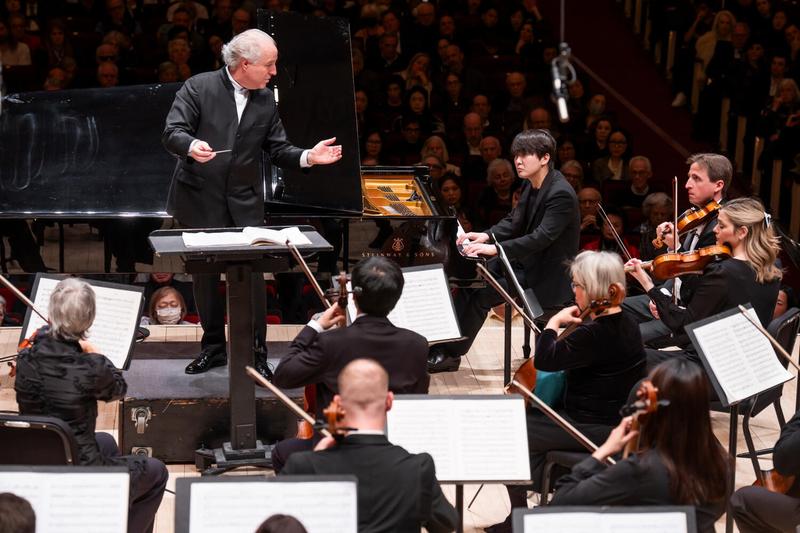
John Schaefer: With us tonight are the musicians of the Pittsburgh Symphony Orchestra, making a return appearance here at Carnegie Hall for the first time in a decade. They're led by their longtime music director, Manfred Honeck. On the program tonight, we have three brightly colored pieces, a New York premiere of a work by the Austrian American composer Lera Auerbach, Sergei Rachmaninoff's popular Rhapsody on a Theme of Paganini, and then after intermission, the mighty Symphony No. 5 by Dmitri Shostakovich.
Jeff Spurgeon: It's going to be a powerful evening of sound. The Pittsburgh Symphony Orchestra has a long history going back to the late 1890s, just like Carnegie Hall. It's also had a long history with this hall as well. The Pittsburgh Symphony performed here for the first time in 1900 at the invitation of Andrew Carnegie himself. Since then, they've returned to Carnegie Hall more than 80 times. The Pittsburgh Symphony Orchestra has been led by conductors such as Andre Previn and Lauren Marzel. The man leading them tonight is their Austrian-born music director, Manfred Honeck. 18 years with the orchestra and his contract goes through at least 2028.
John Schaefer: He'll be leading the orchestra in two pieces before intermission. The first of them is by the composer Lera Auerbach. It's a New York premiere of a piece called Frozen Dreams, which is actually based on Lera's 2020 string quartet by the same name. In her own words, Frozen Dreams, "Explores the fragility of perception and the shifting nature of reality itself," which is a pretty ambitious thing to attempt in a 12-minute piece of music. We asked Manfred Honeck about this piece, and he told us just what kind of composition it is.
Manfred Honeck: Frozen Dreams is a very powerful piece, but not in a way what you expect. It is not bombastic, not at all actually. As the title suggests, it's a little bit kind of a nightmare things and sometimes joy, but is always interrupted by something strange things, but that's exactly what Lera Auerbach wanted to compose. I was very happy with this piece.
John Schaefer: That is Manfred Honeck, who will conduct this piece. Frozen Dreams by Lera Auerbach. Now, despite the title Frozen Dreams, there's actually a lot of motion, a lot of fluidity in this piece. Auerbach is really focused on the idea of how time changes and shapes memory. The way that works in this piece is you'll get a theme introduced, and then it'll fade away, and eventually it'll come back, but it'll come back in a slightly altered state. After Frozen Dreams, we'll hear the Rachmaninoff Rhapsody on a Theme of Paganini. This, Jeff, is based basically on one of the 19th century's greatest hits.
Jeff Spurgeon: [laughs] The 24th Caprice by Niccolo Paganini has been a source of variations by a number of composers, but I think Rachmaninoff's is certainly the most enduring and most famous in our time.
John Schaefer: Yes, although Brahms, Liszt, even Andrew Lloyd Webber got into the act and wrote a set of variations on that Paganini Caprice, very popular, despite being also incredibly virtuosic. The Rachmaninoff Rhapsody on this theme has 24 variations.
Jeff Spurgeon: We're going to hear the pianist Seong-Jin Cho, the young South Korean pianist to play those variations. Then that work will be followed by intermission and then the 5th Symphony of Shostakovich. Now the stage doors are closed, the house has been darkened, and in front of us is standing Maestro Manfred Honeck, just with a few last-minute notes before he goes out to conduct this performance of the Pittsburgh Symphony of Lera Auerbach's Frozen Dreams.
As you mentioned, John, this piece is based on a string quartet. This is practically brand new music. The quartet was from 2020, and the orchestration of the work that we're going to hear was created just in the last year. Honeck and Pittsburgh introduced it in I believe, June of 2025. He repeated the work with the Vienna Symphony a little bit later that year, and this is the New York premiere of the orchestral version of this work.
John Schaefer: If you're not familiar with Lera Auerbach's music, there is a lot going on, generally, very big ideas that she inhabits in her music, and yet somehow there is a clarity and accessibility. I use that word carefully, but Lera Auerbach's music has-- it reflects her own experience as someone who was born in the then Soviet Union, was one of the last artists to defect before the Soviet Union dissolved. Came here at the age of 17 to New York City, not speaking a word of English, decided to settle here, studied here, and began her compositional career.
Jeff Spurgeon: She's already accomplished a great deal. She's won a number of prizes, performed as a pianist, also has published poetry. She really is an artistic person.
John Schaefer: And a conductor herself.
Jeff Spurgeon: Yes, that's right. Speaking of conductors, there goes one now. [applause] Out on stage at Carnegie Hall, Manfred Honeck and the members of the Pittsburgh Symphony Orchestra rise to their feet to open this concert of music by Russian composers, beginning with Lera Auerbach's Frozen Dreams. The Pittsburgh Symphony and Manfred Honeck from Carnegie Hall Live.
[MUSIC - Lera Auerbach: Frozen Dreams]
[applause]
John Schaefer: That piece is called Frozen Dreams, New York premiere of this orchestral work by Lera Auerbach. She wrote it for the Pittsburgh Symphony Orchestra, whom you just heard live on stage at Carnegie Hall, conducted by Manfred Honeck, based on an earlier string quartet of Lera Auerbach, also called Frozen Dreams. A piece full of dreamlike, eerie sounds, and perhaps none more so than the opening waterphone, an instrument, Jeff, that sounds electronic but is completely acoustic.
Jeff Spurgeon: It wasn't the only watered instrument on stage. There were also a couple of crystal glasses being played. Did we see correctly? It looked like they were being bowed, actually.
John Schaefer: Yes.
Jeff Spurgeon: You mentioned earlier that there was a lot of fluidity in the piece, but you didn't mean water, but in fact, that played a part.
John Schaefer: Yes. The waterphone, in case you're wondering-- Lera Auerbach on stage to bask in the glow of the sold-out Carnegie Hall audience here tonight. The waterphone is a metal container with water on the inside and metal rods around the outside. You bow the rods, and it makes a pitch, but because of the water sloshing around inside,-
Jeff Spurgeon: It keeps changing.
John Schaefer: -it keeps wavering. It's a very kind of eerie and uneasy sounding. That was what you heard at the beginning of Frozen Dreams.
Jeff Spurgeon: Just like what would happen, in fact, in a dream. That concludes the first work on this program of music by Russian composers we're bringing you with the Pittsburgh Symphony and music director Manfred Honeck from Carnegie Hall Live. Now the sounds that you're hearing in the background are members of the Pittsburgh Symphony leaving the stage and the stagehands getting ready to bring out that great big Steinway grand piano for the second work on the program, the Rhapsody on a Theme of Paganini by Rachmaninoff.
For that, the Pittsburgh Symphony Orchestra will be joined by the blockbuster Korean pianist Seong-Jin Cho, no stranger to these Carnegie Hall Live broadcasts. He is the pianist who stepped in at the last moment in 2022 to perform the Rachmaninoff Piano Concerto No. 2 with the Vienna Philharmonic on about 36 hours' notice. He flew in from Berlin. He's a little better rested for this performance today. We asked him what makes this particular Rachmaninoff work so incredible.
Seong-Jin Cho: Technically, of course, his music is so demanding. I find it to be so difficult stylistically because of his own recording. If I try to imitate his style of playing, I always failed. Of course, I have to find my own voice. His music itself is so romantic and lyrical, beautiful, dramatic, but how can I produce this? How much rubato I can take, how fast I can play? This is the big question, and I can't still find the answer. Probably no one will find the right answer and probably there's no right answer.
John Schaefer: Seong-Jin Cho, waxing philosophical there about the music of Rachmaninoff that he's about to essay on stage here with the Pittsburgh Symphony. Rachmaninoff was typically very cagey about any programmatic elements that he might have in his works, but this rhapsody is a little different.
It really gives a window into his thoughts because he wrote to the choreographer Mikhail Fokin about a plot for a ballet based on the piece, directly referencing the rumors about Paganini that he had sold his soul to the devil in exchange for his violin virtuosity. As Rachmaninoff writes about the ballet, he references the devilish violinist and uses the Dies Irae, the Day of the Dead theme from the Latin Requiem Mass, to represent this evil spirit. That ballet actually came to fruition in London in 1939.
Jeff Spurgeon: It was a very interesting moment for Rachmaninoff because, as you say, he didn't usually like to say too much about his inspiration, but the ballet inspired him to speak a little bit more fully, at least. We asked Seong-Jin Cho about what he hears in this very popular Rachmaninoff work.
Seong-Jin Cho: It's a masterpiece written by Rachmaninoff. Of course, every version have different characters and colors, and of course, Dies Irae, this character is very prominent. Sometimes it's jazzy, sometimes it's diabolic and colorful. Famous 18th version is beautiful, lyrical, of course. So colorful music, I can say.
Jeff Spurgeon: Seong-Jin Cho talking about the work he's about to play, the Rachmaninoff Rhapsody on a Theme of Paganini. The 18th variation is the famous romantic one, but there are 24 all together. I did ask Seong-Jin Cho about any particular ones that he sort of looked out for, and he said the 24th because it's the hardest.
[laughter]
Then we were reminded that Rachmaninoff found it hard, too, and a friend of his recommended a Creme de menthe before the concert. [applause] Rachmaninoff took it, and so that 24th variation is the Creme de menthe variation. We're going to hear all 24 now from Seong-Jin Cho and the Pittsburgh Symphony, conducted by Manfred Honeck, a young superstar pianist on stage. Now, the music, from Carnegie Hall Live.
[MUSIC - Rachmaninoff: Rhapsody on a Theme of Paganini]
[applause]
From Carnegie Hall Live, you just heard the Rhapsody on the Theme of Paganini by Sergei Rachmaninoff, a performance by the Pittsburgh Symphony music director, Manfred Honeck, and the young man for whom the cheers we just heard are for Seong-Jin Cho, the soloist. That's a work that was popular from the very beginning when Rachmaninoff first performed it in 1934. The work had its first performance in Baltimore and has been a hit ever since. It was the last work that Rachmaninoff played in concert, too. It's a great favorite of piano virtuosi around the world. Backstage at Carnegie Hall, I'm Jeff Spurgeon, alongside John Schaefer.
John Schaefer: It is a favorite of audiences around the world as well, especially that lovely, lyrical, ultra romantic 18th variation. There are 24 variations in all. Actually, Rachmaninoff sells himself a little short with the title.
Jeff Spurgeon: What do you mean?
John Schaefer: Because it's not just a rhapsody on a theme of Paganini, it's a rhapsody on two themes, the Paganini theme and the Dies Irae, literally the Day of Wrath, but an excerpt from the Latin Requiem Mass for the Dead. A interweaving of those two themes to create this image of the diabolical Paganini, who was thought to have sold his soul to the devil in exchange for his incredible violin skills. Of course, Paganini, in addition to being a great musician, was a master of PR, and we now know, started those rumors himself.
[laughter]
Jeff Spurgeon: It takes skill to build a career, and just because you can play the instrument doesn't mean you're a success.
John Schaefer: Seong-Jin Cho can clearly play his instrument and has been called back to it by the Carnegie Hall audience, and we'll get an encore.
[MUSIC - Frédéric Chopin: Waltz in C-sharp minor, Op. 64, No. 2]
[applause]
Jeff Spurgeon: An encore from pianist Seong-Jin Cho, the famous Waltz in C-sharp minor of Chopin. Seong-Jin Cho, when he's not playing Rachmaninoff in concert these days, he's playing a recital program that includes some Liszt in the Beethoven Sonata and an enormous suite of Chopin waltzes. He certainly has these notes in his hands these days. What a beautifully delicate touch he had on that?
John Schaefer: We also heard him earlier in the broadcast before the Rachmaninoff piece, wondering about rubato, how much rubato to use in the Rachmaninoff. He clearly got it right with the show pad. [laughs]
Jeff Spurgeon: Beautiful, beautiful gossamer touch on the keyboard.
John Schaefer: The Op. 64 No. 2 by Chopin, the Waltz in C-Sharp minor, an encore from this very popular and prolifically gifted young pianist who is, as Jeff mentioned earlier, no stranger to our Carnegie Hall Live broadcasts. Last time we met him, he was thoroughly jet-lagged, [laughs] sleep-deprived, and still put on a great show. [laughs]
Jeff Spurgeon: Yes, he did. He practiced that Rachmaninoff piano concerto too, in a hotel lobby waiting for a flight to come to the United States to replace a pianist on a broadcast in 2022. Now, Seong-Jin Cho back on stage once again just to take another bow from this sold-out house that has come to hear him as well as the Pittsburgh Symphony.
With that, we've reached intermission of this concert at Carnegie Hall by the Pittsburgh Symphony and music director Manfred Honeck in a program of Rachmaninoff and in a moment, Shostakovich, and the work that opened the program, Frozen Dreams by the composer Lera Auerbach, who is with us at the Carnegie Hall microphones right now. Congratulations on the New York premiere of the orchestral version of this piece.
Lera Auerbach: Thank you.
John Schaefer: It's a work that had me reaching for adjectives like Lynchian. Are you a fan of David Lynch's films by any chance?
Lera Auerbach: Of course. Who isn't?
John Schaefer: The kind of eerie, uncanny sound, especially at the beginning and end of the piece, struck me as very much in that kind of ethos.
Lera Auerbach: Yes. The work transcends the reality. I wanted the listener to be in this out-of-this-world, strange realm of dreams. Thank you for noticing it.
John Schaefer: The water phone at the beginning of the piece, immediately, especially, I would think, for the radio audience that can't see what's happening on stage, you're wondering, what am I hearing?
Lera Auerbach: There are some actually unusual techniques also used on usual instruments such as Tums. They actually scrape, instead of hitting the gong, they scrape it, and it creates this normal, like very strange, haunting sonorities among other instruments that also join them.
John Schaefer: This was originally a string quartet that Manfred Honeck and the Pittsburgh Symphony Orchestra commissioned you to create an orchestral version of. In the program notes for tonight's concert, you actually ask the question, when you take something, goes from the intimacy of string quartet to the expansive sonic palette of an orchestra, does it retain its essence or does it become something different? You don't answer that question, but what's your gut feeling about this piece?
Lera Auerbach: It's not an arrangement of the string quartet, because I wanted to create an authentic orchestral version. In fact, I was already thinking about it as I was composing the string quartet. When you have this great canvas of the orchestra, with so many colors, of course, it becomes another experience altogether, and this is what I love about creating these quantum lives of the thematic material. That, of course, experience is completely different when it is intimacy of string quartet versus this grandeur of the orchestra. Both versions are equally original, I would say, and not arrangements of each other.
John Schaefer: Each one has its own separate life.
Lera Auerbach: Absolutely.
Jeff Spurgeon: Your work has been given a new life tonight at Carnegie Hall, and so we congratulate you. Lera Auerbach, thank you for spending a little bit of time with us at intermission.
Lera Auerbach: It's my pleasure.
Jeff Spurgeon: Congratulations once again.
Lera Auerbach: Thank you.
Jeff Spurgeon: Thank you. We want to take a moment to speak with one of the members of the Pittsburgh Symphony before he gets busy, ready for the second half of the concert. Joining us right now is Principal Clarinet Michael Rusinek. Thank you for being with us.
Michael Rusinek: It's a great pleasure to be here.
Jeff Spurgeon: You've been with the Pittsburgh Symphony for a while.
Michael Rusinek: For 28 years.
Jeff Spurgeon: You look like you joined--
John Schaefer: You're a lifer.
Jeff Spurgeon: Yes.
Michael Rusinek: I am a lifer, and it's a pleasure to be a lifer with the Pittsburgh Symphony.
Jeff Spurgeon: How has the symphony changed in 18 years under Manfred Honeck? What has he done, and what has the orchestra retained because you've been here for those changes?
Michael Rusinek: First of all, being with the orchestra 18 years, he's appointed probably half the orchestra. So many principals, a lot of section players. He's really put his stamp on the orchestra. Manfred, one of the things that is really special about him is, first of all, his humility. He is so beloved by the Orchestra that after 18 years, there's still such a positive feeling, and it's really, I think, created a very special team between music director and orchestra, a unique collaboration. I came in with Mariss Jansons, and of course, I loved Jansons. Jansons was so wonderful, and he had such a warm heart and great personality, and spirit. I remember he said one time in a rehearsal that he was asked what he wanted the identity of the Pittsburgh Symphony to be, and he said, "I want the identity to be that when people hear it, they recognize that this is an orchestra that gives 110% every night." Mariss really conducted every concert like it was his last.
Manfred came in, and he really continued with that kind of spirit, and in contrast to Mariss, who was so creative and so warm, really was actually quite controlling. He controlled how everyone was going to play. Even though he let the principals be interpretive and be comfortable, he really controlled the overall sound of the orchestra. He would go around and move chairs on stage. He was a control freak. Manfred really allows the orchestra to play the way that they feel they want to play, but Manfred is able to--
We often joke that if you want to play with Manfred, you have to play soft, you have to play loud, you have to play fast. He goes for a lot of extremes. He's really able to mine a lot of the folk elements out of music, and he is unique amongst the conductors that I've worked with in being able to create such special moments. He is uncompromising in creating those special moments. Whether they are these tender, soft, beautiful moments or transitions or exuberant power. It really is quite a range that he's able to get out of the orchestra.
John Schaefer: What is the relationship, would you say, as such a long-serving member of the Pittsburgh Symphony, between the orchestra and the broader Pittsburgh community, because we've seen that relationship being very fraught in certain parts of our country? What is it like? What's the situation there?
Michael Rusinek: I think Pittsburgh has a very loyal audience. We maintain very close relationships with our board of directors. They're all not only generous supporters of the orchestra, but they're also our friends. They come on tour with us, and we're very close. That really creates a very good feeling. Like a lot of smaller communities, which I think Pittsburgh is, we have a challenge in reaching the broader public. I would love to say that our houses sell out every night, but they don't.
I think that the Pittsburgh Symphony is very treasured in the community, and it certainly has a history of that going back 100 years, but I think that we face the challenges that a lot of cities do. One of the things that's very special for us is that we seem to also have somewhat of a global brand, so that when we do go on tour, we are appreciated not just in Pittsburgh, but around the world, which is nice.
John Schaefer: Those recordings, that's your calling card.
Michael Rusinek: Yes. I think the recordings have been very successful.
John Schaefer: Absolutely.
Jeff Spurgeon: It might be because you guys are actually really, really a good orchestra, too.
Michael Rusinek: It's a good orchestra, but I think it's also an orchestra that is constantly breaking expectations.
Jeff Spurgeon: Your own expectations or the world's?
Michael Rusinek: I think the world's. I think that the Pittsburgh Symphony certainly has a great tradition, but we can't rest on our laurels. When we go out, we have to prove ourselves, and we take pride in doing that. Everybody's on the same page. We're very fortunate that we actually-- I'm very proud. It's a great pleasure to play with these people.
John Schaefer: Next year is America's 250th anniversary, and the orchestra is making a major commitment to that.
Michael Rusinek: Yes, you say it, so I believe it.
John Schaefer: Lots of repertoire, plus--
Jeff Spurgeon: That is going to celebrate the anniversary of the country. Michael Rusinek, what you tell is really wonderful. I think other orchestral musicians and orchestras might be incredibly jealous of the relationship you've described between the musicians and the music director, and the community tonight. Congratulations.
Michael Rusinek: If every orchestra could enjoy that, they'd be very fortunate because we are very blessed here.
Jeff Spurgeon: Thank you, Michael.
Michael Rusinek: Thank you.
Jeff Spurgeon: I don't want to keep you. I think you need to warm up.
Michael Rusinek: Yes, I'm going to go.
Jeff Spurgeon: I hear there's another second act.
Michael Rusinek: I'm not leaving just yet.
John Schaefer: A pleasure to talk to you.
Jeff Spurgeon: Thank you so much. Michael Rusinek, he is the principal clarinet of the Pittsburgh Symphony. He's in fact headed out on stage with his instrument now to get warmed up and ready for the Shostakovich Symphony No. 5 that will occupy the second half of this performance tonight by the Pittsburgh Symphony from Carnegie Hall live.
This is Classical New York, WQXR 105.9 FM at HD Newark, 90.3 FM, WQXW Ossining, and WNYC FM HD2, New York.
John Schaefer: In just a few minutes, the Pittsburgh Symphony Orchestra will return to the stage here at Carnegie Hall, and they'll play the Fifth Symphony by Shostakovich, but before they do, let's hear a bit more from tonight's piano soloist, Seong-Jin Cho, from a 2024 performance with the Boston Symphony Orchestra. This is Ravel's Piano Concerto for the Left Hand and Orchestra.
[MUSIC - Maurice Ravel: Piano Concerto for the Left Hand and Orchestra]
Jeff Spurgeon: A bit of Ravel's Piano Concerto for the Left Hand, a performance by Seong-Jin Cho with the Boston Symphony and Andris Nelsons. We're at intermission of a broadcast from Carnegie Hall live by the Pittsburgh Symphony and their music director, Manfred Honeck. With the stage doors open now, there are members of the orchestra drifting in and out of the stage, some of them you can hear rehearsing their parts in the Shostakovich Symphony No. 5 that will occupy the second half of this concert.
Audience members still strolling in after stepping out, maybe for a bit of fresh air. The house lights are still up. We're just a couple of minutes away from getting ready to hear one of the great works in the symphonic repertoire. What a story behind it, too. The composer, trying to protect himself from the state leader in the 1930s in Soviet Russia.
John Schaefer: Shostakovich wrote this fifth symphony as maybe not a follow up, but in the wake of his opera Lady Macbeth of Mtsensk, which got him into a fair bit of trouble with Stalin himself, after an unsigned letter to the Soviet newspaper Pravda, which was very much an organ of the government, condemned the opera as coarse and vulgar, saying the opera was muddle instead of music.
Jeff Spurgeon: It was obviously a bad review, but, oh, that meant so much more in that place in that time. Nowadays, it might cause an artist to go into depression, might reduce performances later. Under Stalin's rule, it was a death threat. Shostakovich decided to turn things around and write a piece for the 20th anniversary of the 1917 Russian Revolution, a work that had a very deliberate intent to please the authorities and help him escape the trouble that he faced in such a way that made him pack a bag that he kept under his bed in his apartment in case the authorities knocked on the door in the dead of night and wanted to send him away to Siberia.
John Schaefer: The composer with a go bag is not a good look.
Jeff Spurgeon: Oh, yes.
John Schaefer: For the Fifth Symphony, Shostakovich set aside, as far as we know, all programmatic elements and instead wrote a very formalistic, straightforward symphony in the traditional four movements to try and sidestep all of this trouble. When it premiered, it was subtitled A Soviet Artist's Reply to Just Criticism. That phrase was attributed to Shostakovich himself. There is now some question about whether he actually wrote that or not, but it turned out to be one of his most popular pieces, and it completely mollified Stalin and the government critics, and it is still programmed quite often to this day.
Jeff Spurgeon: I don't think it'll get the ovation tonight that it got at its premiere in Leningrad in 1937, an ovation that lasted more than half an hour, which is very difficult to imagine in today's world. We should say that in today's world, the Pittsburgh Symphony has made a mark with this particular work. They earned a Grammy Award in 2018 for Best Orchestral Performance with a recording of the symphony we're about to hear. Manfred Honeck conducted that recording, and when we spoke to him earlier today, we asked him, "What makes this Shostakovich Symphony No. 5 so remarkable?
Manfred Honeck: Shostakovich was very popular in the 1920s, and his opera Lady Macbeth of Mtsensk was played everywhere. Then in Moscow, Selvan Stalin heard about that. He came to the performance, and he left in the break, saying, "This is chaos. This is not music." Now, Shostakovich was in danger. Now, he knew exactly that many of his friends lost his life or were sent to the gulag in Siberia. He knew that even including his own sister with her husband, was sent to Siberia.
Now, Shostakovich had to find a way to escape. This is a testimony of this situation. The Fifth Symphony is an answer to the situation. It shows a lot of drama. It shows a lot of triumph, but underneath of this triumph, you hear a passion for freedom. You hear the suffering. You hear, especially in the last movement, the last two minutes, when you have repeating notes in the strings--
John Schaefer: That is Manfred Honeck, the conductor of the recording that won the Grammy Award and the conductor of the performance you're about to hear of the Shostakovich Symphony No. 5. A work written under trying circumstances, to put it mildly. There's a lot of controversy among musicologists about the meaning of the finale, which on the surface appears to be a blaze of triumph and glory, and yet there's an undercurrent of unease that some have found in this piece. The question is, just how much was Shostakovich playing both sides of the coin?
Jeff Spurgeon: It seems to be the case in scholarship, too. His motives remain uncertain in some quarters even to this day, but imagine living and making art in such circumstances. Now, the Pittsburgh Symphony and music director Manfred Honeck bring you Shostakovich's Symphony No. 5 from Carnegie Hall Live.
[MUSIC - Dmitri Shostakovich: Symphony No. 5]
[applause]
Jeff Spurgeon: From Carnegie Hall Live, Shostakovich, Symphony No. 5, an enormous symphonic statement and an enormous symphonic sound on the stage made by the Pittsburgh Symphony and music director Manfred Honeck. Backstage at Carnegie Hall, I'm Jeff Spurgeon, alongside John Schaefer.
John Schaefer: And what does it all mean, you know, is it unalloyed triumph and glory at the end there? Or is Shostakovich indulging in that acerbic, sarcastic side that we hear so much in some of his other pieces?
Jeff Spurgeon: As he said of this march at the end, it's not quite sincere. It's someone being asked, compelled to be joyful, always be rejoicing, always be rejoicing.
John Schaefer: And that is what Shostakovich wrote in his Testimony, his autobiography late in life. But of course, whether he actually meant that 40 years earlier when he wrote the piece under difficult circumstances, we have no way of knowing. Whatever he meant, we can be sure that Manfred Honeck and the Pittsburgh Symphony meant every note, that they just-- that was a committed performance. You can hear the response from the sold-out audience here at Carnegie Hall to what they have just heard.
Jeff Spurgeon: Innovation now for the brass section, being asked by Honeck to stand. Those cheers for the percussionists had extremely important roles. Now, the entire orchestra is on its feet. Concluding this broadcast of Russian works from the 20th and 21st centuries, but with a great deal of romance, beauty, and some unusual sounds too, in the work that began this broadcast, which was Frozen Dreams by Lera Auerbach in a New York premiere of the orchestral version of this work, which she said was not really. An expansion on the original string quartet work by that title, but a recomposition of the idea.
John Schaefer: Right. Its own thing with its own life.
Jeff Spurgeon: As she told us.
John Schaefer: Then, of course, another piece built on earlier music, the Rhapsody on a Theme of Paganini by Rachmaninoff. After intermission, this massive Symphony No. 5, which remains one of Shostakovich's most popular pieces. Let's not forget late '30s and especially early '40s, Shostakovich was pretty close to being a pop star.
Jeff Spurgeon: Yes.
John Schaefer: This is a guy who appeared on the cover of Time magazine and Newsweek magazine, and was for many Americans at that time, the face of Russia, of Russian resistance to the Nazis.
Jeff Spurgeon: And as such, in his own country, he was in incredible danger and fearing for his life, as we told you, in a way that inspired this work as a response to just criticism, or again, so Shostakovich said of this work. After the opera, the Lady Macbeth of Mtsensk was panned by Pravda, the organ of the Soviet government.
John Schaefer: Well, the audience on their feet. The orchestra mostly on their feet as Manfred Honeck continues to point out soloists and sections, concertmaster rises, takes a bow, and now everybody up on their feet. It may not be the half hour ovation that greeted this piece, but it's a pretty solid showing of support from the audience here at Carnegie Hall for what we have heard tonight.
Jeff Spurgeon: A sold-out crowd that came to hear the Pittsburgh Symphony and Manfred Honeck and pianist Seong-Jin Cho, the soloist in the Rhapsody on a Theme of Paganini by Rachmaninoff. This is Classical New York, WQXR, 105.9 FM in HD Newark, 90.3 FM WQXW Ossining, and WNYC FM HD2 New York
John Schaefer: And that wraps up our broadcast of Carnegie Hall Live. Our thanks to Clive Gillinson and the staff of Carnegie Hall. WQXR's team includes engineering, George Wellington, Duke Markos, Neal Shaw, Kelvin Grant, and Noriko Okabe. Our production team, Lauren Purcell-Joiner, Laura Boyman, Eileen Delahunty, Dominic Hall-Thomas, and Christine Herskovits. I'm John Schaefer.
Jeff Spurgeon: And I'm Jeff Spurgeon. Carnegie Hall Live is a co-production of Carnegie Hall and WQXR in New York.
[02:13:59] [END OF AUDIO]
Copyright © 2025 New York Public Radio. All rights reserved. Visit our website terms of use at wqxr.org for further information.
New York Public Radio transcripts are created on a rush deadline, often by contractors. This text may not be in its final form and may be updated or revised in the future. Accuracy and availability may vary. The authoritative record of New York Public Radio’s programming is the audio record.