 Live Broadcasts
Naumburg Orchestral Concerts: Baroklyn, Simone Dinnerstein, & CONCORA
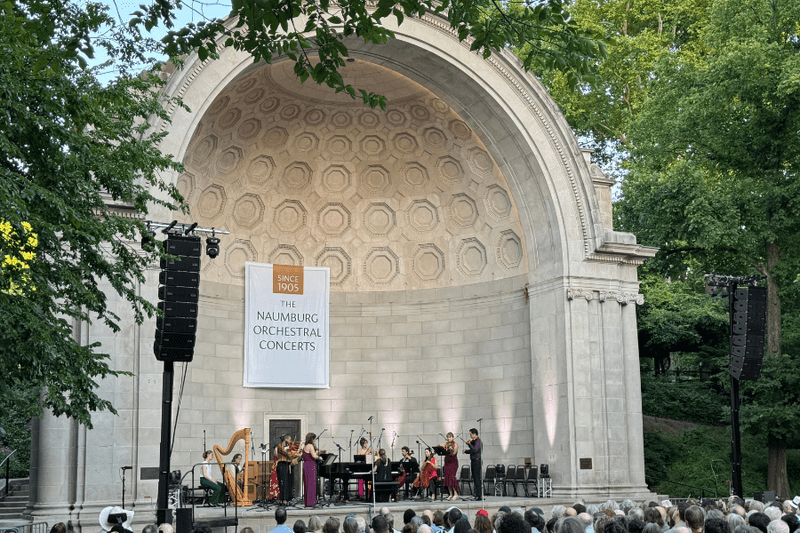
( Christopher W. London )
Elliott Forrest: Go Knicks.
[applause]
Elliott Forrest: Good evening. Welcome to the Naumburg Orchestral Concerts here in Central Park. I'm Elliott Forrest, midday host on WQXR, and I'm thrilled to welcome such a large crowd on this beautiful night for the first Naumburg Orchestral Concert of the Summer. We're going to have a lot of folks on stage. We are broadcasting live. Please welcome to the stage Simone Dinnerstein and her ensemble, Baroklyn.
[applause]
Elliott Forrest: Oops, can you hear me? Test. Test. Yes, there we go. Founded in 2017, Baroklyn is a string and piano ensemble led by Simone. They're a group of exemplary musicians united by the artistic vision that music should be creative and new. They've just released their second album called Hourglass, which we'll hear a piece from, and in the second half of the program, they'll be joined on stage by CONCORA, Connecticut's premier professional choir. Before, let's chat a little bit with Simone. Tell us about the organization and how it started.
Simone Dinnerstein: Well, basically, I founded Baroklyn because I wanted to have a group of musicians that I could lead in playing the works of Bach in the way that I wanted to play them. I put together a group of musicians who were compatible with me and were willing to go along for the ride that I wanted them to go on. The concertmaster is my really dear friend Becca Fischer.
[applause]
Simone Dinnerstein: Everybody in the group is just an incredible chamber musician and collaborative player.
Elliott Forrest: The title, well, if you're going to play Baroque music from Brooklyn, Baroklyn.
Simone Dinnerstein: Yes. I think I might be the only person in the group who's actually from Brooklyn, but I was born in Brooklyn, and I am a real Brooklynite, so.
[applause]
Elliott Forrest: What's the approach in taking older pieces and making them more modern?
Simone Dinnerstein: I maybe wouldn't phrase it exactly like that, but what I would say is that when we play anything, we're playing in our present moment. I'm not really thinking about being historically informed. I'm thinking more about structure and sound and all sorts of values that come from all of the music that was composed since Bach's time.
Elliott Forrest: Tonight we're going to hear Bach and Philip Glass. Is there a connection for you?
Simone Dinnerstein: I think there's a very strong connection in that Glass's music is also highly polyphonic. There's a lot of counterpoint. There's a lot of layering of voices that are many different lines happening at the same time.
Elliott Forrest: What are we going to hear first?
Simone Dinnerstein: We're going to start with our own arrangement of a chorale prelude by Bach called Herr Gott. It's originally written for organ, but we've arranged it for our group. We have joining us on oboe d'amore, the beautiful oboist Katherine Needleman.
[applause]
Elliott Forrest: Let's hear it. Simone Dinnerstein, Baroklyn, at the Naumburg Bandshell in Central Park, live on WQXR.
[applause]
[music]
[applause]
Elliott Forrest: Live from the Naumburg Bandshell in Central Park, Simone Dinnerstein and Baroklyn playing J. S. Bach's Chorale Herr Gott, BWV 617. Elliott Forrest, we're broadcasting live from the Naumburg Bandshell in Central Park. Up next, music from a completely different century. We're going to hear an arrangement of the music of Philip Glass. [music] [applause]
Elliott Forrest: Music of Philip Glass, A Suite from the Hours, arranged by Michael Riesman and performed here by Simone Dennerstein, pianist, and Baroklyn. That performance comes to you live as part of the Naumburg Orchestral Concerts here in Central Park in New York City on WQXR. I'm Elliott Forrest. That arrangement of Philip Glass's award-winning soundtrack was from the film The Hours, the 2002 film that follows the lives of three women connected by a Virginia Woolf novel. It's intermission here in Central Park.
In the second half of the concert, we return to the music of Johann Sebastian Bach with a modern twist. This is listener-supported Classical New York, 105.9 FM and HD WQXR Newark, 90.3 FM, WQXW Ossining. This is our first concert of the summer, live from the Naumburg Concert Bandshell. We've got a whole series of broadcasts coming up with an amazing lineup. You'll hear from The Knights, Delirium Musicum, the Orchestra of St. Luke's, and Nosky's Baroque Band. The next concert, featuring The Knights, will be on June 23rd.
Our featured performer tonight is Simone Dennerstein. She is an American pianist. Her breakout recording was her own interpretation and her own recording of Bach's Goldberg Variations, which was released in 2007. She's released 15 different albums, all of which topped the Billboard charts. We are proud to say Simone is one of the hosts of WQXR's Young Artists Showcase. She's committed to sharing classical music in non-traditional venues for underserved communities. We're just so happy to have her here tonight, performing live in Central Park.
Joining me now is one of the composers for tonight. Joining me is Philip Lasser. Good to see you.
Philip Lasser: It's nice to be here.
Elliott Forrest: Tell us your role here tonight.
Philip Lasser: Well, I'm an audience member right now, but I did write the continuo parts for the cantata that we're going to hear very soon, Cantata 9, and then an unusual piece, which is a piece really written as an independent work for piano, nested into the Air on the G String, the famous Air on the G String by J. S. Bach. My continuo parts for the cantata are what I would imagine Bach would have done on the fly if he had been here in the 21st century.
Elliott Forrest: What do you mean? In what way?
Philip Lasser: I think continuos have gotten over time a certain bad rap, because after all, he was the continuo player. When we know his imagination, his incredible ability to create so much, and he's sitting at a keyboard, if you think about those plunking chords that so often people do, I doubt that he was doing that. He was imitating. He was listening to the flutes. He was listening to the violins. He was listening to lines and the singers and actually incorporating that into his continuo. I have tried to do that in my own style, and certainly not violently different from Bach, but still close to what I think he might have done today.
Elliott Forrest: Were those originally ad-libbed for him, or were those scripted?
Philip Lasser: Well, so there would be a bass line with numbers, which would basically tell him or remind him what harmony there was at a particular time. That's only just for him to remember so that he could then build a piece as he was writing. He was a great improviser, as we know, and he most likely did fairly complex continuo parts.
Elliott Forrest: You mentioned the in the air. Just give us just one more word about that. What are we going to hear?
Philip Lasser: That's an unusual piece. Simone wanted me to go all out. As she and I have collaborated for, I calculate it now, should I say it? Over 24 years. I've written mostly because of her, but I've written on Bach, under Bach, in Bach, around Bach, every other possible way.
Elliott Forrest: You were the right guy.
Philip Lasser: Of course, Bach was my teacher as a very young man. Anyway, as he was for many. Briefly, it's a nested work. It's a piano piece that is literally independent, you can play it on its own, or you can play it nested in the Air on the G String. The string players do exactly what Bach wrote.
Elliott Forrest: We're going to hear that at the end of the program here tonight.
Philip Lasser: Right.
Elliott Forrest: I'm Elliott Forrest. It's intermission time here. We will have plenty more music with Simone Dinnerstein and Baroklyn. Joining us now is the concertmaster of Baroklyn, Becca Fischer. Thank you so much for stopping by during intermission. I know it's a busy time for you.
Becca Fischer: No, absolutely. It's always a pleasure to talk a little bit after we play because we're on such a high, so it's nice to converse about what we just did.
Elliott Forrest: Just talk a little bit about it in this-- it always amazes me that we start these concerts and we say we're going to go live and there's got to be, I'm guessing, I'm not good at this, maybe a thousand people, maybe.
Becca Fischer: It's a lot of people.
Elliott Forrest: Three? Two? Two thousand people, I'm told now. Two thousand people, and they're like really quiet. I think if you walked by here in Central Park, you would have no idea there's 2,000 quiet people attentively listening to Bach and Philip Glass. How does that feel for you on stage?
Becca Fischer: Well, it's very special because I think no matter what we as musicians are having an intimate experience on stage and we're hoping to communicate that to an audience, and to be able to do this outdoors for folks who are here at a free concert, and to be able to communicate that intimacy is very unusual and special. I think usually we're used to having an enclosed space, so this is quite unique.
Elliott Forrest: Yes. You don't normally get helicopters and dogs and boomboxes, and stuff.
Becca Fischer: You know, that really added to the ambiance, to the mood, I think.
Elliott Forrest: I think Philip Glass would approve.
Philip Lasser: He would. He would.
Becca Fischer: I hope so.
Philip Lasser: If I could just interject. Hearing 2,000 people in dead silence, that's impressive, it really is, and moving.
Elliott Forrest: You've been, Becca, with Baroklyn since the beginning. How has it grown? Tell us about the evolution.
Becca Fischer: Well, I think Simone has always had this vision for this group. As she mentioned, before we started playing, a group that she felt comfortable with, that she could work on with Bach. I think that we have become more fluid and more experimental as an ensemble over the years. We've also become more legitimate. This just started as this kind of a special fun opportunity for some of us to get together and to play these extraordinary, mostly Bach concertos and some chorales. Then we really started honing our rehearsal process and working with Philip's works and seeing what he does to magnify and bring out these extraordinary voices in Bach, but also with his own creative voice.
I feel like that's what we've started doing more, as we make our own arrangements, even of very traditional chorales like the Herr Gott you heard. We're always experimenting, "Okay. Let's have the violas play the top line here, and let's try the cellos dropping out, or let's have pizzicato in the second violin." We're always experimenting, really, with texture and with flexibility in general. Also with repeats, especially in something like Philip Glass where-
Elliott Forrest: It's all repeats.
Becca Fischer: Yes. There a lot of repeats.
Elliott Forrest: That's`a really [unintelligible 00:43:59]
Philip Lasser: You said it, I [unintelligible 00:44:01]
Becca Fischer: We never play things the same way twice. I think that that's sort of a rule that you try to adopt as a performer, but I think we're really, really trying to emulate that. We're trying. There's a lot of spontaneity in rehearsals, and we hope that that communicates.
Elliott Forrest: I think it does. In the program notes, Simone Dinnerstein stresses the importance of rehearsal, and it sounds like that that's a time to experiment more than just practice.
Becca Fischer: Absolutely.
Elliott Forrest: It's the time to figure things out. What are projects coming up for Baroklyn?
Becca Fischer: Well, there are a couple projects that are just happening and that are evolving at this moment, sort of represented by some of the things we're presenting today. For example, our second album just came out, Hourglass, these works of Philip Glass. Also, this collaboration with CONCORA has just started, I feel like. We're going to be doing some more performances of that. Also just going back and forth between Bach and Glass, I feel like this is something that I know that Simone enjoys doing in her own solo work, and so I think we're going to be experimenting more with some of this back and forth. It feels really fresh to play something by a living composer, whether it's Philip Lasser's work or Philip Glass's work-
Elliott Forrest: The two Philips.
Philip Lasser: The two Philips.
Becca Fischer: -juxtaposed next to Bach. I think we always want things to sound fresh and new irregardless of their time of composition.
Elliott Forrest: Concertmaster Becca Fischer and Philip Lasser, one of two living composers here for tonight. Thank you for stopping by.
Philip Lasser: Thank you.
Elliott Forrest: Enjoy the rest of the intermission and the rest of the concert and thank you for joining us.
Becca Fischer: Thanks so much.
Philip Lasser: Thanks so much.
Elliott Forrest: You're welcome.
Philip Lasser: Thank you.
Elliott Forrest: Coming up in the second half of this concert with Simone Dinnerstein and Baroklyn, we'll hear music by Bach, and then they'll be joined on stage by singers from CONCORA. Before we get there we have a bit more time during this intermission. I mentioned earlier that we have a couple of more concerts coming up this summer live from the Naumburg Bandshell. The next one is on Tuesday, June 23rd, featuring The Knights. Let's hear a little preview. The Knights are regulars here at the Bandshell. Here's a performance from 2024 of Beethoven's Pastoral Symphony on WQXR.
[music]
Elliott Forrest: Everybody having a good time?
[applause]
Elliott Forrest: Everybody behaving themselves? You guys down here, can you save me some wine right there, a glass? I like to drink after, not during. Welcome to the second half of the program. I'm Elliott Forrest. We're broadcasting live this evening here on WQXR. If you're listening on the radio, you just heard the music of Beethoven from the Symphony No. 6, performed by The Knights, recorded right here on this stage at the Naumburg Bandshell a couple of years ago. You can hear The Knights in a live performance right here on this stage again on June 23rd, 7:30 PM, right here in Central Park. The night is still young. We have more music. Please welcome back Simone Dinnerstein, Baroklyn, and now CONCORA.
[applause]
Elliott Forrest: These singers behind me, CONCORA stands for Connecticut Choral Artists, founded in 1974. It was Connecticut's first professional choir under the leadership of artistic director Chris Shepard, who is with us tonight. CONCORA's mission is to cross cultural boundaries and to move hearts. Here to talk more about CONCORA is vocalist, mezzo-soprano, Megan Roth. Megan?
[applause]
Elliott Forrest: Tell us how long you've been with CONCORA and what it means to you.
Megan Roth: Yes, of course. Well, I have been with CONCORA for two seasons. I relocated to Connecticut four years ago, and I have found my musical home in CONCORA. I love singing in CONCORA because we do such innovative programs that focus both on music of the past and also music of today. There's always a theme, often around social justice movements as well.
Elliott Forrest: You keep coming back, the group does, to the music of Bach. What keeps coming you back time and time again?
Megan Roth: Well, Bach's music is timeless. It has this incredible ability to speak to both the intellect and the heart, so through this incredibly complex structure and architecture, we can experience all of the human emotions.
Elliott Forrest: Tell us what we're going to hear first.
Megan Roth: Yes. First is Cantata 9, which was one of the early church cantatas that Bach wrote while stationed in Leipzig. It's got this beautiful Lutheran chorale hymn tune that he gives to the sopranos, and they just soar over top of the altos, tenors, and basses who have these fun musical interjections. The message is very simple: "that faith and trust and the reassurance that we are not alone."
Elliott Forrest: Thank you so much.
Megan Roth: You're welcome.
Elliott Forrest: I think Steven Spielberg would agree this week.
[applause]
Elliott Forrest: Thank you so much. All right, let's get ready to hear this Bach cantata performed, Simone Dinnerstein, Baroklyn, CONCORA from the Naumburg Bandshell in Central Park on WQXR.
[applause]
[music]
[applause]
[music]
[applause]
[music]
[applause]
[music]
[applause]
Elliott Forrest: The choral cantata by J.S. Bach, BWV 9. It is our salvation come here to us. Performed live in the Naumburg Bandshell here in Central Park. You heard Simone Dinnerstein, chamber ensemble Baroklyn, and vocalist singers from CONCORA. The featured soloists and of these were soprano, Louise Fauteux, mezzo-soprano, Megan Roth, tenor, Jack A. Pott, baritone, Jermaine Woodard, Jr.. You also heard contemporary continuos written by Philip Lasser who we spoke to at the intermission. I'm Elliott Forrest, we're broadcasting live from Central Park with a concert of Baroklyn with Simone Dinnerstein. We have three more pieces of Bach to hear.
[music]
[applause]
[music]
[applause]
Elliott Forrest: Three Movements from three Cantatas by Johann Sebastian Bach, performed here by Simone Dinnerstein, Baroklyn, and CONCORA. Two of them came from transitional periods in Bach's life, the second, BWV 22, was written as an audition piece. Bach wrote the final and third cantata that we heard in his late 20s. Here's Simone Dinnerstein to tell us about the final work on tonight's program.
Simone Dinnerstein: Thank you so much for being here tonight. It's so, so special to be with fellow New Yorkers. As I said earlier, I'm from Brooklyn, and I hope there are a lot of people from Brooklyn here tonight.
[applause]
Simone Dinnerstein: I wanted to say that what we do together is so, so special. I look forward to every time that I'm with Baroklyn, and being joined by CONCORA has just been the cherry on top. Can we give a big round of applause to CONCORA?
[applause]
Simone Dinnerstein: At the beginning of the show, Elliott was asking me about making Bach new again. One of the things that I've been doing to make it new is I've been collaborating with the fabulous composer Philip Lasser. Philip Lasser wrote the continuo parts that I played in the Cantata earlier. They're just so beautiful, and they bring something modern and contemporary to this world of Bach. The next piece that we're going to play is a very, very special thing that he wrote for us, which is based on the Air on the G String, which Baroklyn will play as Bach wrote it.
While Baroklyn is playing that, I'm going to play something that Philip wrote, which he used Bach's continuo part, the harmonies that are in the music, but he created something unique in his own voice, and something that's really just incredibly beautiful and written for me to play. We're so lucky to have in the audience tonight, Philip Lasser. If you could just stand up, that would be so great.
[applause]
I don't know where he is exactly.
[applause]
Simone Dinnerstein: Yay. Woohoo. Thank you. I hope you all enjoyed this.
Elliott Forrest: Simone Dinnerstein telling us about the final work on tonight's program. It's called In the Air by Philip Lasser and J.S. Bach, performed by Simone Dinnerstein, Baroklyn, from the Naumburg Bandshell in Central Park. We are live on WQXR.
[music] [applause]
Elliott Forrest: A beautiful performance of In the Air by Philip Lasser and J.S. Bach. The final piece by our featured performers tonight, Simone Dinnerstein and Baroklyn. Our next concert from the Naumburg Bandshell is Tuesday, June 23rd with The Knights featuring a program of contemporary composers including Samuel Barber and Caroline Shaw. Beautiful night for a concert live in New York City here in Central Park. Some 2,000 people came tonight on this stunningly beautiful night. They're up on their feet. Simone is waving for the entire chamber ensemble of Baroklyn to stand and take a bow as well.
A great thanks to Christopher London, President of the Naumburg Orchestral Society, and Anthony Bracewell, the executive director, and the Naumburg staff as well, including stage manager extraordinaire Patty Dines. Also thanks to Wilson's Showtime Services and our friends at SummerStage. Big thanks to everyone at the WQXR team, including engineers George Wellington, Duke Markos, Noriko Okabe and Kelvin Grant.
Our production team is Laura Boyman, Lauren Purcell-Joiner, Christine Herskovits, Nicole Nelson, and Eileen Delahunty. I'm Elliott Forrest. Thank you so much for listening. This is listener-supported Classical New York, 105.9 FM and HD WQXR Newark, and 90.3 FM WQXW, Ossining.
[01:55:14] [END OF AUDIO]
Copyright © 2026 New York Public Radio. All rights reserved. Visit our website terms of use at www.wqxr.org for further information.
New York Public Radio transcripts are created on a rush deadline, often by contractors. This text may not be in its final form and may be updated or revised in the future. Accuracy and availability may vary. The authoritative record of New York Public Radio’s programming is the audio record.