
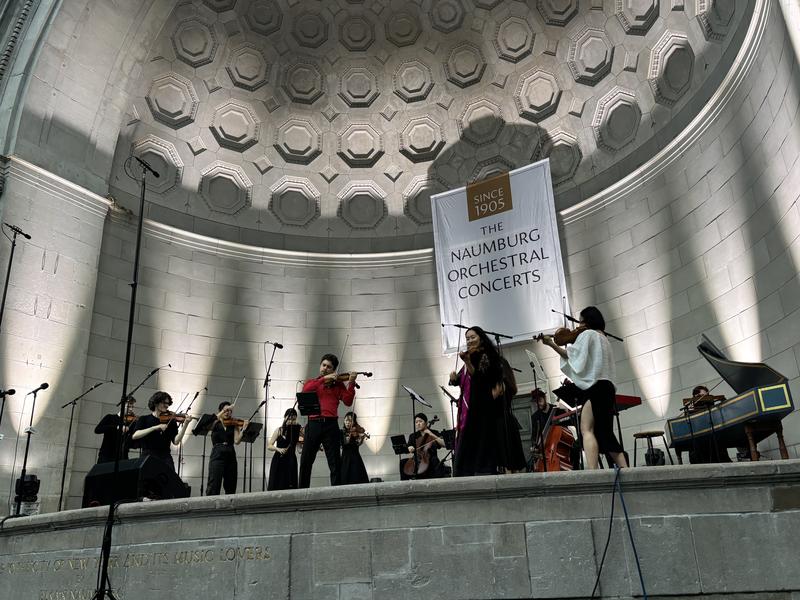
( Nicole Nelson / WQXR )
Jeff Spurgeon: In 1862, in Harper's monthly, these words were written, "Central Park is the greatest work of art ever executed in our country." That was just in 1862. Look at it now. What a glorious space we are in tonight.
[applause]
Jeff Spurgeon: Good evening. To those of you listening to WQXR and to those of you here in Central Park at the historic Naumburg Bandshell, I'm Jeff Spurgeon, and this is the New York concert debut at the Naumburg Orchestral Concerts series of the Los Angeles-based chamber ensemble, Delirium Musicum.
[applause]
Jeff Spurgeon: They may be based in Los Angeles, but as you see, they got the memo. They're mostly in black. They're ready to be in New York.
[laughter]
Jeff Spurgeon: They're ready to bring us a great concert of music with a special accent on the richness of classical music, and we're so pleased to present their program, which begins tonight with just a moment of orchestral music from an opera that first appeared in the world 100 years ago, Háry János by Zoltán Kodály. Ladies and gentlemen, one more welcome, please, for Delirium Musicum live on WQXR.
[applause] [music] [applause]
Jeff Spurgeon: Live from Central Park on WQXR, the third of this season's Naumburg Orchestral Concerts and the first performance in New York City by the ensemble, Delirium Musicum. Their founder or artistic director is Étienne Gara. Would you come to the microphone, sir? Welcome.
[applause]
Étienne Gara: Thank you. Good evening, everyone.
Jeff Spurgeon: You're from France-
Étienne Gara: Or so.
Jeff Spurgeon: -and the orchestra began in Los Angeles. Tell us how this group formed. What did you do? What did you do?
[laughter]
Étienne Gara: Well, I have to say, I'm not quite French. I'm half-French, I'm also half-Hungarian, and half-American.
[laughter]
Jeff Spurgeon: Good, you do math like Americans then, too.
[laughter]
Étienne Gara: It's a West Coast musician thing.
Jeff Spurgeon: Yes.
[laughter]
Étienne Gara: Well, I was looking for musicians that would be as crazy as possible, so I would feel a little better about myself.
[laughter]
Jeff Spurgeon: Okay.
Étienne Gara: Then, I'm hoping and operated as a magnet bringing those musicians in this little group and giving ourselves an opportunity to do ferocious music, delirious music together. That's a very short version. Do you want me to talk for two hours?
[laughter]
Jeff Spurgeon: No, I would like to. Other people might object, but that was wonderful. I also want to credit your composer-in-residence, Gianluca Bersanetti, who made the arrangement of the Kodály that you just heard, and a number of other works that are on the program tonight. You'll see them mentioned in the program.
[applause]
Étienne Gara: Just show him some love because he's here tonight.
Jeff Spurgeon: Oh, he's here?
Étienne Gara: Yes.
Jeff Spurgeon: Oh, there he is.
[applause]
Jeff Spurgeon: Congratulations. Thank you, Mr. Bersanetti, for your contributions tonight. You guys released an album last year of Halloween-ish things. Is that fair to say?
Étienne Gara: Yes, it is our second album for Warner Classics, and it's called Cabinet of Curiosities. Imagine that you have many little windows that you can open. Behind each of these windows, you have a piece of music that is completely unique in its stylistic genre. You get all these different acoustics, sonic texture, characters, moods. Everything is different every time. It's not really like your typical album where you have my favorite encores or whatever. This is more like a concert program, the way we like to do it.
Jeff Spurgeon: All right.
Étienne Gara: Little pieces that bring you from the Baroque era up to music of tomorrow. We play Barber, Adagio, French Baroque music, a piece by Gabriella Smith that we're going to play tonight. It really goes the whole gamut of things. We have also Korean pop music, rock music, movie music. Yes, whether you want it or not, you will like something on this album.
[laughter]
Jeff Spurgeon: That sounds right for a Cabinet of Curiosities. You want something to discover. Well, the thing you're going to play for us next is something I'm sure you all know. We don't hear it usually at this time of year, but you can imagine the sun having gone down a couple of hours ago.
Étienne Gara: Oh, and it's Halloween every day in my life--
Jeff Spurgeon: Yes, that's right.
[laughter]
Jeff Spurgeon: It's New York City, so it really is Halloween every day.
[laughter]
Jeff Spurgeon: We're going to hear Danse Macabre.
Étienne Gara: Danse Macabre. French composer, of course, because you cannot play a concert without a French composer on it. Camille Saint-Saëns. [chuckles] Danse Macabre is a piece that I really like because my imagination can go in wild places, and I'm sure yours will do, too. You have to imagine that it's midnight right now. You almost can't tell. You'll hear the 12 gongs of midnight played by Nathan on the keyboards there. If you want to make some noise for him, I'm sure he would appreciate it.
[applause]
Étienne Gara: As soon as the 12 gongs of midnight rung into the night, you'll hear me play the devil's interval, a tritone that is absolutely scary. That will wake up, ladies and gentlemen, all the skeletons, all these cute little skeletons that are buried under this very stage.
[laughter]
Étienne Gara: Probably other artists who didn't have a very successful debut here.
Jeff Spurgeon: Could have been.
[laughter]
Étienne Gara: I'm counting on you to help us have a better end. These little skeletons are going to wake up to that call, and they're going to dance a waltz and have really a great time. They're going to play vibraphone, xylophone on each other's skulls, with each other's bones, and have the really best time of their entire death.
[laughter]
Étienne Gara: All that, ladies and gentlemen, until the rooster wakes up, which I will be playing as a Frenchman. You might know that the animal of France is a rooster. If you are watching the World Cup, you'll know. At which point, all these delicious skeletons have to run back into their graves before the first ray of the sun, unless they would be turned into ashes by the first ray of sun. That's a dramatic end that we're going to try to avoid.
Jeff Spurgeon: Here it comes now. It may not look like midnight, but it's going to be that-
Étienne Gara: It feels like.
Jeff Spurgeon: -in just a moment with Delirium Musicum.
Étienne Gara: Thank you.
[applause] [music] [applause]
Jeff Spurgeon: The orchestra Delirium Musicum on stage at the Naumburg Bandshell in Central Park. Leader Étienne Gara and his musicians, with that arrangement of Saint-Saëns's Danse Macabre made by the orchestra's Composer-in-Residence Gianluca Bersanetti. Now, I think we'll hear Étienne with a word or two about the next work on this program, coming to you tonight live from Central Park. Musicians are just regrouping a little bit, doing a little bit of stage resetting before we'll hear a work by one of the-- perhaps the youngest composer on this program, Gabriella Smith. She was born in 1991. Here's Étienne.
Étienne Gara: So far, so good? Can you hear me?
[applause]
Étienne Gara: Now that we really started the concert and we're in the middle of the night, I can tell you about the next piece. It's a piece that I really, really like because, well, many reasons. One of them is that it was written for us. The title of this piece is Cactus-Yucca Scrub, which is the fifth movement of a piece called Desert Ecology, which is a piece that is part of a bigger project, which is called Treelogy. Tree, like a tree, like a plant, like a big tree.
This project was a musical homage to the three iconic trees of California that suffered so much during recent wildfires. It premiered in 2023. The three trees and composers were the giant sequoias, which was written by Billy Childs; the redwoods, which was written by Steven Mackey; and, of course, Desert Ecology, which is about the Joshua trees and Joshua Tree National Park, was written by an amazing, young, super-talented composer called Gabriella Smith. What is even more cool about her is that she's also a violinist.
She's also from Seattle, which I think has the best beer in the entire universe, which Evan here made me discover. We can fight about this after the concert, I'm sure. For now, what you're going to hear is also really interesting because some of our musicians are going to put paperclips on their instruments, on the strings. The reason for that, beside that it is a really cool sound, is that it's also emulating the sound that it makes when you pluck the barrel cacti. Don't try. I tried. Very bad idea.
[laughter]
Étienne Gara: The sound is pretty amazing. We are going to start with that sound. As the piece goes on, you are going to be witnessing that awe that you feel when you step in the Joshua Tree National Park. This desert opening in front of you, the Joshua trees, the cacti. In the back, you have this amazing mountain. It's an amazing sight. If you've never been there, I really encourage you to go to California. You'll see the weather is totally fine. Also, we have this amazing national park. If you've been there, then just close your eyes, and you might see again in front of you that first sight that you had as you were stepping in Joshua Tree National Park. This is just for you, Cactus-Yucca Scrub by Gabriella Smith.
[applause] [music] [applause]
Jeff Spurgeon: The orchestra Delirium Musicum with music of Gabriella Smith, the fifth movement of the work Desert Ecology called Cactus-Yucca Scrub. From the Naumburg Bandshell in Central Park, coming to you live on WQXR, this young Los Angeles-based chamber orchestra is making its debut appearance in New York. What a nice venue to start at: Central Park on a July summer evening in New York. Now, more words from Étienne Gara, the founder.
Étienne Gara: Now that we've arrived to destination, we're going to change completely the country. [chuckles] Going back to France, because, why not? With a composer, Erik Satie, quite peculiar. As a good French, he really liked to annoy as much as possible his colleagues and friends. I hope I'm not as good as him at doing that, although I'm sure we have the same background.
He was also a very peculiar man in the sense that, just for example, he decided one day that he would eat only white food. As a French, I cannot understand why he would do that to himself. I was studying his music, trying to really get the essence, the DNA of who he was as an artist, as a composer. It went through my mind to try the same thing just to feel a little bit what he felt, but that was a limit for me.
I never went there. There are just certain things one cannot do to his own self. Nonetheless, this is a very beautiful piece of music, originally for piano, it's Gnossienne No. 1. Of course, with Delirium Musicum, once we start liking something and we fall in love with a piece of music, it's very hard to hold ourselves back from asking Gianluca, again Gianluca Bersanetti, our composer-in-residence, to make an arrangement for us and just make it a little, well, delirious.
[laughter] [applause] [music] [applause]
Jeff Spurgeon: The orchestra Delirium Musicum and the Gnossienne No. 1 of Erik Satie. The music coming to you live from the Naumburg Bandshell in Central Park tonight, the third of this season's Naumburg Orchestral Concerts, and the premiere performance in the series and in New York City of this Los Angeles-based chamber ensemble. They're making a couple of changes on stage now, and we'll hear the last work before intermission in this concert, but there is an entire second half of this program by Delirium Musicum.
To wrap up the first half of their concert, and I'm sure that Étienne Gara will speak about the work in just a moment, he's resetting some things on stage, will be some of Max Richter's music, a composer most recently, I think, noted for his Oscar nomination for the score for the film Hamlet, such a powerful movie. We're going to hear one of Max Richter's best-known works, some of his Four Seasons, Recomposed, a look at Antonio Vivaldi's work and changed a little bit according to Richter's tastes.
You hear Delirium Musicum tuning up now. They're still moving a couple of music stands. For those of you wondering what the night is in Central Park, dusk is just beginning. There are one or two lanterns lit in the park, but the major lights haven't quite come up yet. There's a little bit of a breeze tonight. The air is cool, but the trees are barely stirring. Against an overcast sky tonight, the thing that you see in the park is the green, so much green in so many different and beautiful shades. It's everywhere you look.
You heard the silence during that performance of the Gnossienne by Erik Satie. That gives you a sense of the atmosphere in the park, too. I did hear a dog leash being rattled and a bark or two, but that sounds like just a confirmation of the silence because, remember, we're in Central Park in New York. You can practically hear a pin drop. You could if the violins would quit tuning, but that's work they have to do. In just a moment, as soon as they get coordinated for this piece by Max Richter, I'm sure we'll hear a couple of more words from Étienne Gara, who approaches the microphone now to tell you about the next work they'll play before intermission in this concert by Delirium Musicum.
[pause 00:37:36] [music] [applause]
Jeff Spurgeon: Live from the Naumburg Bandshell in Central Park on WQXR. You've just heard the first half of the very first concert given in New York City by the orchestra Delirium Musicum. The music they just played for you was Max Richter's The Four Seasons, Recomposed, Summer, Antonio Vivaldi's music, given a little something extra by the German composer and producer Max Richter.
[applause]
Jeff Spurgeon: A great big bow and wonderful applause here in Central Park from a crowd of, what, 1,200, 1,500 people, something like that, here on the seats that are set up in front of the Naumburg Bandshell. This historic structure, built in 1923 by Elkan Naumburg, is a gift to New York City and the music lovers in it, and the site tonight of the New York premiere of the orchestra, Delirium Musicum. In a moment, we'll meet one of the musicians from the orchestra besides Étienne Gara, the founder and artistic director, whom we've heard from already.
A reminder to you now that this is the third of the five concerts this summer at the Naumburg Bandshell. Weather permitting, we'll be bringing them all to you here on WQXR. Two weeks from tonight, the Orchestra of St. Luke's will perform an all-Mozart program. Then, two weeks from that, August 4th, we'll have a program by the Baroque Band led by violinist Aisslinn Nosky.
You'll hear both of those concerts as you heard this one, starting at 7:30 in the evening on those Tuesdays here on listener-supported Classical New York WQXR 105.9 FM at HD, Newark, 90.3 FM WQXW, Ossining, and 90.3 FM WQX-- I already said that. 90.3 FM WNYC FM HD2, New York. Well, it was in there somewhere. I'm just short. I'm Jeff Spurgeon. It's intermission at this concert, and we are joined now at our table, just a little bit away from the Naumburg Bandshell, by Evan Hjort. He is one of the violinists in Delirium Musicum. Are you able to hear a little more, a little more, a little more? We're getting his headphones adjusted. Which one are you on? That's the one.
Evan Hjort: There we go.
Jeff Spurgeon: There. Can you hear?
Evan Hjort: I can hear. I'm happy to be here.
Jeff Spurgeon: That was so fascinating because as soon as you were able to hear, you were also able to speak. Before that, you didn't make a sound. It's amazing, the power in those little headphone amps, isn't it?
Evan Hjort: Modern technology isn't really my thing. I'm used to the whole 300-year-old thing.
Jeff Spurgeon: I get it. I get. Well, Evan, you're from Seattle, where I understand the beer is better than anywhere else in the world.
Evan Hjort: Hey, he said that, not me.
Jeff Spurgeon: [laughs] How long have you been in Delirium Musicum?
Evan Hjort: I believe I joined in our first album recording, which was January of 2021, I think.
Jeff Spurgeon: How did you find the orchestra? You were in Los Angeles.
Evan Hjort: I was actually living in Boston at the time.
Jeff Spurgeon: As I said, you were living in Boston at the time.
Evan Hjort: No worries. I can't even keep up with my own life. Delirium doesn't really operate like, I think, most standard orchestras do when it comes to membership. It really is a word-of-mouth thing. Typically, we care just as much that you want to be there, and that you have a presence that contributes to making the group fun, just as much as you're playing, and so I actually-- through a mutual acquaintance that I played chamber music with in Hawaii. She was, at the time, a part of the group and transitioning out, and she recommended me as her successor.
Jeff Spurgeon: Here you are, these years later. What's the experience been like? What is special about this orchestra?
Evan Hjort: I always say, I found them, or they found me at the exact correct time, because when I was living in Boston, I was doing my master's degree. It was the height of COVID, and it was just such an isolating experience. I was looking around at my colleagues at the New England Conservatory. So many of them were able to turn inwards and just double down and spend 6, 8, 10 hours a day practicing. I, for some reason, just wanted to get out.
I was feeling sad and unfulfilled and lonely because I think, personally, in my music-making, it's a very outward-looking process. I'm an introverted person. For me, performing music is all about finding the people I'm collaborating with, finding my audience. Yes, I was getting pretty discouraged, and just this cold call from Étienne. Immediately, the first time I played with the group, it was a full month in Los Angeles, going from Boston to LA in January.
Jeff Spurgeon: That was pleasant in and of itself?
Evan Hjort: Oh, yes. It was like a dream world. Suddenly, I was going to safely, but closely collaborating with these people every day, all day. The first thing I noticed was the total joy in music-making. It's so often that we're expected to be self-effacing and pretend like we're not there and just the vessels of these great compositions that we're lucky to play. For Delirium, the real joy is in exploring our own friendship, our own personalities through this fantastic music.
Jeff Spurgeon: You've been playing some really wonderful arrangements tonight by Gianluca Bersanetti. Have you guys been involved in that creation as well, or is that Étienne and Gianluca, or have you had some voice in it as well?
Evan Hjort: Oh, absolutely. I love the story of Beethoven rehearsing his quartets that were ensembles that were premiering them. He would sit famously in between the first and second violins, even when he couldn't hear, and he'd just shout at them. They'd shout back. It was a very malleable thing. We believe that just because these people are no longer with us, it doesn't mean that music needs to stop living and to stop changing. Our rule is, does it sound better? Yes? Then let's do that. It might be sacrilegious, but it doesn't really matter to us if the composer is no longer with us, or with us in that very room. It's always changing, even these pieces, many of which we've played over and over for years. We might still have a brand-new idea, and nothing's out the table.
Jeff Spurgeon: Well, then, with an orchestra like that, which, as you say, comes together when need be, how many rehearsals did you do for this program, for instance? You guys are pretty tight.
Evan Hjort: Every rehearsal, or every concert we give, we put in about 24 hours of rehearsal time, which is a lot more than most symphony orchestras, and it's a real luxury.
Jeff Spurgeon: Is that over a period of two days or three days or six?
Evan Hjort: Typically, it's a week of three hours of rehearsal a day. Actually, before this tour that we just came off of a tour around the Northeast, our first ever, and we condensed the whole rehearsal process into, I believe, four days of six-hour rehearsals every day. Then, the day after that was over, we played a concert in Long Beach. The day after that, we flew over here to the East Coast. I don't quite know where I am. I mean, I do. It's Central Park. It's incredible.
Jeff Spurgeon: [laughs] Have you played in New York before?
Evan Hjort: I actually have. I've personally given several concerts in Carnegie with several different ensembles. I've never played an outdoor concert here. That is a new experience.
Jeff Spurgeon: We don't have the most beautiful weather. Sometimes the sky is clear, and the sun would still be up, obviously, but it's not bad. It should feel like home to you, I would think. Damp and gloomy-looking.
Evan Hjort: I was about to say, this reminds me of home, though. We get a bad rap. Seattle, I think-
Jeff Spurgeon: I know you do.
Evan Hjort: -it's 70 and sunny right now. I wouldn't change it for anything, though. I'm happy to be here in New York.
Jeff Spurgeon: Well, we're very happy to have you here. You have an unusual hobby, we understand. What's this Halloween costumes business of yours?
Evan Hjort: Oh, wow, you've been digging into my past. Yes, I really--
Jeff Spurgeon: You've got to change your passwords, really. [laughs]
Evan Hjort: Fantastic. For the past many, many years, each Halloween, and Halloween is a big thing for this group overall, I've been approaching my Halloween costumes as an extended performance art piece about committing yourself to very futile work. I pick inanimate objects, and then I spend untold amounts of money and time building scale models of those that I then inhabit for one day.
Jeff Spurgeon: That you can wear?
Evan Hjort: Post boxes, a seven-pound fire extinguisher, trash can. This year is going to be one of those LK water bottle dispensers.
Jeff Spurgeon: All right. It's good to have a hobby in between making great music.
Evan Hjort: Exactly.
Jeff Spurgeon: This is wonderful. Well, the orchestra sounds wonderful, and it sounds like a really fun organization to be part of. Here's to you, Evan Hjort. Congratulations for being part of Delirium Musicum. Thanks for talking with us.
Evan Hjort: Thank you so much. It's an absolute pleasure.
Jeff Spurgeon: We look forward to the second half. Go get a drink of water and check your tuning.
Evan Hjort: Sounds good. Enjoy.
Jeff Spurgeon: All right. Thanks so much. Evan Hjort, one of the violinists in the dozen-member chamber ensemble, Delirium Musicum. You're listening to the sounds of an intermission crowd of 1,200 or so people in Central Park at the historic Naumburg Bandshell, part of the landscape of New York City's Central Park for more than 100 years. You could think of the historic organizations like the Goldman Band that played so many hundreds of concerts here in the 1920s and the 1930s. As amplified music and terrible ideas like, say, the radio came into existence, there was less necessity for live music, but the Naumburg Bandshell has been a great vehicle for just that thing through so many decades.
Now, again, in the 21st century, thanks to stewardship by the Naumburg family and assistance from the city of New York and other organizations that support the arts and WQXR as well. In a few minutes, we'll hear the second half of this concert by Delirium Musicum. Right now, we're going to bring you a little more music from Naumburg Orchestral Concerts of a few years ago. Performance now from 2015, the East Coast Chamber Orchestra at their Naumburg Bandshell concert played Tchaikovsky's Serenade for Strings.
[music]
Jeff Spurgeon: Sounds of Tchaikovsky from an earlier Naumburg Orchestral Concert in 2015. A performance by the East Coast Chamber Orchestra. If you'll forgive me, those of you listening to WQXR, you folks here in Central Park, I'm not talking to you right now.
[laughter]
Jeff Spurgeon: Just be patient. I'll get to you. We've got to catch the people up on the radio. This is a live broadcast from the Naumburg Bandshell of the premiere appearance in New York of the orchestra Delirium Musicum. Have they not been fabulous?
[cheers and applause]
Jeff Spurgeon: Central Park in the evening and summer is such a special place with the lanterns lit along the Mall and here in the area in front of the Naumburg Bandshell. The sky is gray, but the air is calm and so sweet. It's so lovely. I was looking up a couple of quotations today about Central Park to share on this occasion. Came across a line from a writer named Anita Weiss. She said, "I moved to New York for my health. I'm paranoid, and it was the only place where my fears were justified."
[laughter]
Jeff Spurgeon: I found something more appropriate to this evening in a novel called Slowdown by Lee Matthew Goldberg. He wrote about an experience that we have all actually had tonight and will have again in the next few minutes. He said, "I wanted solitude, but a treasure like that didn't exist in the city. I only found silence in Central Park, still littered with people, of course, but the only place that held moments of calm. I breathed in that wonderful silence as my pace finally slowed and nature delighted my senses."
That silence we heard earlier tonight as the orchestra was playing between the notes, and we'll hear it again in the second half of this program by Delirium Musicum. Now, Etienne Gara, artistic director, founder of Delirium Musicum, what do we have to look forward to in the second half of this concert?
Etienne Gara: Well, we have many really cool pieces, as different one from the other as it gets. The first one we're going to play is by Philip Glass, and I think it's one of the two Philip Glass pieces that are my absolute favorites. It's really funny when we try to program Philip Glass sometimes it's met with great enthusiasm, and sometimes presenters really don't want us to play Philip Glass because they think that they're going to lose all their patrons. Nobody's going to come to a classical music concert ever again in their entire lives, and so on and so on. That's when we get to fistfights, and I'm really asking to give us a chance so we can play this music, which is really incredible.
This piece, Echorus, is one of those two pieces. I'm not going to tell you which one is the other piece because I'll tell you when we come back to play it for you.
[laughter]
Etienne Gara: This piece, every time we play it, and I hope it works again tonight, I should not say that just in case it doesn't work out, but a lot of people write us after telling that was a favorite piece on the program because it's a piece that requires you almost to close your eyes and let go of everything, all the worries you had during the day, the week, the life. Forget about the fight you had with your siblings or whoever you had and just let go of everything. That's helpful these days, I think, right?
Jeff Spurgeon: We need that. That's what we look to people like you for. All right, so once again, ladies and gentlemen, this time with Philip Glass, Etienne Gara and Delirium Musicum, live on WQXR.
[cheers and applause]
[music]
[cheers and applause]
Jeff Spurgeon: Music of Philip Glass performed at the Naumburg Bandshell in Central Park by the orchestra, Delirium Musicum. You're listening to a live concert broadcast from the historic Naumburg Bandshell in Central Park. Debut performance in New York by this Los Angeles-based chamber orchestra. They've been in existence for only about six years. Etienne Gara put this orchestra together. We have a dozen young players on stage tonight, and we've heard a couple of keyboard effect instruments, but otherwise, of course, all the strings and the harpsichord are here.
Now, the next work on the program. Well, I don't know if Etienne Gara will talk about it or not, but we'll tell you that it is one of Franz Schubert's most famous and terrifying songs. And here's Etienne Gara now.
Etienne Gara: How are you feeling?
Audience: Good.
[cheers and applause]
Audience: That was amazing.
Etienne Gara: Man, I thought that was a moment of relaxation, but you're on fire. A delirious audience. For the next piece, ladies and gentlemen, we're going to play an absolute masterpiece by Franz Schubert. Franz Schubert wrote this piece on a text by Goethe, one of Germany's greatest poets. You might know the title already. This is Erlkönig, or The Erl King, originally for piano and voice. It's an absolutely tragic story. Interestingly, apparently, they teach that in primary school in Germany to kids.
[laughter]
Etienne Gara: I think that's because it's an amazing piece of literature and not because of the story, which is, you might know, is this young child who is horse riding on a dark horse with his father in the middle of the night, rushing home because his kid is sick. He hears this voice in the darkness trying to lure him into the realm of the Erl King. He's asking his father, "Father, father, are you hearing this voice that I hear in the dark?" The father trying to reassure him that, "No, my kid, this is only the wind in the trees."
You have several characters in this piece that you are going to hear in the different instruments, masterfully arranged again by our composer-in-residence, Gianluca Bersanetti.
[applause]
Etienne Gara: You are going to hear the galloping horse, of course. You are going to hear the voice of the child with all the anxiety he has. You're also going to hear the father reassuring, and the Erl King with its soothing little suave dolce, this voice that is at the same time luring him and really scary. Of course, you have the narrator telling the story. We are going to hear a little bit of all this. If you don't know the text, well, just listen to the music, and you will know everything by the end.
[applause]
[music]
[cheers and applause]
Jeff Spurgeon: Erlkönig by Franz Schubert, one of the greatest and most frightening Halloween tales in all of literature, and a masterpiece of the song. You heard it performed just now by the ensemble, Delirium Musicum, in an arrangement made by Gianluca Bersanetti for the ensemble. You're listening to a live broadcast from Central Park in New York City, a performance coming to you from the Naumburg Bandshell, which has been in the park for 123 years. It's had its ups and downs, but was restored just a few years ago.
Now, sometimes it's a play space, sometimes it's a rehearsal space during the day, and once in a while, too, there are concerts such as tonight's from the orchestra, Delirium Musicum, who are now preparing to bring you a piece of music by the American composer, Jessie Montgomery. This is a work called Banner. It was written in the year 2014 for the 200th anniversary of the declaration of The Star-Spangled Banner as America's national anthem. That's the theme that Jessie Montgomery is exploring through her own 20th-century prism. Etienne Gara is now telling you more from the stage.
Etienne Gara: Ladies and gentlemen, just last weekend was the 4th of July. I hope you celebrated well. We were on tour, so we did what we could. We chose a piece for you that is honoring that beautiful day. It's called Banner. It's by, again, a wonderful young composer called Jessie Montgomery. This is a piece where you're going to hear the national anthem, of course, and it's more or less deconstructed manner, but you're also going to hear what we commonly call the Black Anthem, and you're also going to hear many other little tunes, a bit like fanfara, fanfare, you say in English, I think. That's correct?
Audience: Fanfare.
Etienne Gara: Okay. To me, it reminds me also little bit the music of Charles Ives, which I very fondly remember studying not that far from here in Boston when I was young and innocent many, many years ago, and still a student. It's a piece that we have a lot of fun playing because it feels a little bit like us. There's a little bit, all these bits and pieces of music, a bit like all these bits and pieces of musicians coming from different parts of the world, and as a country, uniting in one group on one stage in front of you. I think it reminds us how we can be as unique as we want and different as it gets, and still get together maybe with the help of music. Find a common way of understanding each other, feeling together, be together. I think that's probably one of the most important things these days.
[cheers and applause]
Etienne Gara: I don't know if this piece is the most romantic in the feeling, but if you feel like it, maybe you can grab someone's arm or hand next to you. If you don't know them and they look at you a little weird, just smile at them. Sometimes, it works.
[laughter]
Etienne Gara: If it still doesn't work, smile better. It's not that you have to fasten your seat belt for this piece, but there's a lot of fun. I think if we feel it together, then the power of it might be just greater and stronger and absolutely delirious. Here's a perfect audience for this. This is the Delirium Musicum with a delirious piece by Jessie Montgomery. It's called Banner.
[cheers and applause]
[music]
[cheers and applause]
Jeff Spurgeon: Call it a meditation on The Star-Spangled Banner. Jessie Montgomery's 2014 work called Banner, a work for string quartet and string orchestra, played here by the dozen members of Delirium Musicum, the Los Angeles-based chamber orchestra making their New York debut on this concert that we're bringing you live on Classical 105.9 WQXR. We have one work left on the scheduled program tonight, a familiar one, and one related to something you heard earlier this evening.
Part of Delirium Musicum's program in the first half of this concert was Max Richter's recomposed version of Antonio Vivaldi's Summer from his Four Seasons concertos. Well, now we're going to get undiluted Vivaldi. Delirium Musicum is going to bring you a performance of the Winter concerto from The Four Seasons. Not inappropriate on a cool summer evening in Central Park. The stage is being reset now for the musicians. I don't know if we'll get another word from artistic director Etienne Gara, but indeed, we will. Here he is.
Etienne Gara: Ladies and gentlemen, this is the saddest moment of the entire week or year because this is going to be the very last piece on this program tonight.
Audience: Ugh.
Etienne Gara: I know. Unless you make a lot of noise, and we might maybe, eventually, perhaps--
[cheers and applause]
Etienne Gara: Thank you, but keep your energy for after this piece.
[laughter]
Etienne Gara: One thing I have to say is that it's so wonderful to be able to play for an audience like this. Not only that you're amazing, and we feel that you're connected to what we do, but I always say that a concert is not an event that you go to attend and go home. It's a moment where we all share something together, and we get as much as musicians on stage as hopefully you get from us in the audience. It's really a moment of bonding.
[applause]
Etienne Gara: It's a moment of sharing. It's a life experience that we're sharing together. I also have to say that the only way that we have to know that you don't completely forget us once this concert is done is through social media. Unfortunately, I'm not a big fan of all these things, but if you want to write us a little note there, follow us. You can write, really anything you want, because, one, we answer to all the messages, and two, we delete the bad ones.
[laughter]
Etienne Gara: This is a small way we have. When we are back home in a cubicle, practicing with no light, food, or water, we know that you're still thinking about us, although we might be thousands of miles away. If you feel like it, as the rain is starting to fall on us, just in time for Winter by Vivaldi.
[cheers and applause]
[pause 01:40:53]
[music]
[cheers and applause]
Etienne Gara: Ladies and gentlemen, thank you so much. Really, thank you so much, but because of climate change and everything, I think there's two more movements to the Winter by Vivaldi.
[laughter]
Etienne Gara: If you don't mind having the same enthusiasm at the end of the piece again, that would be absolutely wonderful. That being said, feel free to applaud, scream, stand up. Don't break anything between or during movements. We're here for having some fun together, but this is a second movement, a very beautiful slow movement as a third, and then I'll talk again after.
[laughter]
[music]
[cheers and applause]
Jeff Spurgeon: Delirium Musicum.
[cheers and applause]
Jeff Spurgeon: Their first appearance in New York City in a broadcast live on WQXR from the historic Naumburg Bandshell.
Etienne Gara: [inaudible 01:52:06]
Jeff Spurgeon: Oh, you're going to do one more. Yes, you're going to play it. We're not letting them go.
[cheers and applause]
Jeff Spurgeon: Before they play, I want to echo what Etienne said. We've had a marvelous moment of community tonight. We're here in this giant outdoor living room with a bunch of friends whom perhaps we've never met, hearing a group of wonderful young musicians play. It's an extraordinary moment, the kind of thing that we should not take for granted in New York City, so thank you for coming and making this such a special evening. Now, let's have that encore.
[cheers and applause]
Etienne Gara: I know it's getting a little wet, so we're going to play very, very fast and meet you after. We're going to play so warmly and fast and furiously that you're going to dry, so don't worry at all about the rain. This is a piece that you might know, but you might not know the title. It's called Misirlou. It is a very beautiful Middle Eastern melody that was also used, and that's why you might know it, in the movie Pulp Fiction. You are going to hear the Middle Eastern melodies, you are going to hear a little bit of rock and roll, and you are going to hear Delirium Musicum. It was lovely to see you a little bit in the dark today and share this moment with you. Thank you for coming. This is Misirlou with Delirium Musicum.
[cheers and applause]
[music]
[cheers and applause]
Jeff Spurgeon: Misirlou, an encore, to close this concert by the orchestra Delirium Musicum, based in Los Angeles, making their New York debut in Central Park at the historic Naumburg Bandshell, and here on WQXL. The Naumburg Orchestral Concert series continues in two weeks, July 21st, with a performance by Orchestra of St. Luke's, an all-Mozart program. We'll be broadcasting that concert, too, on Tuesday the 21st at 7:30 in the evening.
Our great thanks to Christopher London, President of the Naumburg Orchestral Society, Anthony Bracewell, Executive Director, and the Naumburg staff, including stage manager extraordinaire Patti Dines. Also, thanks to Wilson's Showtime Services and our friends at SummerStage. A big thanks to the WQXR team, engineers George Wellington, Edward Haber, Bill Siegmund, and Neal Shaw, and our production team, Lauren Purcell-Joiner, Eileen Delahunty, Laura Boyman, Christine Herskovits, and Nicole Nelson. I'm Jeff Spurgeon. Thank you so much for listening.
[01:58:58] [END OF AUDIO]
Copyright © 2026 New York Public Radio. All rights reserved. Visit our website terms of use at www.wqxr.org for further information.
New York Public Radio transcripts are created on a rush deadline, often by contractors. This text may not be in its final form and may be updated or revised in the future. Accuracy and availability may vary. The authoritative record of New York Public Radio’s programming is the audio record.