
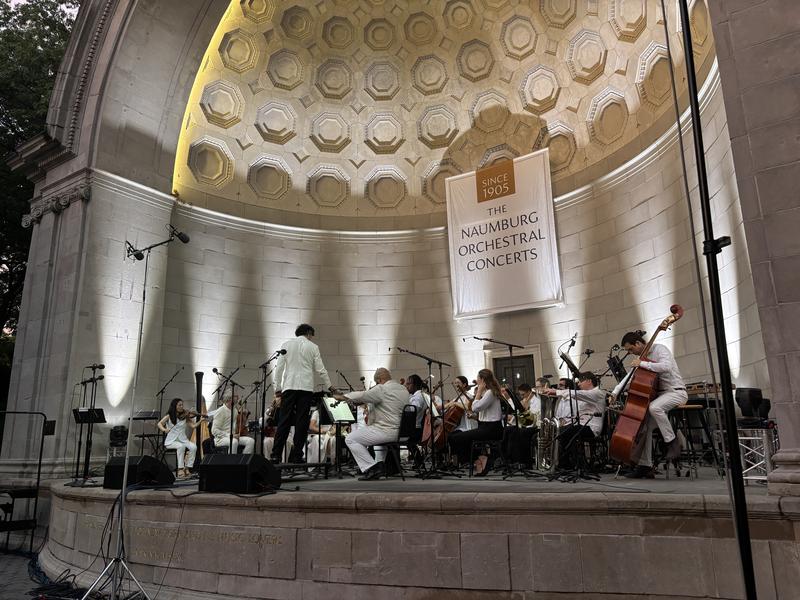
( Nicole Nelson / WQXR )
Paul Cavalconte: Welcome to the Naumburg Orchestral Concerts in Central Park.
[applause]
I'm Paul Cavalconte. Ah. Better late than never. [laughs] Paul Cavalconte, your host for this evening, New York's classical music station, WQXR.
[applause]
I am thrilled to welcome this enormous crowd to this extraordinary evening for the second Naumburg Orchestral Concert of the summer. We are broadcasting a live performance by New York's hometown band, The Knights.
[applause]
Here's a bit of The Knights' mission statement. They say, "We seek to engage with contemporary culture through vibrant performances that honor the classical tradition and our passion for musical discovery," and that's what we will hear tonight. It is a program of American music. Some pieces you'll know, some may be new to you. Some familiar pieces may be done in a new way. Please welcome one of the founders of The Knights, Colin Jacobsen.
[applause]
And the composer, violinist, and singer, Christina Courtin.
[applause]
Colin Jacobsen, tell us all about tonight's program.
Colin Jacobsen: Oh my God. It's going to unfold in so many different ways. I would say it's a very rhapsodic program. Rhapsody is a project we've been working on for several years. I look out and think of New York, and I think it's such a rhapsodic city. This was inspired by Gershwin's Rhapsody, of course, from the '20s. We commissioned all these new pieces, including one by my dear friend standing here, Christina Courtin, that we're going to start the program with.
I think when you go to the root of the word "rhapsody," you find the word "rhapsode" coming from ancient Greek, and talking about bardic kind of recitation and working oneself into an ecstatic expression of the human spirit. All the pieces on tonight's program really tell stories in very different ways and are full of webs of connection between everyone on stage and many of you. We're just really excited about this program.
Paul Cavalconte: Christina Courtin, tell us about this work we're going to hear, which is called Rhapsody on Being Giant-Proof.
Christina Courtin: When I looked up the word "rhapsody," it said, "bold." For me, my dreams are incredibly bold. As an overwhelmed parent, that moment that you have in the morning before you're fully awake and you don't really know where you are and you can catch 10 more minutes of sleep, that's when I have the wildest and craziest dreams. This piece is a little bit about the dream sequence. It's a little bit about being in New York City and being able to make music with my dear friends that I love and cherish that are on this stage tonight.
Paul Cavalconte: We're going to do just that. Let's hear it. Rhapsody on Being Giant-Proof by Christina Courtin, performed by The Knights at the Naumburg Orchestral Concerts and broadcasting live on WQXR.
[applause]
[music]
[Rhapsody on Being Giant-Proof by Christina Courtin]
And for a moment the morning belonged to me.
That old in-between laid out like a bunch of arts and crafts.
And for a moment my reflection indeed have me tied up,
tied up there on the mast.
I've been told everything under the sun,
and I took it all in as if it were the truth.
Whoa-whoa-whoa-whoa-whoa-whoa.
That old in-between, the dream and the dreamer,
there's more to it than I can see.
That old in-between, the dreamer and the dream.
A dream that had a paved runway laid out for a thousand miles,
laced with fields of poppies, lined with limestone tiles.
With my broom I swept and kept looking for that looking-glass pill.
I swallowed it whole, I turn my back, and under the covers I go.
My eyelashes united for a party you were not invited to.
You were not invited.
Pavement hit the night,
walking until dawn, I can almost see the light.
Little birdies chirping, I can almost see the light.
Deep in my pocket is the lint from another life,
and I push, and I push it down as I run to catch the bus across town.
I forgot my wallet. Can I still catch a ride?
You cannot scan my eyeball,
you can't scan my eyeball,
so I remain curbside.
It is sus to ride the bus in exchange for my DNA,
so I will run like I am someone who's been to the Milky Way.
Oh, it is sus to ride the bus with the robot at the wheel,
so I will run like I am someone who's big and primal and real,
and I will run like I am someone who's big and primal and real. But I am no charming
It's a sign I am giant proof
Impervious to the discourteous
Patient with the sentient being
Yeah, yeah, yeah
'Cause I'm no billionaire
In fact I'm, I'm Christina Courtin,
Sitting at my window
Do-ki-do-ki-do
As I watch the world go by
Then I finally made it to the east side
I looked up from the rebel rousing rubble
From the never-ending, people-pleasing puzzle
And in that moment, I remembered
It's so easy to forget
Just in softness days might be a good pal
Larger than life in male form
Bright spot amidst the chaos
Easter candy coated but I learned a lot
Fun to run on the plaid I'd injected into my blood
For the love of game and connect to God somehow,
Yeeeah.
And it's hard sometimes to remember
CNYC is such a small town
Friends showing up when you least expect it
And a place where we are all hopefully, actually accepted
Despite the biggest, baddest people, I'm the gladdest
Don't confuse my weary eyes with the sadness that I carry
It's the little things in life, ain't they extraordinary
Take my tired and your shadows,
go ahead and make it fashion
I forgive you in advance,
we all gotta make it happen
I am the piece of salt that is cutting through your snow
And you know in my great city,
hope to be on the committee
Of our youngest humans, I will have to leave them someday, oh
Where is my smart device that takes me back in time,
To red triangles pointing to the left that say rewind
Each night after the onslaught I get out my trusty broom
Going through my rusty consciousness and sweeping every room
And all the particles they be falling from my ears like fairy dust
Settling atop my pillowcase are the words
In her I trust
The moon belonged to me
There's a branch outside my window
Just blowing in the breeze
And long before I got here
And long before I will be gone,
A piece of my own cosmic singing
Of mother nature's song
Yeah Yeah
I might be small, but that's not all
I hear the screams of future G's
I'm deeply grateful to and for you
To and for, forever more
I know it's time to get up
I know it's time to get up
I know it's time, I'm coming
[applause]
Paul Cavalconte: The Knights, conducted by Eric Jacobsen, and a work by Knights member Christina Courtin, who sang and played violin on the piece called Rhapsody on Being Giant-Proof. We're broadcasting live tonight from the Naumburg Bandshell here in Central Park on WQXR.
[applause]
Paul Cavalconte: That is Christina Courtin on vocals and written that piece.
[applause]
Paul Cavalconte: Please welcome to the stage the composer of the piece that we're about to hear. This is Lisa Bielawa.
[applause]
Paul Cavalconte: Lisa, this is such a spectacular piece you wrote. We are so thrilled to play it. This is the first time we've gotten to play it here, and boy, are we so thankful because the last time we were here with the incredible Tessa Lark, unfortunately it did rain and it didn't stop. Luckily it stopped today, but we're so thankful to get to play your piece here. Can you tell us a little bit about what we're going to hear?
Lisa Bielawa: Sure. This piece was inspired by the incredible Tessa Lark, who was born in Kentucky and is not only a fierce, beautiful, virtuoso violin soloist, but she also is a really amazing old-time fiddle player. As I wrote this piece and things were changing in the American ethos around me, I started to think about what music means to American communities as they go through various historical events, how they experience them together and process them together in musical communities in Appalachia.
In shape-note singing in churches, the way I did when I was a child in my mother's church, and also in these wonderful communities that Tessa and her artistry have introduced me to in Appalachia.
Paul Cavalconte: Lisa, can you tell us one more thing about the next thing you're working on, just so we are aware of what's on Lisa's brain?
Lisa Bielawa: Wow. Okay. I have a number of pieces that I do for hundreds of musicians in public spaces where I write music for any group. They just have to have an administrative audition. I don't care how you play your instruments. You just have to be organized enough. It's performed in public space. The next one is going to be in Basel, Switzerland, with around 1,000 singers, so that's going to be amazing.
Paul Cavalconte: Amazing. Thank you so much, Lisa.
Lisa Bielawa: Thank you.
[applause]
Paul Cavalconte: Now please welcome to the stage Tessa Lark.
[applause]
[music]
Paul Cavalconte: Tessa Lark and Lisa Bielawa on stage at the Naumburg Bandshell. We're going to hear the piece now called the Violin Concerto No. 2, Pulse, with, again, violinist Tessa Lark and The Knights live at the Naumburg Bandshell in Central Park, broadcasting on Classical New York 105.9 WQXR.
[music] [music] [applause]
Paul Cavalconte: The Violin Concerto No. 2 called PULSE by composer Lisa Bielawa, featuring the violinist Tessa Lark and The Knights conducted by Eric Jacobsen, performed live here at the Naumburg Bandshell in Central Park on Classical New York 105.9, WQXR. Quite a workout for our soloist, Tessa Lark, switching to effectively electric violin for the last segment, affixing a bit of a microphone pickup to the instrument, and demonstrating her tremendous range.
It was mentioned that she could hold her own in a standoff of Appalachian fiddlers, and some of that Americana influence was heard in this piece that touched on many global influences musically. Tessa is coming back on stage for a well-deserved bow and a very appreciative crowd.
[music]
[applause]
Paul Cavalconte: A bit of a hoedown-flavored encore from violinist Tessa Lark, here at the Naumburg Bandshell, live in Central Park and on Classical New York, WQXR. Tessa is now taking a bow with The Knights standing. Of course, the composer, Lisa Bielawa, sharing the stage with her as they exit, and we are now concluding the first half of this concert by The Knights. Now coming up in the second half, we'll have more American music with works by Samuel Barber, Caroline Shaw, and Paul Simon.
I'm Paul Cavalconte, and we are broadcasting live tonight from this historic New York City location. In just a moment, one of the founders, Colin Jacobsen of The Knights, will talk to us here at the mics, discussing tonight's program along with violinist Tessa Lark. A reminder that this is the second of five concerts this summer at the Bandshell. Weather permitting, we'll be bringing all of them to you. On July 7th, we'll have the ensemble Delirium Musicum from Los Angeles, their first time here at the Naumburg Orchestral Concert Series.
On July 21st, a performance by the Orchestra of Saint Luke's. On August 4th, the Nosky Baroque Band, led by violinist Aisslinn Nosky. Of course, this is listener-supported Classical New York 105.9 FM in HD, WQXR, Newark, and 90.3 FM, WQXW, Ossining. The Naumburg Bandshell is really a treasure in New York City, and this audience is appreciating the clearing of the atmosphere, the settling of the rain. It is a cool, humid, but comfortable night, and the history of this particular Bandshell and this spot in New York City is always palpable.
Performers on this stage have included Leonard Bernstein. Spoiler alert, his daughter Jamie is here tonight to participate in the second half of the program. Pete Seeger has performed here. Victor Herbert, Irving Berlin, Zero Mostel, the Grateful Dead. They've all been here, and now Colin Jacobsen is taking a seat, and Eric as well. The Jacobsen brothers, The Knights' beating heart, you might say, and founding members. It's always great to have you guys.
Colin Jacobsen: Hey, Paul. Great to be here.
Paul Cavalconte: What a fantastic show. So far we have heard tremendously energetic and sinewy music. Boy, the violin sounds really did cut through the thick June air this evening, and a lot of musical influences brought to bear in the piece we heard.
Colin Jacobsen: Yes, by Lisa Bielawa. I think she really did the thing of the Charles Ives layering. She's got Tessa playing amazing old-time fiddle but then layering all kinds of very Lisa Bielawa quirky things on top. It's a real riotous romp in that last movement, particularly in the second movement was so tender.
Paul Cavalconte: Now, the first half of the concert featured pieces by Bielawa, who you just mentioned, and also Christina Courtin. How important is it for you to bring new voices to your concerts, and especially regarding Christina having been a member of The Knights for a number of years?
Colin Jacobsen: It's incredibly important. You think about this moment. We're so happy to be doing this program, coming on the 250th anniversary of our country and all-American music from some of our favorite American musicians and voices. We're very lucky that Christina Courtin has been a member of The Knights since the beginning. Just watching her own voice compositionally, arranging, producing. She's the one who produced The Knights' holiday album called The Knights Before Christmas, which is a fun thing, and she sings on a lot of it.
She has her own voice as a singer-songwriter and really brought that to bear in the piece that you heard. I don't know. We've played it now a couple of times, and I get-- It really touches a special place, that piece.
Paul Cavalconte: It's an interesting one because it's not a song by any means. It's much more elaborate than that, and there's tremendous composition going on behind it, or in a way, she's seated atop this mountain that you have built of composition played by an orchestra. This is another kind of musical form. Yes, she's singing, and yes, she is using her vocal inflections to do what a soloist does. I suppose if there's any constant in America, it is change, innovation, and it seems like something new is culturing here.
Colin Jacobsen: She's improvising, she's playing the fiddle. Actually, just in a few days on Friday, she'll be playing at SummerScape with Laurie Anderson, who she works with a lot these days. Many of the Knights have these really multi-layered lives in music and don't do just one thing. They do so many different things, and everyone brings that to the pot. Now Tessa Lark is to my right.
Paul Cavalconte: Tessa has joined us.
Tessa Lark: Hello.
Colin Jacobsen: That was so killing. That was so amazing.
Tessa Lark: You all were killing it too. Oh my gosh, what a fun time.
Colin Jacobsen: Burning.
Paul Cavalconte: You gave us a little bit of a spoiler alert or a prep in terms of how you've got the fiddling chops as well as the exquisite classical technique, and the way you can switch back and forth between them is just dazzling.
Tessa Lark: Oh, thank you so much. They say you can take the girl out of Kentucky, but you can't quite take the Kentucky out of me. It's amazing how Lisa Bielawa has really digested and gotten in her bones that style, and I think the way she has composed this piece, too, letting the orchestra do their orchestra thing and leaving some space for that fiddle world is really cool. I don't know another piece that really offers so much of both the classical and fiddle playing.
Paul Cavalconte: Before you just sat down, Colin and I were talking about the role that voice is playing in tonight's program, and you were absolutely speaking to us through-
Tessa Lark: Wow, thank you.
Paul Cavalconte: -the violin. It had the quality of vocalization. Wordless, albeit, but the emotional connection was there. You were telling us a story. It seems like this is a narrative program for sure.
Tessa Lark: Thank you so much. I think Colin would agree, all of us violinists, all we're trying to do most of the time is imitate the human voice. That's the biggest compliment you could receive. Maybe you've already said this, but Lisa herself is an incredible vocalist. I think it's no coincidence that there's a lot of singing.
Colin Jacobsen: She's really able to get inspired by someone like Tessa and get inside of what she does and provide a framework for you to do your thing but also to put her own spin on it in a way. It's beautiful to see how that came together. I feel so lucky that we got to play today because here we are at Naumburg Orchestral Concerts in Central Park, and I don't know, it was about 8 years ago, 10 years ago, we tried to play with Tessa here, and the rain happened. We went underneath the tunnel to the fountain and played a little bit there with a rain delay, but we never got to actually play the piece with Tessa that time.
We're so happy we got to tonight.
Paul Cavalconte: There's a New York story in and of itself.
Tessa Lark: No kidding. Yes.
Colin Jacobsen: Also, I should say I met Tessa the first time at a fiddle camp.
Tessa Lark: That's right.
Colin Jacobsen: Mark O'Connor's fiddle camp about 20 years ago.
Tessa Lark: Many, many years ago. [chuckles]
Colin Jacobsen: We've gotten to play a little bit together recently. I've just always been a great admirer. As a violinist, you get picky about violinists, but-
Tessa Lark: You really do.
Colin Jacobsen: -Tess--
Tessa Lark: The violin world isn't always-- That's not true. I was going to say it's rude, but Colin for sure is an exception.
Paul Cavalconte: He sits in the hot seat as technically first violinist, I guess you could say, of The Knights, and there is that weight that's on you.
Tessa Lark: He's the sweetest boss I know. [chuckles]
Paul Cavalconte: Confirmed.
Tessa Lark: Yes.
Paul Cavalconte: Now, Summerfest is rolling along. Tell us, Colin, about the work that you're doing in the next few months.
Colin Jacobsen: Oh, it's actually this little mini festival we realize we're having between the Naumburg Orchestral Concerts and on Sunday at Caramoor Festival in Westchester, and then next week at Bryant Park. It's all-American music. We really wanted to seize this moment. You can't tell, obviously, the whole story of American music in any number of concerts, but you can hint at some of the incredible variety of music both in the classical world and in many of these pieces, like tonight and on the other concerts, touching on other musical genres that come to bear.
At Caramoor, Conrad Tao is joining us for Rhapsody in Blue. I'm playing a piece by Jessie Montgomery, a Rhapsody for violin and orchestra that Michi Wiancko orchestrated. Then next week at Bryant Park, we have two other great fiddlers. Jeremy Kittel is joining us-
Tessa Lark: Wow.
Colin Jacobsen: -for his fiddle concerto based on Revolutionary Era and Civil War era tunes. Curtis Stewart is doing some of the 24 Negro Folk Melodies by Samuel Coleridge-Taylor. He orchestrated them. Just a few of the things in the next couple of weeks, and I'm sure Tessa is all over the place playing at festivals this summer and Moab, of course.
Tessa Lark: Yes. We're celebrating America's 250 and Moab as well with some of those familiar faces. You're right, the breadth of American music is such a far reach, and all of our music is inspired by music of the world, so it really is impossible probably to-- Even if you celebrated for an entire year, you wouldn't scratch the surface.
Paul Cavalconte: What better year than America 250 to discover so much more about our own heritage? In the second half, which we're about to get to, of this evening, concert from the Naumburg Bandshell in Central Park, works by Samuel Barber, Caroline Shaw, and an artist who comes from this town, makes it his home, and will always have an association with Central Park in a different context, Paul Simon.
Colin Jacobsen: That's right.
Paul Cavalconte: All fitting and all very much eagerly anticipated, as we're almost at part two of our broadcast tonight. Thank you, Colin Jacobsen, Tessa Lark. The Knights, a big favorite here at the Naumburg Bandshell, always.
Colin Jacobsen: Thank you, Paul.
Tessa Lark: Thank you.
Paul Cavalconte: While we wait for the second half to begin, let's listen to an excerpt of a concert recorded here a couple of summers ago. The Nosky Baroque Band, led by Aisslinn Nosky, performing a work by Locatelli, a Concerto Grosso in E-flat major. They're going to be back on August 7th for another concert right here at the Bandshell.
[music]
Paul Cavalconte: Welcome back to the second half of this concert from the Naumburg Bandshell.
[applause]
I'm Paul Cavalconte from WQXR. If you are listening on the radio, you just heard an excerpt from a concert recorded a couple of summers ago. The Nosky's Baroque Band, who will be back on this stage August 7th for the final Naumburg Orchestral concert of the season. Next, let's hear the beloved Adagio for Strings by composer Samuel Barber, performed by The Knights, conducted by Eric Jacobsen, and live here at the Naumburg Bandshell, broadcasting live over WQXR.
[applause]
[music]
[applause]
The exquisite Adagio for Strings by Samuel Barber performed by The Knights live here in Central Park on an evening dedicated to American music. That Barber piece, famously associated as a work of comfort and hope in times of trouble, including in 1963.
Colin Jacobsen: One of the greatest pleasures of being in New York City is you have these friends. We have Christina Courtin, who sang on the first half, we had Tessa Lark, and boy, it is such an honor. Please welcome to the stage the incredible Jamie Bernstein.
[applause and cheering]
We have such a beautiful piece by Caroline Shaw, who is the Debs Composer’s Chair next year at Carnegie Hall. We get to work with her there, and we thought, "Ah, this is such a wonderful piece that she wrote," and we thought we'd present it here in Central Park. It feels like the perfect place. Jamie, this is such a beautiful piece. Maybe you could tell us what it's called, and just a little bit about why to put this here in Central Park.
Jamie Bernstein: Right. This piece is amazing, and it was, it still is, a children's book called The Mountain that Loved a Bird. I never knew this book before, but Caroline Shaw, the composer, just figured out the right way to set this story. I call it an eco-fable.
[chuckles]
It's a story that's very elemental, and so I think it's the perfect piece to bring to Central Park tonight, after we had all this intense weather, and all that rain and wind, and then at the last possible second, it all lifted, and here we are in this spectacular evening. I love that I can share this piece with everybody, which brings nature right into our ears.
[applause]
There once was a mountain made of bare stone. [wind chimes] It stood alone in the middle of a desert plain. No plant grew on its hard slopes, nor could any animal, bird, or insect live there. The sun warmed the mountain, and the wind chilled it. [background music] The only touch the mountain knew was the touch of rain or snow. There was nothing more to feel.
[music]
All day and all night, the mountain looked only at the sky, watching for the movement of the billowing clouds. It knew the path of the sun that crossed the sky by day, and the course of the moon that crossed the sky by night.
On clear nights, it watched the slow wheeling of the far-off stars. There was nothing more to see, but then, one day, a small bird appeared. [music] She flew in a circle above the mountain, then landed on a ledge to rest and preen her feathers. The mountain felt the dry grasp of her tiny claws on the ledge. It felt the softness of her feathered body as she sheltered herself against its side.
The mountain was amazed, for nothing like this had ever come to it from the sky before. "Who are you?" the mountain asked. "What is your name?" [music] "I am a bird," replied the other. "My name is Joy, and I come from distant lands where everything is green. Every spring, I fly high into the air, looking for the best place to build my nest and raise my children. As soon as I have rested, I must continue my search." [music]
"I have never seen anything like you before," said the mountain. "Must you go on? Couldn't you just stay here?" Joy shook her head. [music] "Birds are living things," she explained. "We must have food and water. Nothing grows here for me to eat. There are no streams from which I could drink." "Well, if you cannot stay, will you come back again someday?" asked the mountain.
Joy thought for a while. "I fly long distances," she said, "and I have rested on many mountains. No other mountain has ever cared whether I came or went, and I should like to return to you, but I could only do so in the spring before I build my nest, and because you are so far from food and water, I could only stay a few hours."
"I have never seen anything like you before," repeated the mountain. "Even if it were only for a few hours, it would make me happy to see you again." [music] "There is one more thing you should know," said Joy. "Mountains last forever, but birds do not. Even if I were to visit you every spring of my life, there might be only a few visits. Birds do not live very many years."
"It will be very sad when your visits stop," said the mountain, "but it would be even sadder if you fly away now and never return." Joy sat very still, nestled against the side of the mountain. Then she began to sing a gentle bell-like song, the first music the mountain had ever heard.
[music]
When she had finished her song, she said, "Because no mountain has ever before cared whether I came or went, I will make you a promise. Every spring of my life, I will return to greet you and fly above you and sing to you. Since my life will not last forever, I will give to one of my daughters my own name, Joy, and tell her how to find you, and she will name a daughter Joy also and tell her how to find you. Each Joy will have a daughter Joy so that no matter how many years pass, you will always have a friend to greet you, and fly above you, and sing to you."
The mountain was both happy and sad. "I still wish you could stay," it said, "but I am glad you will return." Now I must go," said Joy, "for it is a long way to the lands that have food and water for me. Goodbye until next year." She soared off, her wings like feathered fans against the sun. The mountain watched her until she disappeared into the distance. Year after year, when every spring came, a small bird flew to the mountain, singing, "I am Joy and I have come to greet you," and for a few hours, the bird would fly above the mountain or nestle against its side, singing. At the end of each visit, the mountain always asked, "Isn't there some way you could stay?" and Joy always answered, "No, but I will return next year."
Each year, the mountain looked forward more and more to Joy's visit. Each year, it grew harder and harder to watch her go. 99 springs came and went in this way. On the 100th spring, when it was time for Joy to leave, the mountain asked once more, "Isn't there some way you could stay?" Joy answered as she always did, "No, but I will return next year." The mountain watched as she disappeared into the sky, and suddenly its heart broke. The hard stone cracked, and from the deepest part of the mountain, tears gushed forth and rolled down the mountainside in a stream.
[music]
The next spring, a small bird appeared singing, "I am Joy and I have come to greet you." This time, the mountain did not reply. It only wept thinking of how soon she would have to leave and of all the long months before she would come again. Joy rested on her ledge and looked at the stream of tears. Then she flew above the mountain and sang as she always had. When it was time for her to go, the mountain still wept. "I will return next year," said Joy softly, and she flew away.
When the next spring came, Joy returned, carrying in her beak a small seed. The mountain still wept a stream of tears. Joy carefully tucked the seed into a crack in the hard stone, close to the stream, so that it would stay moist. Then she flew above the mountain and sang to it.
[music]
Seeing that the mountain was still unable to speak, she flew away once more. During the weeks that followed, the seed in the crack of the rock began to send down tiny roots. The roots reached into the hard stone, little by little, spreading into yet smaller cracks, breaking through the hardness. As the roots found water in the cracks and drew food from the softening stone, a shoot rose from the seed into the sunlight and unfolded tiny green leaves. The mountain, however, was still deep in sorrow. Blind with tears, it did not notice a plant so small.
The next spring, Joy brought another seed, and the spring after that, another. She placed each one in a protected place near the stream of tears and sang to the mountain. The mountain still only wept. Years passed in this way, the roots of the new plants softening the stone near the stream of tears. As softened stone turned to soil, moss began to grow in sheltered corners. Grasses, little flowering plants, sprouted in hollows near the stream. Tiny insects, carried to the mountain by the winds, scurried among the leaves.
Meanwhile, the roots of the very first seed went deeper and deeper into the heart of the mountain. Above the ground, what had started as that tiny shoot was growing into the trunk of a young tree, its branches holding green leaves out to the sun. At last, the mountain felt the roots reaching down like gentle fingers, filling and healing the cracks in his heart.
[music]
Sorrow faded away, and the mountain began to notice the changes that had been taking place. Seeing and feeling so many wonderful new things, the mountain's tears changed to tears of happiness.
Each year, Joy returned, bringing another seed. Each year, more streams ran laughing down the mountain's sides, and the ground, watered by the new streams, grew green with trees and other plants. Now that the mountain no longer wept with sorrow, it began to ask once more, "Isn't there some way you could stay?" But Joy still answered, "No, but I will return next year."
More years passed, and the streams carried life far out into the plains surrounding the mountain, until finally, as far as the mountain could see, everything was green. From land beyond the plain, small animals began to come to the mountain. Watching these living things find food and shelter on its slopes, the mountain suddenly felt a surge of hope. Opening its deepest heart to the roots of the trees, it offered them all its strength. The trees stretched their branches yet higher toward the sky, and hope ran like a song from the heart of the mountain into every tree leaf.
Sure enough, when the next spring came, Joy flew to the mountain, carrying not a seed but a slender twig. Straight to the tallest tree on the mountain, she flew, to the tree that had grown from the very first seed. She placed the twig on the branch in which she would build her nest. "I am Joy," she sang, "and I have come to stay."
[music fades]
[applause]
Paul Cavalcante: We just heard The Mountain That Loved the Bird by composer Caroline Shaw, based on a children's book by Alice McLerran, narrated by Jamie Bernstein, with The Knights performing the work on this summer evening from the Naumburg Bandshell in Central Park. I'm Paul Cavalcante with you on Classical New York 105.9 WQXR. Applause for Jamie and for Eric conducting, and the work that you heard, commissioned by Carnegie Hall, Caroline Shaw rose to the occasion.
Speaker 2: Thank you so much, Jamie Bernstein and Caroline Shaw, for that incredibly hopeful piece in these times.
[applause]
The next piece is the last official song on the program. It's Paul Simon's American Tune. We did this a number of years ago. We made a video at Caramoor during the pandemic, and it was of Brandenburg's Third Concerto. We made this the second movement because Paul Simon borrowed a chorale from Bach's St. Matthew Passion, which is the backbone of this tune. We thought we could go from the world of Brandenburg to Paul Simon and back to Brandenburg, and of course, the amazing Christina Courtin, who you already heard from, played the fiddle on the first movement, went and sang, and then went back and played more, as she does.
I should say that there's a moment in this piece, several moments, where on the stage right, you'll hear Megan Conley playing the harp, and on the other end of the stage, Shawn Conley playing the bass. Just a nice little story that I'm going to embarrass them with because they play the biggest instruments here, right? They met at Rice University because they were the last ones out of the orchestra room, and Shawn, being the gentleman that he is, would hold the door for Megan. That's how it happened.
[applause and cheering]
Here they are, and they are able to fit both those instruments in a Subaru Outback. Is it? Okay.
[applause and cheering]
Paul Simon, American Tune. Please welcome back Christina Courtin.
[applause and cheering]
[music] Many’s the time I’ve been mistaken
And many times confused
Yeah, and I’ve often felt forsaken
And certainly misused
But it's all right, I’m all right
I’m just weary to my bones
Still, you don’t expect to be bright and bon vivant
So far away from home, so far away from home
And I don’t know a soul who’s not been battered
I don’t have a friend who feels at ease
I don’t know a dream that’s not been shattered
Or driven to its knees
But it’s all right, I'm all right
For we've lived so well so long
Still, when I think of the road
We’re traveling on
I wonder what's gone wrong
I can’t help but wonder what’s gone wrong
And I dreamed I was dying
I dreamed that my soul rose unexpectedly
And looking back down at me
Smiled reassuringly
And I dreamed I was flying
And high up above my eyes could clearly see
The Statue of Liberty
Sailing away to sea
And I dreamed I was flying
We come on the ship they call The Mayflower
We come on the ship that sailed the moon
We come in the age’s most uncertain hour
And sing an American tune
Yeah, and it’s all right, I'm all right
You can’t be forever blessed
Still, tomorrow’s going to be another working day
And I’m trying to get some rest
That’s all I’m trying to get some rest
[applause and cheering]
Paul Cavalconte: Paul Simon's American Tune performed by The Knights live at the Naumburg Bandshell in Central Park. The singer was Knights' member, Christina Courtin.
[applause and cheering]
Christina Courtin: We'll do one more, a quick song. This is a song called I'll Fly Away, traditional song. I'm going to sing it with my dear pal, Alex Sopp.
[applause and cheering]
Speaker 2: Everyone, Christina Courtin. Oh my gosh.
[applause and cheering]
We're The Knights. We loved being here at the Naumburg Bandshell. [unintelligible 01:45:26]
[applause and cheering]
[music]
Some bright morning when this life is over
I'll fly away
To that home on God’s celestial shore
I'll fly away
I'll fly away, oh glory
I'll fly away (In the morning)
When I die, Hallelujah, by and by
And I'll fly away
When those shadows of this life are gone
I'll fly away
Like a bird from these prison walls I'll fly
And I'll fly away
I'll fly away, oh glory
I'll fly away (In the morning)
When I die, Hallelujah, by and by
And I'll fly away
Oh, how glad and happy when we meet
And I'll fly away
No more cold iron shackles on my feet
And I'll fly away
I'll fly away, oh glory
I'll fly away (In the morning)
When I die, Hallelujah, by and by
And I'll fly away
Just a few more weary days and then
I'll fly away
To a land where joy will never end
I'll fly away
I'll fly away, oh glory
I'll fly away (In the morning)
When I die, Hallelujah, by and by
I'll fly away
I'll fly away, oh glory
I'll fly away (In the morning)
When I die, Hallelujah, by and by
I'll fly away
When I die, Hallelujah, by and by
I'll fly away Yeah, when I die, Hallelujah, by and by
I'll fly away
[applause and cheering]
Paul Cavalconte: I'll Fly Away, an encore by The Knights, a song by American gospel composer Albert E. Brumley. The singer, once again, was Christina Courtin. She also played violin, and she arranged that piece for The Knights. What a great evening of American music here in Central Park. It spoke America's heart. It told our story. The appreciative crowd cheers for The Knights as conductor Eric Jacobsen waves goodbye.
Members begin to depart the stage. It looks like this one is for the books, but our next concert from the Naumburg Bandshell will be Tuesday, July 7th, with a group called Delirium Musicum, playing works by Saint-Saëns, Philip Glass, Franz Schubert, Jessie Montgomery. A real mix of centuries from this LA-based ensemble. We'll be broadcasting that live from right here in Central Park.
Our great thanks to Christopher London, president of the Naumburg Orchestral Society, and Anthony Bracewell, the executive director, and the Naumburg staff, including stage manager extraordinaire, Patti Dines. Also, thanks to Wilson's Showtime Services and our friends at Summer Stage. A big thanks to the WQXR team, including engineers George Wellington, Ed Haber, Noriko Okabe, and Neal Shaw. Our production team, Eileen Delahunty, Lauren Purcell-Joiner, Christine Herskovits, and Nicole Nelson. I'm Paul Cavalconte. Thank you for listening. This is listener-supported Classical New York WQXR 105.9 FM and HD, Newark, WQXW 90.3 FM, Ossining.
[background chatter]
[01:53:13] [END OF AUDIO]
Copyright © 2026 New York Public Radio. All rights reserved. Visit our website terms of use at www.wqxr.org for further information.
New York Public Radio transcripts are created on a rush deadline, often by contractors. This text may not be in its final form and may be updated or revised in the future. Accuracy and availability may vary. The authoritative record of New York Public Radio’s programming is the audio record.