
( Nicole Nelson / WQXR )
[applause]
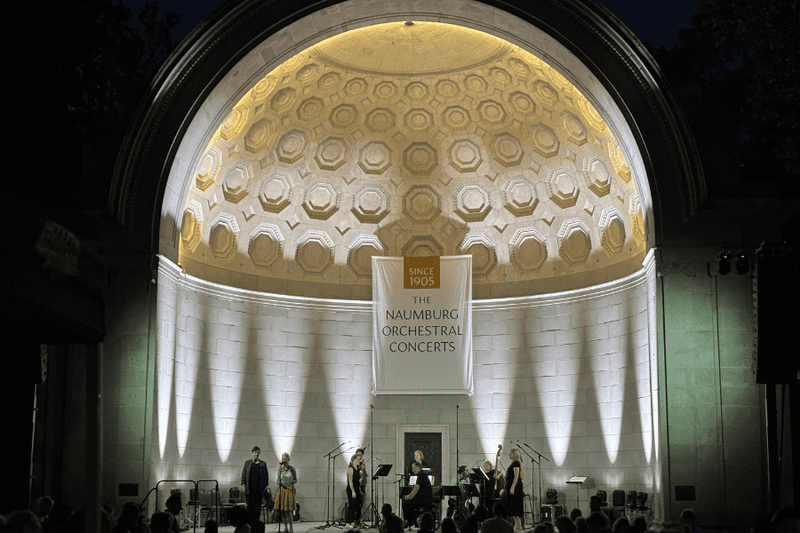
Annie Bergen: Live from the Naumburg Bandshell in Central Park, I'm Annie Bergen, weekend host on WQXR, New York's classical music station. Thank you so much for coming tonight. We are thrilled to welcome such a large crowd on this beautiful summer night for the final Naumburg Orchestral Concert of this season. Tonight, we're broadcasting live with a group performed by Baroque violinist Aisslinn Nosky. Aisslinn has become a regular here at the Naumburg Band Show Concerts. This is her band's fourth year in a row in Central Park. We're going to talk with her right now. Aisslinn, welcome.
Aisslinn Nosky: Thank you so much.
[applause]
Annie Bergen: Four years in a row, what keeps you coming back?
Aisslinn Nosky: Oh, it's definitely the crowd.
[laughter]
Aisslinn Nosky: No, it's true, I'm not trying to butter you up. We look forward to this all season. We get to play in different combinations together all around the country and sometimes in Europe, but we always-- whenever we see each other, we talk about how much fun we have here in the park with these wonderful audience members, so thank you for welcoming us back.
[applause]
Annie Bergen: Tell us about the program tonight. Is there a thread that connects all of these works?
Aisslinn Nosky: Yes, it's a little bit, I'd say, based around the idea of the evolution of the concerto from the early Italian style right up until the high German Baroque of J.S. Bach. That's maybe a more academic way of saying it's a bunch of pieces that we really like to play together, and some of them have trumpet.
[laughter]
Annie Bergen: Including the first work we're going to hear, correct?
Aisslinn Nosky: That's right, yes.
Annie Bergen: Tell us about that.
Aisslinn Nosky: This is a piece by the Italian composer Torelli, who was actually very pivotal in making the trumpet become a prominent, or showcasing that it could be a prominent concerto instrument. He wrote many, many concertos for trumpet, as well as several for violin, and I think he's a really underrated composer myself, so I'm glad to be featuring two of his works tonight.
Annie Bergen: Let's hear it. Aisslinn Nosky's Baroque Band at the Naumburg Bandshell in Central Park performing Giuseppe Torelli's Trumpet Concerto in D.
[applause]
[music]
[applause]
[music]
[applause]
Annie Bergen: A work by Giuseppe Torelli and his Trumpet Concerto in D, performed by trumpet soloist Steven Marquardt and Nosky's Baroque Band live on WQXR from the Namburg Bandshell in Central Park. Well, the next piece on our program is a Concerto Grosso by Arcangelo Corelli. The Concerto Grosso is a form that Corelli really brought to the cultural forefront, and it divides the ensemble into two contrasting forces. On one side, you have a small group of soloists, and on the other, you have the rest of the orchestra. 12 of these works he composed were published posthumously, and that collection also inspired future composers like Handel to write collections of concerti grossi that have become staples.
[music] [applause]
[music] [music]
[applause]
Annie Bergen: Violinist Aisslinn Nosky leading her Baroque Band in Arcangelo Corelli's Concerto Grosso, Op 6 No. 10 on WQXR. I'm Annie Bergen, and we're live from Central Park, bringing you the final concert in this season's Naumburg Orchestral Concert series. It's a beautiful night. We started off with a little music by Giuseppe Torelli. We're going to hear a little more from him now, his Violin Concerto, Op 8 No. 9 in E minor. While Corelli was known for growing the Concerto Grosso, this piece really points the way to the modern violin concerto.
Torelli is one of the first composers to completely separate the soloist from the orchestra, and the soloist who is going to bring that part to life tonight is the leader of this great band, violinist Aisslinn Nosky. There are hundreds of people in attendance here in the park. Folks have gathered with their friends and family, their pets, bringing picnics and snacks to partake in this wonderful summer tradition. Free concerts at the Naumburg Bandshell. Here is Giuseppe Torelli's Violin Concerto, Op 8 No. 9 in E minor, performed by Nosky's Baroque Band live at the Naumburg Bandshell in Central Park.
[music]
[applause]
[music] [applause]
Annie Bergen: Live from Central Park, violinist Aisslinn Nosky and her ensemble Nosky's Baroque Band getting a standing ovation from a large part of our audience tonight. What a terrific performance. Giuseppe Torelli's Violin Concerto Op 8 No. 9 in E minor. Torelli was the first composer to write a concerto for solo violin and string orchestra.
It is a beautiful night in Central Park. We have one more piece before intermission, and it's a bit of a contrast with the other works on the program. It's Telemann's Burlesque de Quixotte Suite. As you might have guessed by the title, it paints a picture of the adventures of Miguel Cervantes' hero Don Quixote and his love for Dulcinea. If you listen carefully, you can hear sighing violins depicting his longing for Dulcinea, the sound of the old horse clopping along, and the hee-haw of Sancho Panza's donkey.
[music]
[applause]
[music] [applause]
[music]
[applause]
Annie Bergen: Musical storytelling on WQXR, Telemann's Burlesque de Quixotte Suite, inspired by the novel by Cervantes, Don Quixote, depicting iconic moments including his attack on the windmills, his longing for Princess Dulcinea, and Sancho Panza being tossed into the air. Nosky's Baroque Band live in Central Park on Classical New York, WQXR. This is Classical New York WQXR 105.9 FM, and HD Newark 90.3 FM, WQXW Ossining, and WNYC FM HD2 New York. I'm Annie Bergen.
It's intermission here at this concert live in Central Park with Nosky's Baroque Band. It's been largely a night of concertos, and we have more coming up in the second half. We've got a violin concerto by J.S. Bach and a concerto for trumpet and strings by Georg Philipp Telemann. We're thrilled right now to welcome the trumpet soloist for this evening, Steve Marquardt. Welcome.
Steve Marquardt: Thanks so much for having me.
Annie Bergen: How did that go there?
Steve Marquardt: I thought it went great. It's always good to get the hardest part out of the way at the top of the show.
Annie Bergen: It was a difficult part at the beginning, then.
Steve Marquardt: Sure. The one dedicated concerto for the trumpet tonight because the program actually, it says it's a concerto for trumpet, the final piece on the show, but it's actually more of a violin concerto with a trumpet part. Then the cello also gets its moment in the sun, too. I think how things were termed back then was a little bit more fluid than maybe we're used to today. It's more so indicating that it's a concerto that has a trumpet part, which is particularly special at that time.
Annie Bergen: What drew you to the Baroque trumpet to begin with? Was it a recording or a performer you saw, and, "That's it for me"?
Steve Marquardt: My story, I was always really interested in the Baroque trumpet. I was always really fascinated by it. I listen to all of those old John Eliot Gardiner recordings of all the masses and the cantatas and the oratorios and things. I was particularly struck by the Dona Nobis Pacem from the B Minor Mass. It just sounds so beautiful and angelic with the Baroque instruments versus the typical bright qualities of the piccolo trumpets, because these instruments are so much longer, there's so much more plumbing and tubing. We can certainly get into that later. I was always just fascinated by it. Ended up going to Indiana University, and they happen to have an early music program, and I just dove in headfirst and fell in love with it. Now I'm sitting here talking to you.
Annie Bergen: It does look different from the trumpets we're used to seeing. What's the difference?
Steve Marquardt: I think the best way to describe it is its modern counterpart is about half the length. If you uncoil all of the tubing of a modern trumpet, it's only about 4.5 feet of tubing or so. If you did the equivalent in B-flat on the Baroque side, it would be about 9 feet of tubing. It has a lot more timbre qualities that you can explore. It's much darker. I think that's the biggest difference is just the length of tubing is so much less on the modern trumpet versus Baroque.
Annie Bergen: Technically challenging.
Steve Marquardt: It's far more challenging because you're playing on twice as much tubing, and you're also playing in the highest part of the instrument, because in the low registers of the instrument, you only have a few notes. In the low register, it's, "Papapa, papapa, papapum." That's all you have. Then in the next register, you have the next octave, you have a full scale. The composers would figure out how to optimize the instrument and such.
Annie Bergen: Have you performed in Central Park before?
Steve Marquardt: I haven't, no. I visited many times.
Annie Bergen: Oh, wow. You debuted?
Steve Marquardt: Yes. I've lived in New York for 11 years now, but I've never gotten the chance to sound the trumpet here.
Annie Bergen: Oh, it's so nice to hear you tonight.
Steve Marquardt: Thank you.
Annie Bergen: What's it like to work with this band, with Nosky's Baroque Band?
Steve Marquardt: Oh my gosh. These are all colleagues who are near and dear to my heart. Sorry. Yes, I work with most of them up at Handel and Haydn in Boston, and they're really incredible and really beautiful souls. Really beautiful musicians. Aisslinn's, obviously, the absolute best and just such a joy to work with. I was so thrilled when this offer came in. I cleared everything and said, "This is going to be a great way to finish the summer."
Annie Bergen: Does it offer you a different opportunity when working with her in this band than other ensembles or accommodations do you have?
Steve Marquardt: Yes, I think so. I think having it be a self-governed thing I think is really freeing. Of course, it's great to work with large ensembles, sacred choral works with the conductor and such, but it's so much fun, especially as a trumpeter, getting to explore smaller ensembles. Normally, we are playing things like Messiah, B Minor Mass, Christmas Oratorio, or things that have 120 people on stage. This is so neat to just do something with 8 or 10.
Annie Bergen: You started to talk about it a little bit, the concerto. We're going to hear it tonight at the end of the program. How does it differ from the first?
Steve Marquardt: The first piece is definitely more of a-- it's really just a feature for the trumpet. It's one of the earliest trumpet concertos. It's the main solo voice in the whole thing. It's really regal and explores the fanfares and the clarino registers and things. This last piece is more of a concerto grosso. I think it really is more of a piece that features everybody. It's a hugely prominent violin part, actually, and the trumpet learns to take a back seat at times. The cello jumps out in the texture at times randomly, and it's like, "Oh, that's his moment in the sun." It's really neat.
The cool thing Aisslinn pointed out in rehearsal is that we think that the bones of the piece are probably by Telemann. Then that Pisendel, who was a very virtuosic violinist back in the Baroque, probably got a hold of it and added this insanely virtuosic violin part. You'll notice that there's a bunch of spots where the violin just goes off on its own, and everyone's playing just downbeats for a while, and she's just sawing away. We think that might be by Pisendel, but it's a really interesting piece, and it doesn't get performed nearly enough.
Annie Bergen: Great. We're looking forward to hearing that. Thank you so much, Steve Marquardt, for speaking with us. We'd love to get ready for the second half of the concert. It is intermission here in the concert by Nosky's Baroque Band. I'm Annie Bergen from WQXR, and we are broadcasting live from the Bandshell in Central Park.
Just a couple of minutes from now, we'll hear more. Before we do, let's hear a little music from an earlier performance from the Naumburg Orchestral Concert series. This is from a Naumburg Bandshell performance in the summer of 2015. The Tchaikovsky's Serenade for Strings, performed by the East Coast Chamber Orchestra.
[music] [applause]
Annie Bergen: Welcome, everybody, to the second half of our concert by Aisslinn Nosky's Baroque Band.
[applause]
Annie Bergen: I'm Annie Bergen. We are broadcasting this concert live on WQXR tonight. If you're listening on the radio, that was the East Coast Chamber Orchestra performing Tchaikovsky's Serenade for Strings, a performance from an earlier Naumburg Orchestral Concert series. The night is still young, and we have lots more great music from Nosky's Baroque Band. Here to talk with me about the second half is the founder of this great ensemble, Violinist Aisslinn Nosky. Welcome back.
Aisslinn Nosky: Thank you.
[applause]
Annie Bergen: Tell us about the Baroque Band. How did you bring this group of musicians together?
Aisslinn Nosky: Well, I met all of these wonderful musicians on stage in different gigs up and down the East Coast and in other places, and always had a marvelous time playing with them. When I finally had an opportunity to bring a group of friends of mine together to play as an orchestra in New York, I called all of these lovely people, and they said yes, and here the rest is a beautiful history.
Annie Bergen: We've been listening to some fabulous Baroque concertos through the night. What draws you to this period?
Aisslinn Nosky: The violin gets to do a lot of fun stuff.
[laughter]
Aisslinn Nosky: In fact, a little-known fact about this next piece, it's reconstructed from an old manuscript for keyboard. Actually, I transcribed the concerto for violin myself. I did it in 2011, and tonight me is wondering why 2011 me put so many notes in the violin part, but we're going to see. I love that aspect of this too, that there's a lot of creativity. You can add your own elements of your personal feelings into the music. It's a wonderful aspect of 18th-century music.
Annie Bergen: We're also going to hear Telemann again.
Aisslinn Nosky: Yes. The Telemann is a completely new piece to me because our wonderful trumpeter, Steven Marquardt, suggested it. I feel like I found a new really good friend. I'm absolutely thrilled to bring it to everybody tonight.
Annie Bergen: Now, are you performing on modern instruments or is there a physical difference in the instruments?
Aisslinn Nosky: Yes, these are instruments from the 18th century themselves. Mine is 1746 from-
Annie Bergen: Wow.
Aisslinn Nosky: -Barcelona, from Spain. I stole it. Just kidding. No, these other ones on stage are copies of instruments from the 18th century, and the instruments themselves have, I think you'll agree, a unique tonal quality. You'll see that Steven, our trumpet player, doesn't have valves on his instrument. He's doing all of that virtuosity with his ambisure, and it makes for a—yes, I know—exciting stuff.
[applause]
Annie Bergen: Aisslinn Nosky, we'll let you get set up now for the second half of our concert live from the Naumburg Bandshell in Central Park on WQXR. We're going to hear JS Bach, Violin Concerto, BWV 1052.
[applause]
[music]
[applause]
[music]
[applause] [music]
[applause]
Annie Bergen: Violinist Aisslinn Nosky, Nosky's Baroque Band, with JS Bach, Violin Concerto, BWV 1052. Live in Central Park with the Naumburg Bandshell. Thrilling ovation for a thrilling performance. This is the last performance in the summer's Naumburg Orchestral Concert Series. Well, the last piece on tonight's program is a Concerto for Trumpet & Strings by Georg Philipp Telemann. We'll hear again from Trumpet Soloist Steve Marquardt and Violinist Aisslinn Nosky on this piece. Though it might be styled as a trumpet concerto, many experts consider it more of a violin showcase.
The violin part is supposedly influenced by one of the leading German violinists of Telemann's Day and features quite a few devilishly difficult passages that really show off the instrument's technical capabilities. Once again, Steve Marquardt is the trumpet soloist; Aisslinn Nosky, the violinist, with Nosky's Baroque Band, in Telemann's Concerto for Trumpet & Strings, live from the Naumburg Bandshell in Central Park.
[music]
[applause]
[music]
[applause]
Annie Bergen: Live from the Naumburg Bandshell in Central Park, Violinist Aisslinn Nosky and trumpet player Steve Marquardt, along with their fabulous ensemble Nosky's Baroque Band, with Telemann's Concerto for Trumpet & Strings. The band taking their bows to a really appreciative audience standing and clapping loudly for-- It's been a wonderful night of Baroque concertos. Perfect weather, perfect setting for classical music from Central Park. The members of the band taking their bows once again, Nosky's Baroque Band. What a night.
[applause]
Annie Bergen: You're listening to Classical New York WQXR 105.9 FM in HD Newark, 90.3 FM WQXW Ossining, and WNYC FM HD2 New York. This has been the last broadcast of the season from the Naumburg Orchestral Concerts. We've been thrilled to be able to bring you these concerts every summer. Our great thanks to Christopher London, president of the Naumburg Orchestral Society, and Anthony Bracewell, the executive director, and the Naumburg staff, including stage manager extraordinaire Pati Dynes.
Also thanks to Wilson's Showtime Services and our friends at SummerStage. A big thanks to the WQXR team, including engineers George Wellington, Ed Haber, Duke Markos, and Kelvin Grant; and our production team, Lauren Purcell-Joiner, Laura Bojman, Eileen Delahunty, Christine Herskovits, Nicole Nelson, and Aimée Buchanan. I'm Annie Bergen. Thank you so much for listening.
Copyright © 2026 New York Public Radio. All rights reserved. Visit our website terms of use at www.wnyc.org for further information.
New York Public Radio transcripts are created on a rush deadline, often by contractors. This text may not be in its final form and may be updated or revised in the future. Accuracy and availability may vary. The authoritative record of New York Public Radio’s programming is the audio record.