
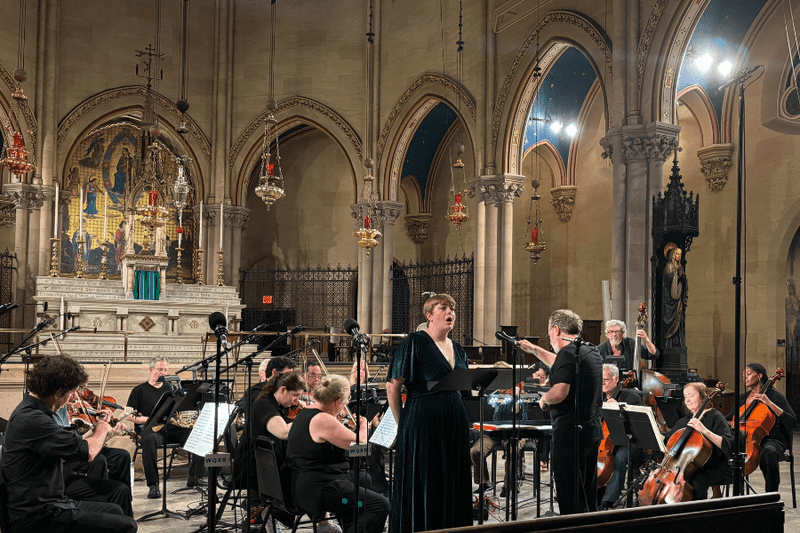
( Nicole Nelson / WQXR )
Terrance McKnight: Welcome to the Naumburg Orchestral Concerts. I'm Terrance McKnight from New York's classical radio station WQXR.
[applause]
Terrance McKnight: Oh, it's exciting. You all at home, we've got a live audience here in the church. We have a live audience in the church. We moved from the park to the church. We canceled the concert in the park, we're in the church. You can probably hear that there are no birds, there are no planes flying above. We're here in the church where the acoustics are great. It's going to be a wonderful concert of all Mozart.
We've been broadcasting these live performances by Orchestra of St. Luke's, which is one of New York's cultural institutions. I talked about the Knicks a little earlier today. I was a little kid when they won a championship in 1973. I remember that team. Well, the city was celebrating. There were a group of musicians organizing around that time at St. Luke's Church here in New York City, organizing a group of about 20 musicians. They started playing then, after the Knicks won that championship in '73, and they've been playing for the next 50 years.
They're still here, they saw the next championship. They're behind me here now. They're going to bring us an all-Mozart program, music that was designed for outdoors. We're going to hear how it works indoors today. We're going to do that all live in front of a radio audience. Are you all still with me?
[applause]
Terrance McKnight: Yes. Now, I get to say this man's name on radio often, but I never met him until tonight. He's conducting this performance, and he's going to tell us about it. Please welcome to our stage, Mr. Brad Lubman.
[applause]
Terrance McKnight: Brad Lubman, ladies and gentlemen.
Brad Lubman: Good evening.
Terrance McKnight: Okay, Brad. My question is, moving from-- I know the first piece on the program is a divertimento by Mozart. He wrote this music for outdoors, oftentimes, these divertimenti. When you're bringing it inside, do you have to make other choices? Do you all have to play differently? Do you have to change the repertoire? What happens?
Brad Lubman: We just play very loud. No, we play very fast because of the heat. No, there's a lot of music that was written that was intended either for outdoors, or for ceremonies, or weddings and parties, but that became part of the concert repertoire. We don't do anything different. We enjoy it as much as we're playing it outside or inside.
Terrance McKnight: There's no difference.
Brad Lubman: There's no difference, except it's much hotter now inside. [chuckles]
Terrance McKnight: For this concert, you all chose an all-Mozart program.
Brad Lubman: Yes.
Terrance McKnight: Why so?
Brad Lubman: Why not? It's an amazing program. Obviously, to say Mozart was one of the greatest composers it's an obvious statement. Also, there's something about a summertime outdoor concert. Certain music, I think, fits very, very well. Mozart, definitely. I always wondered, some people have chosen Mahler 9 for an outdoor concert, and I love Mahler 9, but to me, I never saw the connection with the outdoors. You know what I mean? Certain repertoire fits not only an outdoor concert, but a summertime concert. Tonight's program is an example of that.
Terrance McKnight: This program extends through a lot of Mozart's life. Some of the music was written when he was 16 years old. We got some arias in here. How much of his career do we get to hear in this concert?
Brad Lubman: You get a really great overview. Two pieces are from when he was 16. The bulk of the other pieces are from much later. In fact, one or two from 1789, that's only a few years before he died. You get a sense of the middle period, but it's like if you're looking at an art book, a retrospective, let's say, of the paintings of artist X, and you thumb through the book. It's very, very cool, because you see the early work. That evolved into the middle, and look at the late stuff. You get this kind of-- here, maybe not so much in the middle, but he only lives 35 years, so that's also relative. Maybe we are getting a great overview of everything that he did in tonight's program.
Terrance McKnight: Tonight includes some arias.
Brad Lubman: Yes.
Terrance McKnight: Mozart loved singers, he married one. Tell us about the arias that we're going to hear tonight. Do they come from that part of his life after marriage, or are these earlier?
Brad Lubman: No, there are some earlier. There's Idomeneo, there's The Marriage of Figaro, a couple of arias. There's some late arias that were known as insertion arias, written to go into other people's operas. A singer would say, "Hey, Mozart, can you write me something to put into this other person's opera?" There are a couple of those, and the opera aria segment itself is a great dramatological exposition. Just the arias themselves make a wonderful thing in and of themselves.
Terrance McKnight: Let's get to it.
Brad Lubman: Yes, great. Thank you.
Terrance McKnight: Okay. Here we are, Saint Mary the Virgin, West 46th Street in New York City, live from the church, Naumburg Orchestral Concert series. Here is conductor Brad Lubman leading the Orchestra of St. Luke's in a performance of Mozart's Divertimento for String Orchestra in D Major on WQXR.
[music]
[applause]
Terrance McKnight: We're live here at Saint Mary the Virgin. We're here in New York City. That was Mozart's Divertimento for String Orchestra in D Major. That's young Mozart, 16-year-old. It was performed by the Orchestra of St. Luke's, their conductor, Brad Lubman, tonight. This broadcast comes to you live as part of the Naumburg Orchestra Concert Series, and up next on this all-Mozart program, we've got an Adagio and Fugue. It's in C minor. For this one, Mozart went back to an old fugue that he had written as a young person.
He had written that work for two pianos, and he rearranged it and added a little slow movement to it. That's what we're going to hear tonight. After he wrote this piece using this counterpoint, he wrote that big Jupiter Symphony. Maybe he was just getting warmed up for that. While the orchestra is retuning, I'm Terrance McKnight here with you. Naumburg Orchestra Concert was-- We moved the concerts inside today because of the weather. We're here at the beautiful church listening to this all-Mozart program. Brad Lubman, very exciting conductor to listen to. Here is this music by Mozart on WQXR, Adagio and Fugue.
[music]
[applause]
Terrance McKnight: Oh, we are here at Saint Mary the Virgin, listening to a concert, Orchestra of St. Luke's here on WQXR. Music by Mozart, his Adagio and Fugue in C Minor. Brad Lubman conducting the Orchestra of St. Luke's in this Naumburg Orchestral Concert. Live from WQXR, not in the park tonight. We're in the church. Because of inclement weather, we brought all the music lovers and the orchestra here in the church with us.
[music]
Terrance McKnight: When I walked into the church today, I could hear the orchestra playing, but backstage I could hear a singer warming up. Big voice, big, robust voice. I'm like, "Who is this?" Her name is Erin Wagner. She's going to be joining the orchestra on stage for the next music, a group of Mozart arias. We're going to hear two arias written for operas by other composers, composed by Mozart, then followed by arias from The Marriage of Figaro and Idomeneo. Erin Wagner, she's a graduate of The Juilliard School and Manhattan School of Music.
She's got a lot of engagements coming up this season. She'll be featured on two Mahler symphonies, and she's going to return to the Met Opera with her production of Medea.
[applause]
Terrance McKnight: Erin's also a regular on WQXR. She's been on our Young Artist Showcase, appearing as a prize winner for various competitions around the country. Here she is. She's on stage. Brad Lubman standing in front of the orchestra. They are about to get started with music arias by Amadeus Mozart on this broadcast, Naumburg Orchestral Concert Broadcast. Special location tonight on WQXR. Glad to have here with us Erin Wagner.
[music]
[applause]
[music]
[applause]
[silence]
[music]
[applause]
[silence]
[music]
[applause]
[pause 00:48:17]
[music]
[applause]
Erin Wagner: If you'll have us, we'll do one more. [chuckles] We'll do one more if you'll have it.
[cheering]
[applause]
[pause 00:53:13]
[music]
[applause]
Terrance McKnight: Erin Wagner, live at St. Mary the Virgin Church here in New York City, performing music by Mozart. We got a bonus aria. She came here prepared to sing a selection of arias, and she just gave us a bonus. That one, Accept My Thanks, so I guess we should say, you're quite welcome. I'm Terrance McKnight, here with you on WQXR. Thanks to Erin and Orchestra, Brad Lubman conducting tonight. First time I got to see Brad Lubman conduct.
I always get to say his name on the radio, but I never got to see him work, and how exciting it was to see him work. He's one of those conductors; I'm watching the players. You can tell they like working with him. I mean, they enjoy working with one other. You could see it in their faces. I'm sitting here with someone right now who puts all this together for this orchestra. He's my good friend now. I've been knowing Jim for a long time now. Jim Roe, thanks for being here.
Jim Roe: Terrance, it's great to see you, and, boy, it's great to hear this music in this historic place. It just gives you such faith in humanity.
Terrance McKnight: Yes. Jim is the president and executive director of the Orchestra of St. Luke's, and I thought at one point he was going to get up and sing. When she sang that Elektra aria, man, you just had to get up and-
Jim Roe: Participate.
Terrance McKnight: -participate. That's right. That's right.
Jim Roe: Music is so physical. It's physical to make it, and it can really move the body. If you think tonight in this room, every square inch of the place is filled with people sitting on the floor, on the benches, climbing the rafters. The audience for classical music is so strong and so dedicated.
Terrance McKnight: Yes. The movement that you're talking about, that's what I picked up from your conductor, Brad Lubman. His physical performance of the music reminds me a little bit of Nicholas McGegan-
Jim Roe: Sure.
Terrance McKnight: -who I think worked with your orchestra [crosstalk].
Jim Roe: Nick has worked with us many times, and just filled in in June for our Bach festival. He'll be back next June with us. I have a great story about Nick with Orchestra of St. Luke's. We were rehearsing for a concert at Carnegie Hall that was canceled. Do you remember back when there was horrible weather and the crane over Carnegie Hall bent. The concert was canceled. Nick was there for the rehearsal. We found out the concert was canceled and they all decided to rehearse anyway just because they were together. That's the spirit of this orchestra.
Terrance McKnight: There's another conductor that comes to mind when I think of Orchestra of St. Luke's, who has that same sort of energy and relationship with the musicians, Donald Runnicles.
Jim Roe: Of course.
Terrance McKnight: It seems like, Jim, that you're picking conductors who enjoy working with these players, and that really does make a difference in the music making.
Jim Roe: Yes. Well, you see it on stage, and you're so close to the players tonight, but they look at each other, they smile when they play. They're interactive with each other and with the conductor and the audience.
Terrance McKnight: Yes.
Jim Roe: Really, it's so fun to hear this music [unintelligible 01:00:45].
Terrance McKnight: Yes, it's infectious because now, we're sitting here at intermission, and people are just standing around talking to one another, greeting other folks. It's a beautiful scene.
Jim Roe: It makes you proud to live in New York, doesn't it?
Terrance McKnight: Yes. Mozart really set us up well for this sort of interaction. Let me just ask you. I talked to Brad about it a little earlier, why Mozart? He said, "Why not Mozart?" What were you all thinking when you programmed all Mozart for Central Park?
Jim Roe: Well, it feels like the perfect summer evening music. Every mood is covered by Mozart, and so perfectly. He can express any kind of emotion. I think that Mozart in the summer is something that New Yorkers know a lot about after 50 years of the Mostly Mozart Festival, which has evolved to something else. We thought we would make an echo of that. One of the conductors we work with every year is Louis Langrée at Carnegie Hall. All these things are themes that are in the air.
Terrance McKnight: How have you been, Jim?
Jim Roe: Really great. This is one of our busiest summers. We have a lot of work coming up. In fact, next week Brad will be conducting us again for our annual Composition Institute. We commission and workshop four new pieces, which will be performed at the DiMenna Center for Classical Music a week from tonight. We go back to Caramoor, where we're orchestra in residence.
I don't know if you're broadcasting from Caramoor this summer, you usually do, but we'll be with conductors Xian Zhang and Gil Shaham. Then we go to Radio City Music Hall, where it's air-conditioned, for seven performances of film and music by Joe Hisaishi, the great genius film composer. He'll be conducting. His films will be playing, and we'll play for 40,000 people in one week, [unintelligible 01:02:32]
Terrance McKnight: That's exciting.
Jim Roe: Then we'll take a little break until the fall.
Terrance McKnight: Well, congratulations.
Jim Roe: Thanks.
Terrance McKnight: I know this is year 10 for you with the orchestra?
Jim Roe: It's the 10th year, yes. It's been an incredible decade. I used to play with the orchestra in a previous life as an oboist. I remember the first time I played with them, I had a sense of what it could mean to really make music at the very highest level. I just am so proud to be the manager of this group now, and to have these relationships that have been in my life for 30 years, from my first years in New York back in the late 1900s.
Terrance McKnight: Some time ago.
Jim Roe: Yes.
Terrance McKnight: [laughs] I alluded to that earlier, but what I didn't say was that when the group was formed back in '73, '74-
Jim Roe: '74.
Terrance McKnight: -when you played your first concert, there are still players today around making music with this orchestra. Maybe not here today with us today, but there are still performers who were there in that first incantation of the group, yes?
Jim Roe: Indeed. We celebrated our 50th anniversary last year, and there are three players in the orchestra who are still playing, Steve Taylor on oboe, Louise Schulman on viola, and Naoko Tanaka on violin. Our founding horn player, Joe Anderer, he's retired from playing, but he's on our board. We have this incredible 50 years of legacy. As well as you can see, we are having, there are new players who are coming on, taking leadership roles. It's an organism that's alive and moving forward.
Terrance McKnight: How important is it to have, for, I don't know, the ethos of the group, those old-timers, folks who started? Are things passed down? Are stories passed down, ways of making music? Is there an Orchestra of St. Luke's sound?
Jim Roe: Absolutely there is. There's an Orchestra of St. Luke's way of making music together, of listening, and we really have made a concerted effort as we're recruiting new players that they have a chance to play side by side with the people who founded the organization. Those legacy elements of the organization are passed along organically, naturally, and become part of the next 50 years of the organization.
Terrance McKnight: Well, this is a great orchestra in our great city, and you've been doing some wonderful work. I'm glad to see you-
Jim Roe: It's great to see you, Terrance.
Terrance McKnight: -and continue these conversations and this great music making, Jim.
Jim Roe: Wonderful. Thank you for broadcasting us tonight. It's a real pleasure.
Terrance McKnight: All right. This is Jim Roe. He's the president, director, CEO of Orchestra of St. Luke's, holding it all down. We're here live at the Church of St. Mary the Virgin Church here in New York City. It's on 46th Street. We were planning on being out at Central Park today, but due to the weather, we had this church standing by. We are here and it is packed. It's really packed.
If you are driving around, if you're close, you can join us. We still have another half to go. You can join. You can just stand around, enjoy the music live here, or just stay right there and listen to it on the radio. We're going to continue with the second half of this show. This is intermission. Got a little bit more time before the Orchestra of St. Luke's takes the stage again to resume their All Mozart program.
I mentioned earlier that we've got one more concert coming up this summer series. The next one is on Tuesday, August 4th. It's Nosky's Baroque Band. They've got an all Baroque program. Aisslinn Nosky, she's a regular in the Naumburg Orchestral Concert Series, and she's back with this band. Annie Bergen's going to host that show. It's going to be August 4th, so join us in the park, 7:30, here on the radio or out in the park.
The musicians are backstage regrouping for the second half of the show and we will continue when they are ready. Let's hear from Nosky's band. I mentioned they're going to be here August 4th out at the Bandshell. Let's take a listen to them playing some music by Joseph Haydn. This is a concerto that Haydn wrote for organ and violin. Let's take a listen to it played at the Bandshell by the Nosky Band.
[music]
[applause]
Terrance McKnight: I see you standing back there. Welcome to the second half of this show. Nice to see all of you all here. If you're listening on the radio, then you probably just heard this Haydn concerto for organ. If you're here in the audience here at the church, you didn't hear that concerto, but it was played by the Nosky band, and I bring that up because the last concert from the Naumburg Orchestral Series will feature Aisslinn Nosky's band.
It's a Baroque band, and they're going to play all Baroque music in Central Park, that's the intention, on August 4th at 7:30. You can meet us there. Wherever it happens, it's going to be on the radio on WQXR. Tonight, we are set for the second half of this program from the Orchestra of St. Luke's here at St. Mary the Virgin in Times Square here in New York City. I'm Terrance McKnight on WQXR, and I want to welcome one of the members of the orchestra to tell us about the second half of the show. Please welcome Alex Fortes.
[applause]
Alex and I have a bit of a history. This is my friend right here. It's nice to be up here talking to you guys about the one thing that we love, and that's music.
Alex Fortes: I remember once doing a spoken word piece with you that I really enjoyed.
Terrance McKnight: You did that show?
Alex Fortes: Yes.
Terrance McKnight: Very cool. All right, what are we going to hear next? What's next on this program?
Alex Fortes: I think Brad spoke really beautifully in the first half about how we're experiencing what we call early and late Mozart, but it's really Mozart the teenager versus Mozart the 30-something. We're continuing that with a piece written by Mozart the teenager, his 21st Symphony, which for most of us is probably the first time that we're playing it. It's not played that often, but it's an amazing work from his last years in Salzburg. Then we're going to one of his most famous pieces of all time, Mozart the 30-something.
Like a lot of the pieces on this program, he's looking back at teenagehood, whether it's Voi che sapete, the beautiful aria channeling teenage passion and love, or the Adagio and Fugue, which in his 30s looks back at Bach and the music before him. This one, Eine Kleine Nachtmusik, I think is really interesting in that it channels the serenades of his youth, but with a little bit more irony of being in his 30s looking back. Every movement has a little part where he just plays trills and more trills and more trills, and I think he's just having fun of how ornamented can I get without throwing everyone off.
Terrance McKnight: How long have you been playing with the orchestra, Alex?
Alex Fortes: About 16 years. If Mozart were born during my first concert, he would have written a lot of these pieces right around now.
[laughter]
Terrance McKnight: Do you have any favorite memories you'd like to share with the thousands of people listening across the world on radio?
Alex Fortes: Oh, so many. I think that the beauty of St. Luke's, it was mentioned a lot, you mentioned it in the first half, is it's a real New York group. It's a group that was founded as a bunch of chamber musicians getting together, and everything we do has that. There's also this institutional memory in the group. A few years ago, I got to play some tango quintets with a bandoneón player, Julien Labro, who mentioned that he was inspired to start playing the bandoneón because he heard a recording by the Orchestra of St. Luke's of the Piazzolla Bandoneón Concerto, conducted by the great Argentinian composer Lalo Schifrin.
Right there, John was playing the bass for it, and he said, "Oh, I remember that recording. I remember where it was." Many of the people who played with Julien had played on that recording and remembered all the details of every take. I don't think there's many groups in New York or in the world that have not only the variety of musical experiences that we got in St. Luke's, but also a real musician's musician knowledge of the pieces that sometimes have become a part of standard repertoire across the world.
Terrance McKnight: Alex Fortes.
[applause]
Let's get to it. Second half of this program from St. Mary the Virgin Church, Times Square, New York City. This is the Naumburg Orchestral Series. I'm Terrance McKnight here with you on New York's classical music radio station. We're WQXR. Quiet yourselves at home. Put your hands together in the hall for the Orchestra of St. Luke's.
[applause]
[music]
[applause]
Terrance McKnight: That's Mozart's Symphony No. 21 in A major, performed tonight by the Orchestra of St. Luke's. Brad Lubman conducting here at St. Mary the Virgin in Times Square here in New York City. This is one of the Naumburg Orchestral Concerts. Not in the park tonight, we're in the church for an All-Mozart program. Brad Lubman is exiting the stage. The orchestra is still in place. We've got more music to get to.
We've got one more piece in this program tonight, and I think you're going to recognize the tune. It's one of Mozart's most iconic pieces, Eine Kleine Nachtmusik, or A Little Night Music. In Mozart's time, you could hear serenades like these in Viennese parks or in gardens as impromptu performances. Well, tonight we're going to-- we've been taking shelter from the rain in Central Park here in the city, and so we're at St. Mary the Virgin Church, which is in Times Square.
We'll have to imagine that beautiful summer evening in a Viennese park, listening to one of Mozart's most famous delights. That's what we're going to enjoy next here on this broadcast. The whole WQXR crew is here tonight. I just have to remind you that we are listener-supported, so our ability to be here is because of listeners, folks who tune in just like you and support the station, making all of these events possible. We thank you for that and we've got a house full here tonight. This place is packed.
[applause]
Terrance McKnight: We got folks standing alongside the walls. I think a lot of these people were expecting to go to the park, so they just followed us over here. Here's Brad Lubman in front of the Orchestra of St. Luke's for A Little Night Music on New York's classical music radio station, WQXR.
[music]
[applause]
Terrance McKnight: Conductor Brad Lubman, The Orchestra of Saint Luke's. Performance of Mozart's Eine Kleine Nachtmusik. We're live here at St. Mary The Virgin, Times Square, New York City. One of the Naumburg Orchestral Concerts broadcast on WQXR. Typically in Central Park, because of inclement weather, we moved up to the church here on 46th Street.
That music by Mozart brings us to the end of this Naumburg Orchestral Concert. Its All-Mozart Program, here's Brad Lubman coming back on stage. If you had any doubt that classical music is exciting, watch this orchestra. Watch Brad Lubman conduct. Pure joy. Folks are standing up in the church. No one's left.
We're going to be back for another Naumburg Orchestral Concert on Tuesday, August 4th. It's going to be Aisslinn Nosky's Baroque Band. Nosky's Baroque Band playing a baroque program featuring music by Torreli, Corelli, Telemann. There was some Sebastian Bach on that show. That's August 4th in Central Park. That's the plan. It's going to be live on WQXR starting at 7:30. That's the final concert of the summer series so be there if at all possible.
Big thanks tonight to the WQXR team including our engineers, George Wellington. Duke Marcos is in the house. Bill Siegmund, Neil Shaw. Our production team includes Laura Boyman, she wrote the show. Lauren Purcell-Joiner is here. Christine Herskovits, Nicole Nelson, and Eileen Delahunty. A great thanks to Christopher London. He's president of the Naumburg Orchestral Society. Anthony Bracewell, the executive director and the Naumburg staff, including stage manager extraordinaire every time, Patty Dines. Also, thanks to Wilson's Showtime Services and our friends at SummerStage.
I'm Terrance McKnight. Thanks so much for listening to WQXR and we're going to return you to the studio now where Miyan Levenson has your evening covered. He's got a bunch of records back in the studio. He's going to bring you some great music here on WQXR. I will see you next time. Have a great evening.
Copyright © 2026 New York Public Radio. All rights reserved. Visit our website terms of use at www.wqxr.org for further information.
New York Public Radio transcripts are created on a rush deadline, often by contractors. This text may not be in its final form and may be updated or revised in the future. Accuracy and availability may vary. The authoritative record of New York Public Radio’s programming is the audio record.