
( Chris Lee )
Taxi Driver: Where to?
Passenger: Carnegie Hall, please. [car screeching]
[car honks]
[sirens]
[music]
[door opens]
Ticket Agent: Okay, here are your tickets. Enjoy the show.
Usher: Your tickets, please. Follow me.
[chatter]
[music]
Jeff Spurgeon: In New York City, there are lots of ways to get to Carnegie Hall: subway, taxi, a walk down 57th Street. You've just found another way to get to America's most famous home for classical music. Welcome to Carnegie Hall Live, the broadcast series that gives you a front row seat to concerts by some of the greatest artists in the world. You hear the performances exactly as they happen. You are part of the audience sharing the experience of music-making at Carnegie Hall. Backstage at Carnegie Hall, I'm Jeff Spurgeon. Closer to the stage is John Schaefer.
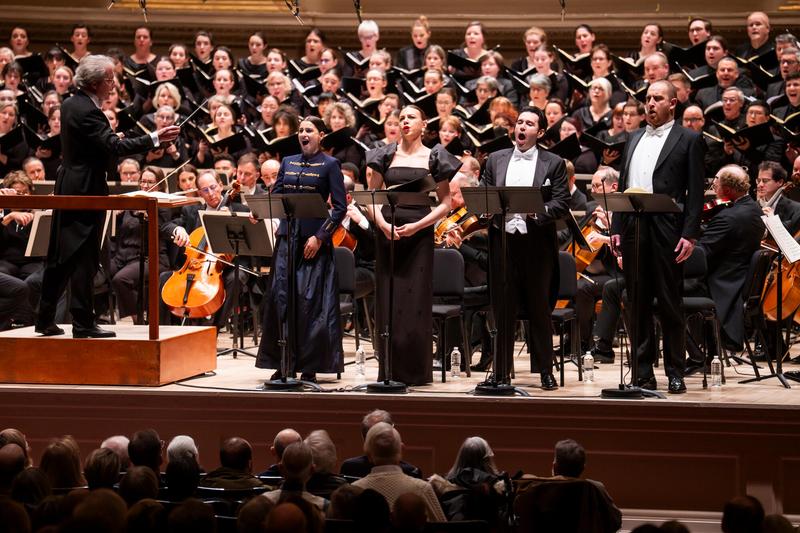
John Schaefer: Out on stage are the members of the Cleveland Orchestra and the members of the Cleveland Orchestra Chorus, a huge ensemble of more than 100 singers who have joined the orchestra and conductor Franz Welser-Möst and four vocal soloists to perform a single enormous work on the program tonight, the Requiem by Giuseppe Verdi. Verdi spent years tramping up and down the Italian peninsula, swearing that this was not an opera, [laughter] despite so much dramatic evidence to the contrary.
Jeff Spurgeon: You have to understand that that's where Verdi had reached great success. It is interesting that this is a Requiem Mass that you're not likely to hear in a church. It's such a powerhouse piece and sets some of the very oldest and most sacred texts in Christianity to accompany the burial of believers, but it's a work that's hardly ever performed in a church.
John Schaefer: In fact, there have been performances where the four soloists are given roles to play, and it is almost like an opera, but as you listen to this Requiem, you can see, Jeff, why it would be difficult to present this in a church. Huge forces, first of all, but there are also parts of the piece, and I'm thinking especially of the Dies Irae, where Verdi seems intent on massing his musical army to storm the gates of heaven. This is, in other words, not a Requiem to bring comfort to the bereaved in the manner of the Faure Requiem, for example. Yes, technically, it is a setting of liturgical text, but as you say, it's really not often used that way.
Jeff Spurgeon: Another reason it's not an opera is that there are no costumes and there are no sets, and the soprano survives. [laughter] That never happens in an opera either. It's not a liturgical piece, but it kind of is. It's not an opera, but it kind of is. It's a strange [crosstalk].
John Schaefer: It is certainly a dramatic piece. A big part of that is the chorus. The Cleveland Orchestra has brought its own band of volunteer singers to Carnegie Hall for this performance. To learn a bit more about them, we spoke with the director of choruses at the Cleveland Orchestra, Lisa Wong, who is the most recent leader in a distinguished line.
Lisa Wong: It's an incredible history. Started off with Robert Shaw, at the request of George Szell, going from Robert Shaw, Margaret Hillis, Robert Page, my immediate predecessor, Robert Porco.
Jeff Spurgeon: And since 2018, Lisa Wong. When the great American choral conductor Robert Shaw held auditions for the Cleveland orchestra chorus in 1956, 1800 people showed up for the audition, 240 were invited to the first rehearsal, and the 200 who came early were the ones who got in. Lisa Wong told us how things work in the chorus a little differently today.
Lisa Wong: It's an all-volunteer chorus. We are right around 140 singers, and everybody auditions to be a part of the chorus, and then the members also re-audition as part of the process. We have re-auditions every three years.
John Schaefer: The Cleveland Orchestra Choir is typically involved in half a dozen projects or so each year. Now, the Verdi Requiem hasn't been played by the Cleveland orchestra for about 20 or so years. This experience will be new or nearly new for most of the chorus members. Lisa Wong says the Requiem is a big assignment for choristers and for choral conductors.
Lisa Wong: It has many, many challenges in it. There is a lot of big, big singing. Not only how do you sing these massive passages in a beautiful and healthy way, but then how do you do that over the course of multiple rehearsals, multiple performances? Just thinking about singer's health is a big part of is, but then there are also these exquisite a cappella passages, and how do you get the same chorus to do both? That's a challenge for sure.
Jeff Spurgeon: Certainly, one of the dangers for singers in a work with big extremes like this is straining your voice in the big parts and then ruining yourself so you can't sing the soft ones. It is something that Lisa Wong is very conscious of.
Lisa Wong: That's a trap for sure. That's something that we build into the rehearsal process. We talk quite a bit about, okay, you've got a long way to go, and you've got to sing smart. Everybody just can't try to be loud because then it's loud, and nobody wants to hear that. It's got to be strong and beautiful. Then we've got to sing these other contrasting parts. We talk quite a bit about the stamina that's required. That's definitely a trap.
John Schaefer: It's interesting how much what Lisa Wong is saying reminds me of an athletic event. The team will-- No coach sends the team out cold. You warm them up.
Jeff Spurgeon: You bet.
John Schaefer: It's similar with the chorus. This group will have had weeks of their own rehearsals, maybe one or two rehearsals with Franz Welser-Möst, the conductor, and a piano accompaniment, and maybe one more with the full orchestra. In the last hour or so, the choir has had a warmup. Not enough to wear anybody out, but to limber up the vocal cords. Lisa Wong has given her little pre-game speech to the team as well. She told us she works hard to strike the right note of inspiration.
Lisa Wong: It's a tricky balance because I want the chorus to feel ready, but knowing they've got a really big sing ahead of them, I don't want to tax them too much. I try to keep the tone positive, but also serious, because we all know that this is an incredible responsibility to be singing this music and to be singing at this level. I want everybody to be focused.
Jeff Spurgeon: That's Lisa Wong. She's the director of choruses for the Cleveland orchestra. The 125 or so members of the chorus who came to New York for this performance are already out on stage, as is the Cleveland Orchestra. The timpanist has been in rehearsal for a number of minutes now, as you've probably heard, and the performance is going to start in just a couple of minutes. They want to wait for latecomers to get to Carnegie Hall on this particular occasion. They're holding the curtain just a little bit. Because we knew we'd have this moment, we asked Lisa Wong about her own favorite moments in the Requiem.
Lisa Wong: I love the Lacrimosa melody.
[MUSIC - Giuseppe Verdi: Lacrimosa]
I think it's so, so beautiful and unmistakably Verdi, so Italian.
[MUSIC - Giuseppe Verdi: Lacrimosa]
So Italian in its sound and melodic content. I look forward to that every time.
[MUSIC - Giuseppe Verdi: Lacrimosa]
John Schaefer: The Lacrimosa melody, Lacrimoso, certainly is one of the highlights of the Verdi Requiem, but Lisa Wong told us about another special moment for her in this piece.
Lisa Wong: Our soloist is Asmik Grigorian, who is just astounding. When she sings this passage with the chorus, it's as if time is suspended. I feel like I'm holding my breath the whole time, but in the very best way because it's so beautiful and exquisite.
[MUSIC - Franz Welser-Möst and the Cleveland Orchestra: Verdi's Requiem]
Lisa Wong: This is just an incredible lineup of soloists. I'm not sure I've seen a quartet that is just so beautifully suited to one another and to this work. They have to sing beautifully by themselves, but also as part of an ensemble. I think that's not always a given, but these are really incredible musicians, and so I think everybody is going to really be in for a treat hearing them.
[MUSIC - Franz Welser-Möst and the Cleveland Orchestra: Verdi's Requiem]
Jeff Spurgeon: That performance by soprano Michelle Kreider in a recording made by Richard Hickox in the London Symphony. The soloists we'll hear tonight in the performance are the Lithuanian soprano Asmik Grigorian, the Turkish German mezzo soprano Deniz Uzun, the Mexican American tenor Joshua Guerrero, and the Kuwait-born German bass Tareq Nazmi. The four soloists are here, so is our music director, the concert master, Joel Link, out on stage having tuned up the orchestra. We're just about ready to get started with this performance of the Verdi Requiem from Carnegie Hall Live.
John Schaefer: It is a massive piece, a huge amount of musicians on stage and several more offstage.
Jeff Spurgeon: Oh, that's right.
John Schaefer: We've got four trumpets on stage and four more in two of the boxes where normally the lighting people are. They're off to either side of the stage. [applause] Stage door opens and out comes Franz Welser-Möst, the longtime music director of the Cleveland Orchestra and the four aforementioned soloists. We will have a performance tonight of that most operatic of requiems, the one by Giuseppe Verdi. You can hear that this sold-out crowd here at Carnegie Hall is more than ready. Here is the Verdi Requiem, Cleveland Orchestra from Carnegie Hall Live. [MUSIC - Franz Welser-Möst and the Cleveland Orchestra: Verdi's Requiem]
[applause]
Jeff Spurgeon: From Carnegie Hall live, you've just heard a performance of the Verdi Requiem. Franz Welser-Möst and the Cleveland Orchestra, and chorus, and soloists Asmik Grigorian, Deniz Uzun, Joshua Guerrero, and Tareq Nazmi. That long pause that you heard as the work concluded was the audience paying close attention to Maestro Welser-Möst, who held his arms still to let the music finish. There's always a space afterward we need to respect. Welser-Möst and the audience here at Carnegie Hall tonight did that. Backstage at Carnegie Hall, I'm Jeff Spurgeon alongside John Schaefer.
John Schaefer: You're right, Welser-Möst, at the end of the piece was conducting the audience as much as he was the--
Jeff Spurgeon: The orchestra.
John Schaefer: Not releasing the hands down to his side to signify the end of the piece. Because that silence at the end is meaningful in the wake of the dramatic sounds that we hear in Giuseppe Verdi's Requiem. Of course, Verdi is known for his operas and that sense of drama, of tension and release, and the sense of melody and rhythmic impetus that you hear in his operas, it's in this piece in spades. It is a requiem. It is a setting of the traditional Latin Mass of the Dead. As we mentioned earlier in the broadcast, it is not a liturgical piece. It is very much a concert work. The four soloists and the conductor, Franz Welser-Möst, back out center stage. A huge roar of appreciation for the Cleveland Orchestra chorus.
Jeff Spurgeon: Now the orchestra itself stands. The soloists came off stage for a moment to slake their thirsts, desperately looking like animals in the parched Serengeti. They got their water and went back on stage for a curtain call. Now all the performers on their feet with Maestro Welser-Möst.
John Schaefer: It is a sold-out crowd here at Carnegie Hall tonight. Certainly, visits by Franz Welser-Möst and the Cleveland Orchestra are always an occasion, even in this hall, that has seen the best of the best. To have them perform this work, the Verdi Requiem, well, it is a pretty special event, and it's a pretty special piece. It has a very unusual origin story.
Jeff Spurgeon: Yes. Oh, for sure. The original idea was Rossini. "Rossini died, we should do a requiem," said Verdi. "We should involve all the other Italian composers in writing it." Guess who bought that idea? Nobody. Publishers, impresarios, nobody wanted to do that. Once again, all of the company on its feet here at Carnegie Hall, the Cleveland Orchestra and their chorus of 125 singers, all volunteers, and our four soloists, and Maestro Franz Welser-Möst.
John Schaefer: Going back to the origin story, it was the Libera Me section of this Requiem that Verdi originally wrote for this purported multi-composer tribute to Rossini. Since, as you say that, that did not come off for various reasons, the actual impetus for the Verdi Requiem was the death of Alessandro Manzoni, the Italian philosopher and writer. For which reason, this piece, over the years, has occasionally, especially in Italy, been referred to as the Manzoni Requiem.
Jeff Spurgeon: He was an extraordinarily important figure in the unification of Italy. That was something that was very important to Verdi as well. It was a huge, huge event in Italy in the second half of the 19th century, and something I think that we take very much for granted. Italy was always Italy. Boy, is that not the case. Once again, cheers, applause-
John Schaefer: Standing ovation.
Jeff Spurgeon: -for the Cleveland Orchestra and their chorus, and our soloists, and Franz Welser-Möst. They performed this work a few days ago at Severance Hall in Cleveland. It's going on the road as well, this work in this particular configuration to Miami. Have you been to Miami yet, or did you come back from Miami? You're going to Miami. Yes, all right. Right. We hope the weather's nice there for it. I hear Miami can be very nice in January.
As you get to discover that, we were just informed the orchestra's headed out on the rest of that situation. Once again, the audience still asking for applause and perhaps one more visit from these four soloists and our conductor. Indeed, the stage door is open, and Maestro Welser-Möst is saying, "Would you go out? Would you just go out? The audience would like to see you again."
John Schaefer: We are not so far away from some of the big midtown subway stations, and the traffic here at the stage door is almost as busy-
Jeff Spurgeon: Surprisingly.
John Schaefer: -with the soloist and the conductor on and off and on and off. Now the full mast ranks of the orchestra, the 120-plus voices of the chorus, the soloists, the conductor, all on their feet. So are the audience. Obviously, an extremely well-received performance of the Verdi Requiem here at Carnegie Hall tonight.
Jeff Spurgeon: It is a special occasion and a difficult work because you need four top-notch soloists, a really fine chorus, and a full orchestra to bring it off. It is a special occasion. The Cleveland Orchestra and Franz Welser-Möst have not done this work for more than 20 years. It's a welcome return, Welser-Möst has said, "A chance to deal with this great work once again."
It seems now that the audience lights are up and the Cleveland Orchestra is beginning to come off stage. Lisa, if you grab that pair of headphones right there, then perhaps you will be able to hear us a little better. We're delighted that Lisa Wong, who is the Director of Choruses for the Cleveland Orchestra, is here with us. As long as you're not assaulted by all those musicians passing behind you. Lisa, congratulations on the performance. Did it come off as you hoped?
Lisa Wong: Yes, yes, we're very, very pleased with how everything went tonight. So pleased with the reception of our New York audience.
John Schaefer: I have an odd question. Where do you experience this piece from? Because you've spent time preparing the chorus, but then Franz Welser-Möst is conducting. Where are you during the performance?
Lisa Wong: I'm sitting in the audience, always taking notes for our next rehearsal.
Jeff Spurgeon: All right. We didn't know, or thought maybe there was a special chorus director's box somewhere backstage.
Lisa Wong: Not yet.
Franz Welser-Möst: We are going to create that.
[laughter]
John Schaefer: That is the voice of Franz Welser-Möst, the longtime music director of the Cleveland Orchestra. Congratulations on this performance.
Franz Welser-Möst: Thank you.
John Schaefer: It is a journey, this piece, isn't it?
Franz Welser-Möst: Yes, absolutely. Verdi took the text really seriously. People say sometimes, yes, it's like an opera. No, it's not. He specifically said, no, it's not an opera. Take the text seriously. With, of course, the unbelievable genius of one of the greatest opera composers ever. With his language, he writes music to this text, which is so profound and so deeply felt and absolutely the opposite of superficial.
John Schaefer: There's also a kind of-- I mean, there's the recurring motif, which involves the bass drum, the--
Franz Welser-Möst: The Dies Irae, the Day of Wrath.
John Schaefer: Yes. It is quite possibly the bass drum's great moment in orchestral music.
Franz Welser-Möst: This one in Mahler 3, I would say.
John Schaefer: Lisa, for the chorus, it's a super challenging work, isn't it?
Lisa Wong: Oh, most definitely.
John Schaefer: As Maestro Welser-Möst says, it's not an opera, but do you have to prepare them as if it were?
Lisa Wong: There is certainly a lot of big singing, a lot of more athletic singing, but there's also so many quiet, beautiful moments. I think they have to be able to prepare both.
Franz Welser-Möst: Yes.
Jeff Spurgeon: Maestro Welser-Möst, you haven't performed this in more than 20 years, I think, at least with the Cleveland Orchestra. How does the work-- How has it changed? Or maybe a better question, how have you changed?
Franz Welser-Möst: I got older. As simple as that. Of course, you form a relationship as an interpreter with a piece of art, and as you change, also the relationship changes. It's something, especially after my health episode, which I had in the last two years, you think about life differently. You think about the end, and that time becomes more valuable. I think just that is really the relationship with the piece. Like with any masterpiece, you do it again and you think, "Oh, my God, last time I was an idiot. That I didn't see that, that I didn't discover that."
I have to say, to be on a stage is teamwork. Between what Lisa prepared so wonderfully, there was-- ahead of time, I sent her a note, "Please, you know this acapella passage at the end in the last movement with a solo soprano. They have to sing that from memory," because Asmik is not just a wonderful voice, she is an incredible artist. Meaning that she recreates every single time a passage. It's never exactly like what she has done before, and that makes it so enjoyable.
Jeff Spurgeon: A living performance.
Franz Welser-Möst: Yes, exactly. You couldn't record that. That's something-- If everyone is prepared that you have to maneuver, don't be rigid, then the music starts to get alive simply.
John Schaefer: Wow.
Jeff Spurgeon: We thank you both so much. This has been such a great thrill. Lisa, thank you for the conversation that we enjoyed. We shared a great deal of that tonight. You cued us into how good Asmik was going to be. You were right on with that. It was just a great pleasure to hear you all. Once again, Lisa Wong, thank you, Director of Choruses for the Cleveland Orchestra, and music director Franz Welser-Möst. You gave us a great experience at Carnegie Hall with your musicians once again.
Franz Welser-Möst: Thank you very much.
Lisa Wong: Thank you.
Jeff Spurgeon: Thank you so much. The choristers are still coming off the stage. That's how many of them were out there for that performance tonight. I believe that's going to wrap up this broadcast of Carnegie Hall Live with our thanks to Clive Gillinson and the staff of Carnegie Hall.
John Schaefer: WQXR's team includes engineers George Wellington, Duke Marcos, Bill Siegmund, and Noriko Okabe. Our production team, Lauren Purcell-Joiner, Laura Boyman, Eileen Delahunty and Christine Herskovits. I'm John Schaefer.
Jeff Spurgeon: I'm Jeff Spurgeon. Carnegie Hall Live is a co-production of Carnegie Hall and WQXR in New York. Classical New York, WQXR 105.9 FM and HD Newark, 90.3 FM WQXW Ossining, and WNYC FM HD2 New York. We now send you back to the WQXR studios for music hosted by Miyan Levenson.
[silence]
[01:41:57] [END OF AUDIO]
Copyright © 2026 New York Public Radio. All rights reserved. Visit our website terms of use at www.wqxr.org for further information.
New York Public Radio transcripts are created on a rush deadline, often by contractors. This text may not be in its final form and may be updated or revised in the future. Accuracy and availability may vary. The authoritative record of New York Public Radio’s programming is the audio record.