
Voice of taxi driver: Where to?
Passenger: Carnegie Hall, please.
Voice of box office: Okay, here are your tickets. Enjoy the show.
Voice of usher: Your tickets, please. Follow me.
Jeff Spurgeon: In New York City, there are lots of ways to get to Carnegie Hall. You can take the subway, a taxi. Go for a walk down 57th Street. You've just found another way to get to America's most famous home for classical music. Welcome to Carnegie Hall Live, the broadcast series that gives you a front row seat to concerts by some of the greatest artists in the world. You hear the performances exactly as they happen. You are part of the audience sharing the experience of music-making at Carnegie Hall. I'm Jeff Spurgeon, backstage at Carnegie Hall and alongside John Schaefer.
John Schaefer: We are here for what has become an annual tradition here at Carnegie Hall, the Isaac Stern Memorial Concert. Every year, Carnegie Hall and its friends, its music community, recognize the remarkable violinist who worked tirelessly to save Carnegie Hall. It seems almost unbelievable that in 1960, this building was slated for demolition. Isaac Stern strategized with city leaders and philanthropists, and politicians, and saved Carnegie Hall. That is why the largest of the three halls here at Carnegie is now known as the Isaac Stern Hall Auditorium because he, Jeff, saved this place from the wrecking ball.
Jeff Spurgeon: It's unbelievable to conceive, but upstairs from where we're sitting now, where John and I are sitting in the recording studio at Carnegie is a picture from, I believe it's Life Magazine in 1957 of a sketch of a very slick looking red modern apartment complex that was going to be really the star of this block at the corner of 57th and 7th in New York City once they got rid of that silly music thing from the 1890s. It almost happened because Carnegie was just a rental hall at that time. The New York Phil was the biggest tenant. They were taking up lots of space for their weekly programs, but otherwise, who needs it?
There was going to be that, that great new beautiful Lincoln Center that was going up a few blocks away. That's what almost happened, so tonight we celebrate Isaac Stern with a program curated this evening by another great violinist, one of our time, Maxim Vengerov. Vengerov is a perspectives artist here at Carnegie Hall, which means he is in the middle of a three-year engagement designing a series of projects and concerts, and tonight is one of those events. I talked to Vengerov a couple of days ago, and he told me he wanted to include a concert of Brahms' chamber music here always.
Maxim Vengerov: His chamber works must be performed as a symphony, and symphonies must be performed as chamber music. This is the idea, especially that we're doing on the grand stage of Carnegie Hall. That gives us a special challenge to play, as I would say, to the last row. This hall is fabulous and couldn't be a greater settings for us for this music.
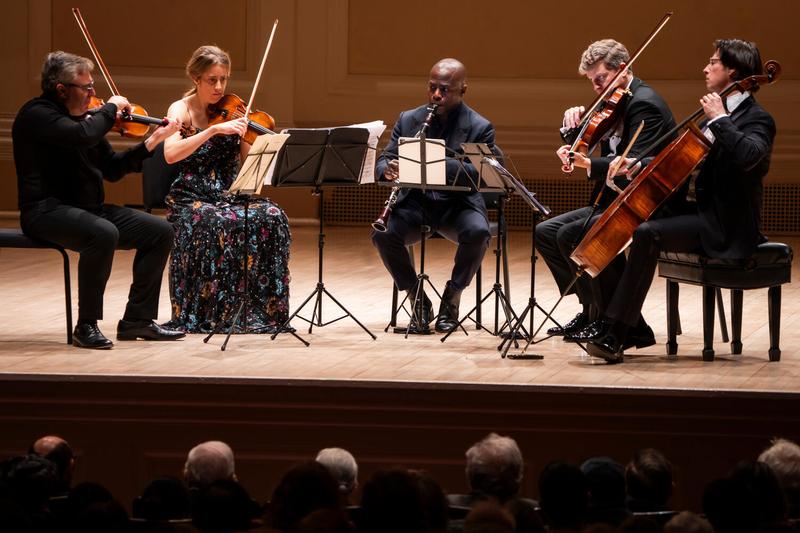
John Schaefer: That is Maxim Vengerov, who leads a group of his musical friends in this concert tonight featuring two quintets by Brahms. In the first half of the program, we'll hear the Piano Quintet with Yefim Bronfman at the keyboard. In the second half, it's the Brahms Clarinet Quintet featuring Anthony McGill, who you may know as the principal clarinetist of the New York Philharmonic. Now, in addition to Maxim Vengerov playing violin on both pieces, the other musicians included on the program are the young Norwegian violinist Vilde Frang, the Canadian James Ehnes, who is usually a violinist but tonight is playing viola, and Daniel Müller-Schott, who plays the cello.
Jeff Spurgeon: Getting all these very in-demand musicians together was, as you can imagine, quite a production, especially for James Ehnes, who, ironically, as Vengerov told us, had the hardest time getting here to New York.
Maxim Vengerov: It was quite a roller coaster to get everyone in that everyone would be available. Most of my friends came from overseas, and James Ehnes came from Chicago. Yesterday he was late for the rehearsal because simply the flight was late, and so it took quite some juggling. I love working with Yefim Bronfman, he's a fantastic friend that I worked with him already for over 30 years. Being 50, it's a lot. Anthony McGill is fantastic. First time for me, great clarinetist. Vilde Frang, one of my favorite younger colleagues that I worked with for the first time, actually, surprisingly for me was we did a gig together in Copenhagen, where she played the Mozart Violin Concerto. I was conducting.
Then, Daniel Müller-Schott, first time for me to work with this fabulous cellist. So all of this great company.
John Schaefer: That is Maxim Vengerov enumerating some of the musicians he'll be sharing the stage with in this concert that he has curated at Carnegie Hall. It begins with the Piano Quartet of Brahms. The work was composed in 1862, and it had quite a tortured birth. It was originally written as a string quintet. Two violins, one viola, two cellos, modeled after the famous Schubert quintet. There was no piano. However, the most famous violinist of the day, Joseph Joachim, told Brahms that he needed to rewrite the piece because, in Joachim's words, it was lacking in charm. He also, Jeff said, the string parts are too difficult to play.
Jeff Spurgeon: I wonder if that's what made him think it lacked charm.
[laughter]
Jeff Spurgeon: Brahms went to work again, and he made another take at the whole thing. This time it turned out to be a sonata for two pianos. That was in a way because of Clara Schumann. She wrote to tell him if the work sounded like it should be played on the piano.
John Schaefer: That third time was the charm.
Jeff Spurgeon: That was the charm, and so in a way, we've combined the both, where we have a quintet, four strings and piano, two violins, one viola, one cello, a string quartet and the piano. That is the lineup for the work that we're going to hear as this program begins. We're backstage now at Carnegie Hall. The audience is mostly settled into their seats, it seems. We've seen-
John Schaefer: We've seen most of the musicians.
Jeff Spurgeon: -four and five.
John Schaefer: You can hear a couple of them tuning in the background. The cellist Daniel Müller-Schott, the Norwegian violinist Vilde Frang, the Canadian violinist turned violist, James Ehnes.
Jeff Spurgeon: Violinist, usually.
John Schaefer: James Ehnes, simply awaiting the arrival of our curator, violinist Maxim Vengerov, and of course, the pianist Yefim Bronfman, who will collectively perform this Brahms Piano Quintet. You know, Jeff, we were talking about the evolution of this piece. The duo piano version actually has been published. The version we know for piano and four strings is the Opus 34. The Opus 34B is that duo piano version.
Jeff Spurgeon: Is the duo piano version.
John Schaefer: However, the original string quintet version, as far as I know, has never been published, and I believe has been lost.
Jeff Spurgeon: Brahms was not the easiest guy to pry music out of. Unless he was happy with it, it wasn't going to go into the world. He reworked this piece a couple of times in order to reach the combination that it's found. Go ahead.
John Schaefer: And of course, he was anointed very early in his composing career as the next Beethoven, which was a terrible mantle to place on the shoulders of a young musician.
Jeff Spurgeon: No pressure there. Well, he did eventually rise to the occasion in more than one way and has produced a couple of singular works for chamber ensemble. We're getting to hear both of them tonight from a group of real-world-class musicians and put together as part of the Perspectives Artists series by the violinist Maxim Vengerov, who is familiar to audiences here at Carnegie Hall and around the world, and stopped playing the violin for a period of years. A little while back, he had a shoulder injury. He was doing some weightlifting and hurt himself enough that he had to stop playing the violin for a while, and so he began to do a great deal of conducting.
The pandemic came along, and that kind of pushed that part of his work back in the closet. Now he's doing more playing than he was conducting, and also is enjoying being the father to a son. He told us too. That's maybe pushed him around just a little bit.
But now the house lights are dark, and we're just awaiting the opening of the stage door with our players back here in front of us.
John Schaefer: Stage door opens, hush falls over the crowd-
[applause]
John Schaefer: -and applause greets Maxim Vengerov and friends taking center stage here in the Isaac Stern Auditorium, the Ronald O. Perelman Stage. The annual Isaac Stern Memorial Concert here at Carnegie Hall begins with a performance of the Brahms piano Quintet, opus 34.
[MUSIC - Piano Quintet Opus 34: Johannes Brahms]
[applause]
John Schaefer: From Carnegie Hall live, a performance of the Brahms Piano Quintet on a concert curated by the violinist Maxim Vengerov, a perspectives artist this season here at Carnegie Hall. The Brahms Piano Quintet featuring a string quartet comprised of Maxim Vengerov and Vilde Frang playing the violins, James Ehnes playing viola, Daniel Müller-Schott with the cello, and at the piano, Yefim Bronfman. Backstage at Carnegie Hall, I'm John Schaefer alongside Jeff Spurgeon. Boy, what a wild ride that final movement of the Brahms Quintet is.
Jeff Spurgeon: The movement before it ends with such a pregnant pause that you know something big is coming. Afterward, it does end. The musicians now all five once again back out on stage. They came off stage for just a moment, exchanging the same kinds of hugs and appreciation to another that they are now offering the audience here at Carnegie Hall. A few of the audience members on their feet for quite a star-studded cast playing this work of barbs.
John Schaefer: Star-studded and also cosmopolitan. There are so many nationalities in such a few musicians, I mean Maxim Vengerov, Russian-born Israeli violinist, Vilde Frang from Norway, James Ehnes from Canada, Daniel Müller-Schott from Germany, Yefim Bronfman, also Russian-born, Israeli American, American citizen now. In the second half of the program, when we get to the Brahms Clarinet Quintet, the American clarinetist Anthony McGill will be joining us on stage and backstage as well at Carnegie Hall. This concert, as I mentioned, part of the Perspective series.
Jeff Spurgeon: Yes, it's a three-year assignment for Vengerov to help create and bring to life projects that he's passionate about with some people that he's passionate about as well. Some old friends part of this group, and some new ones as well. Vengerov will be performing with the Budapest Festival Orchestra and conductor Iván Fischer in February. Vengerov playing the Sibelius violin concerto, then in May, performing with pianist Polina Osetinskaya in the concert of Schubert and Shostakovich, and of Brahms. It's intermission here at Carnegie Hall. In the second half of this concert, Maximum Vengerov and friends will perform the Quintet by Brahms for Clarinet and Strings.
This is Classical New York, WQXR 105.9 FM and HD Newark, 90.3 FM, WQXW Ossining, and WNYC FM, HD2, New York.
John Schaefer: We are backstage at Carnegie Hall, and for a change, the piano is being wheeled off stage and not directly past where Jeff and I are sitting.
[laughter]
John Schaefer: That's a little bit of a difference, but we have been joined backstage by the pianist Yefim Bronfman, who is fresh off of that emotional roller coaster of the Brahms Piano Quintet.
Yefim Bronfman: It is emotional indeed.
John Schaefer: That last movement alone, you have these moments of elegant, almost classical restraint, and then these moments of manic energy. How do you find your way through that?
Yefim Bronfman: I wish I knew how to explain it. Just hoping for the best.
[laughter]
Jeff Spurgeon: You had a couple of days of rehearsal with these musicians. You've played with a couple of them before.
Yefim Bronfman: Only with one. I played with Maxim before, but I have never played with the other musicians, and it was just, I think, love at first sight, love at first play. It was just really such pleasure to rehearse with them. We just enjoyed the music.
Jeff Spurgeon: How does it work? Do you just go through every-- let's play everything once and then see where we want to look at that. How was the process?
Yefim Bronfman: We do it both ways. We play through, and then we stop, and we decide on things. We try different pianos, we try different halls. We were rehearsing in different places. We had three rehearsals, and I think they were very packed emotionally and physically just to get things done. It was a very complex piece and obviously needs a lot of work, and we had to be very organized, and it's exactly what's happened.
Jeff Spurgeon: This is not repertoire that you play a great deal, I'm guessing. You don't have this stuff in your fingers completely. You've known about this for a while, I guess.
Yefim Bronfman: Yes, of course, I plan to practice it. This is like a piano concerto, and Brahms is always hard for pianists, at least for me personally. I speak for myself. It's always very hard, always requires a lot of practice, no matter how many times you played it. I play the concerto, played some solo pieces, but German music is less of a thing for me. I just do it a lot less. There was a special occasion, and I enjoyed it very much.
John Schaefer: Have you ever played the two-piano version?
Yefim Bronfman: I have. I recorded it also.
John Schaefer: How different is that?
Yefim Bronfman: It's different, and yet it's the same thing. It's just different distribution of parts. Some string parts are played by second piano or first piano sometime, and some of our parts is played by strings by other pianos. The whole thing is between two pianos.
John Schaefer: It's simply a difference in distribution of notes.
Yefim Bronfman: Correct.
John Schaefer: The emotions, the form, all still the same
Yefim Bronfman: It's absolutely the same. Of course, when you play only two pianos, it requires different approach of tempos and sonorities.
John Schaefer: There were moments in the third movement where you were all just-- it was as if you had a train to catch.
[laughter]
Yefim Bronfman: This has to be very exciting and very fast.
John Schaefer: Absolutely.
Yefim Bronfman: I feel it's very difficult, but has to be done.
Jeff Spurgeon: With your work largely in the work with orchestras and solo performances. Is chamber orchestra a break for you?
Yefim Bronfman: It's not a break, it's just a pleasure. I can't say it's a break. Break associates with boredom, but no.
[laughter]
Yefim Bronfman: It's not. It's just great pleasure to get together with friends and play this fantastic music that not only strings, but with the singers and with the wind instruments, and the violin sonatas and viola sonatas, and cello sonatas. It's vast repertoire, and I always enjoy it.
Jeff Spurgeon: It's wonderful. You got to play with some friends, and we got to enjoy the performance.
Yefim Bronfman: Thank you very much.
Jeff Spurgeon: Thank you so much.
Yefim Bronfman: It's great to see you here. Thank you.
Jeff Spurgeon: Pleasure to talk to you. Yefim Bronfman joining us here at intermission at this concert of Maxim Vengerov and some of his friends. The only one in the quintet that Yefim Bronfman had played with before. Now Bronfman has some more friends, and perhaps you do too, listening to this broadcast.
John Schaefer: The second half of our concert brings us another Quintet from Brahms. It's the Clarinet Quintet. Same string players, but the clarinetist Anthony McGill will join them on stage, and he joins us backstage. Good to see you, Anthony.
Anthony McGill: Good to see you.
John Schaefer: Tell us a little bit about stepping into a project like this. Yefim told us just a few minutes ago that he felt like the piano quintet was almost like a concerto. Do you feel that way about the clarinet quintet?
Anthony McGill: I don't, actually. I think it's much more of a collaborative effort. Really, there's so many weaving parts. Maybe it's a concerto for the violin and the clarinet. Really, everyone has their moment in this piece, similar to the Mozart clarinet quintet, where there's these variation movements where everyone gets featured equally throughout the piece.
Jeff Spurgeon: So does that change your experience of pressure in a performance like this?
Anthony McGill: I play this piece a lot. I just enjoy playing it all the time, so I don't think of it as a kind of pressure situation when I'm playing this work. It's such a familiar thing for me that it feels like I'm coming home to it every time, and it's always very different. It's just such a gift to get to play it that that takes away a lot of the pressure. There's still some, of course, but it's such a gift and an honor to play this work.
Jeff Spurgeon: Do you have a sense of what Brahms was hearing in this clarinetist, this friend of his, Richard Mühlfeld?
Anthony McGill: I have specific thoughts about it because he had specific qualities that he possessed in his playing. He called him his nightingale (Nachtigall), but he used a lot of vibrato and a lot of rubato. It's not common still for clarinetists to use very much vibrato at all. I read recently that Mühlfeld was a violinist first and switched to the clarinet, so he had, I believe,-
Jeff Spurgeon: He brought some of that sound with him.
Anthony McGill: -that sound in this group. The sound of the clarinet really melds with the strings beautifully in this.
John Schaefer: So do you use a little more vibrato in this piece?
Anthony McGill: I don't, no, but maybe I will tonight. [laughter] I don't know.
John Schaefer: If you just read it, you may as well bring the lessons into the concert hall.
Anthony McGill: It's nerves. It's shaky. You hear a shaky sound, it's nerves, not-- Actually, maybe it's vibrato.
John Schaefer: I don't believe that.
Anthony McGill: You said there was no pressure. You just said that a minute ago.
John Schaefer: Yes, it's vibrato. It's definitely vibrato. [laughter] How much of a student of the history of your instrument are you? Because I'm thinking of the Mozart, the clarinet that he wrote for, different from the clarinet that Mühlfeld played for Brahms, and possibly even different from the clarinet that you play tonight.
Anthony McGill: Yes, there were quite a few advances in the instrument around Brahms's time, especially with people like Weber, Carl Maria von Weber, the clarinet had a wider range, and so he really explores that range in this piece. Extremely. In the second movement, you'll hear some of those very, very high, high beautiful notes kind of crying out, almost like Strauss or Wagner in there or something like that. There are these beautiful cries in this very improvisatory section in the second movement, which you'll hear.
John Schaefer: At this point, I'm sure you've had just enough time to get to know these musicians and their approach to the piece. How does it feel in the moments before you step out on stage with a group that you're playing with for the first time?
Anthony McGill: It's really exciting because it's almost like a different piece every time I play this piece with a different quartet or a different group, a bunch of different folks from all around the world. Like this group is an amazing kind of experience because, of course, it's an all-star group as they say. That makes the piece take on its life, unique to this performance specifically. Different tempe, different dynamics, different colors. That exploration is what I'm most looking forward to. It has that element of surprise always.
John Schaefer: That means that we get that element of surprise, too, shared with us. I think that's one of the great things about any given live performance of a piece of music is, it is, in a way, brand new.
Anthony McGill: Yes.
John Schaefer: That's a great treat. Well, Anthony McGill, thanks for spending a few minutes with us.
Anthony McGill: Thanks.
John Schaefer: We'll be listening for that vibrato. [laughter]
Anthony McGill: Thanks, guys.
John Schaefer: Of lack thereof.
Jeff Spurgeon: Or lack thereof, as it appears in the Brahms' Clarinet Quintet that we're going to hear in just a few minutes from Anthony McGill and Maxim Vengerov, who is the name on this particular concert. Well, one of, actually, a few names on this concert, for Maxim Vengerov is the Perspectives Artist at Carnegie Hall, who designed the program for this concert; however, another name that we really must mention again is Isaac Stern, the great violinist and protector and preserver of Carnegie Hall.
I believe it was the conductor George Szell, who spoke of a certain frustration in dealing with Isaac Stern, who was always busy working on something or other, one or two projects, people in this part of the world, these people. Certainly, then, when Isaac Stern realized the danger of Carnegie Hall being destroyed, being raised, putting up a parking lot, or some other object, and went to work in regard to saving Carnegie Hall, and effectively so. George Szell said of Isaac Stern that he would have been the greatest violinist in the world, except he was too busy being Isaac Stern.
John Schaefer: [laughs] This is the Isaac Stern Memorial Concert today.
Jeff Spurgeon: Thank you, Isaac, for being maybe the greatest, but one of the greatest violinists of the world. Thank you for being Isaac Stern so that we have Carnegie Hall preserved to enjoy today.
John Schaefer: Isaac Stern Memorial Concert, an annual event here at Carnegie Hall. Anthony McGill, who joined us a moment ago, will be joining the string players in a performance of the Brahms Clarinet Quintet. He was a visitor to the WQXR Greene Space with his brother, the flutist Demarre McGill, and the pianist Michael McHale. They performed for us some of Dmitri Shostakovich's Four Waltzes.
[MUSIC - Anthony McGill, Demarre McGill & Michael McHale: Four Waltzes]
John Schaefer: That's a little bit of the Four Waltzes by Dmitri Shostakovich, recorded live in WQXR's Greene Space, our ground-floor performance venue, with Anthony McGill playing the clarinet. We're getting near the end of intermission here at Carnegie Hall. You'll hear Anthony McGill in the Brahms Clarinet Quintet. The big piece that takes up the second half of this Isaac Stern Memorial Concert.
Jeff Spurgeon: It's darkened a little bit, and the stage door is closed, so we are getting closer to the beginning of the second half of this concert. At the beginning of this program, we mentioned that the concert is dedicated to Isaac Stern, a great activist and violinist, but as an activist who kept Carnegie Hall from being raised and replaced by an apartment building or a parking lot, or something else. There is an annual concert in his memory. When I spoke with Maxim Vengerov yesterday, I asked him if he had ever met Isaac Stern.
Maxim Vengerov: Isaac Stern, for me, was one of the first great musicians I met when I came from Soviet Union. I was 16. I met him. I played for him. For me, Isaac was my idol. After I met him, I remember we had this lovely dinner together. After my first Carnegie performance with orchestra, he invited me to the Carnegie Deli just across the street. I humbly asked him, "Maestro Stern, could you tell me who does Carnegie Hall belong to?" He took the keys, and he said, "I have the keys." [laughs] He was the savior of this institution. It's the center of the world. It's one of the important hubs of this musical universe.
John Schaefer: Violinist Maxim Vengerov, a Perspectives Artist here at Carnegie Hall. He'll be on stage in just a moment with some musical friends to perform the Brahms Clarinet Quintet with a chamber ensemble of five musicians who just gathered a few days ago to rehearse this work together for the first time. Vengerov told us about the process of putting this concert together.
Maxim Vengerov: I really played them a lot. Every time you meet different musicians, you experience these works all over again. It's like a world premiere because you have five different musical souls and you have to come together. Almost without words, you just need to breathe together. I'm so happy that in this short rehearsal time, we are finding what you call telepathy, when we are able to not only breathe together but to have these instant vibrations this music absolutely requires to lift our soul to the universe of Brahms.
Jeff Spurgeon: Violinist Maxim Vengerov. Now, we're going to have our souls placed in the hands of Brahms by these musicians in just a moment, a couple of them warming up backstage. This work by Brahms, the Clarinet Quintet, was written almost 30 years after the piano quintet that we heard in the first half of the program. Brahms, by that point in his life, was contemplating retirement and said he didn't really have much music left, but then he heard the clarinetist Mühlfeld and that was inspiration enough for him to write the work that you are about to hear, along with several other works for clarinet.
John Schaefer: In fact, Brahms wasn't just contemplating retirement, he actually sent a score to his publisher and said--
Jeff Spurgeon: "This is it."
John Schaefer: -basically, "Don't expect anything else from me after this," which has always struck me as a peculiar thing for a creative person, whether that's a composer or a painter or a novelist, to say, it's like, "I'm retiring." It seems like that never takes-- [chuckles] You know.
Jeff Spurgeon: Well, it sounds like it has a little bit of deliberateness in it. I'm deliberately telling you, as if with my other hand, I keep trying to pick up the pen to write some more with. That was the case certainly for Brahms. He was re-inspired and wrote a couple of sonatas for the clarinet and the quintet that we're about to hear as well. Yes, late-life inspiration, you never know when it's going to strike you.
John Schaefer: Those Clarinet sonatas. Brahms toured around with those, with Mühlfeld. They were a great success as well. This clarinet quintet has a special place in the repertoire of the contemporary clarinetist. Along with the Mozart Quintet, it is one of the pinnacles of the chamber music repertoire for this instrument.
Jeff Spurgeon: This particular work is in a darker place; it is in a later life place than the piano quintet that we heard in the first half of the program. There will be some darker sounds and some-- What was the word that Vengerov used? I believe he said that it's a little more cynical. Brahms was at a little more cynical place in his life when he wrote this piece.
John Schaefer: And yet a great enough composer that that doesn't perhaps seep into the music in a way that you would perceive it as being cynical.
Jeff Spurgeon: Or, it is an additional flavor that might not have been present in the work of a younger person.
John Schaefer: Interesting that Anthony McGill was telling us that there are some pretty solid contemporaneous accounts of Mühlfeld's playing and his style being so unusual. Heavy on vibrato, heavy on rubato.
Jeff Spurgeon: Well, how many clarinetists do you think of who were violinists first and so would want to bring some of the legato possibilities of the violin along with them, as he moved to this other instrument, to the clarinet?
John Schaefer: Yes, but rubato, the idea of robbing or borrowing time often heard in performances of Chopin's piano music, is an interesting thing for a class clarinetist to attempt, if indeed he's going to. He was kind of cagey about this when he was speaking to us. An interesting thing to bring to an ensemble that is not a set string quartet, but rather a pickup group, essentially of all international, all-star musicians.
Jeff Spurgeon: But yet a pickup group nonetheless.
John Schaefer: Right. It is an ensemble that we are very much looking forward to hearing once again out on stage. That is Maxim Vengerov and Vilde Frang playing the violins, James Ehnes playing the viola. Daniel Müller-Schott, the cello, and with them, New York's own Anthony McGill playing the clarinet.
[applause]
The five on stage now, this international group assembled for this Perspectives series concert of Maxim Vengerov, and this Isaac Stern Memorial Concert. The music now, the Brahms Clarinet Quintet, comes to you from Carnegie Hall Live.
[MUSIC - Maxim Vengerov, Vilde Frang, James Ehnes, Daniel Müller-Schott, & Anthony McGill: Brahms' Clarinet Quintet]
[applause]
Jeff Spurgeon: A late-life work by a composer who had thought, to one degree or another, that he was done writing music, but then a single instrumentalist inspired Johannes Brahms to create the work you just heard, his Quintet for Clarinet and Strings. You heard it performed from Carnegie Hall Live by an ensemble of five musicians led by Maxim Vengerov, a Carnegie Hall Perspectives artist this year, with clarinetist Anthony McGill, violinist Vilde Frang, violist James Ehnes, and cellist Daniel Müller-Schott, all from Carnegie Hall Live. Now, the five musicians just stepping off stage, or probably backstage. Beside me, Jeff Spurgeon, and my colleague John Schaefer.
John Schaefer: A performance that shows just how well the clarinet blends with the sounds of the four string instruments. You know, Brahms is not alone among composers who wrestled with the idea of the piano and its hammered strings being in an ensemble with the bowed strings of the violins, viola, and cello. Obviously, he worked it out, as we heard in the first half of this program, but the woody sound of the clarinet is just such a great fit, especially with the lower string instruments, the viola and cello. And of course, in the last movement of the Brahms Clarinet Quintet, everybody gets a turn to shine.
Jeff Spurgeon: Yes, that's right. That's right. So there were wonderful solo moments, and as Anthony McGill told us in intermission, you also get to explore the range of the clarinet as well, its high sound and its low, and very warm sound as well.
And so the musicians backstage, they're going to go out, I think, and take another curtain call. Yes, there they are. Just chatting over the options, I think, trying to decide who's going out first.
John Schaefer: Anthony McGill is practically pushing Maxim to get back out there to accept the plaudits of the Carnegie Hall audience. He is the instigator, the curator of this concert that we've heard tonight. It is the annual Isaac Stern Memorial Concert, celebrating the violinist who helped to save and really spearheaded the project that did save Carnegie Hall back in 1960, when it was slated for demolition. The five of them back out on stage to acknowledge a standing ovation from the audience here at Carnegie Hall.
Jeff Spurgeon: This is one of Maxim Vengerov's performances this season, part of his Perspectives series. He has two more concerts happening this season as a Perspectives artist with the Budapest Festival Orchestra, playing the Sibelius Violin Concerto with Hungarian conductor Iván Fischer and with pianist Polina Osetinskaya, concert of Schubert and Shostakovich, and Brahms as well. When I talked with Maxim Vengorov yesterday, he told us that to play in Carnegie Hall, he said it's like driving a fine automobile.
Maxim Vengerov: This hall is an instrument that you have to really know how to play. It's a very challenging instrument. The acoustic is so sensitive. It's like a great Stradivari. For someone who doesn't know what it takes to play a Strad and what it takes to play in a great hall like Carnegie, I always make the parallel, like Formula One cars. "You can drive normal car, but can you drive Formula One?" No, you have to learn how to do it.
Jeff Spurgeon: Maxim Vengerov playing in Carnegie Hall with a group of musicians, only one of whom this evening, whom he had worked with before, Yefim Bronfman. The pianist in the piano quintet. That was the first half of the program. We may get a word with Vengerov before he heads off, but we are beginning to reach the concluding moments of this concert broadcast here at Carnegie. A couple of photographs being taken backstage by our group of five. Remember, they had to come from several corners of the world in order to get into New York for this concert. Backstage, they're going to grab a photographic moment to make sure that all of them, Daniel Müller-Schott and Vilde Frang, Maxim Vengerov, and--
John Schaefer: As kids say. As the kids say, pics or it didn't happen.
Jeff Spurgeon: That's right. That's right.
John Schaefer: They're all now memorialized backstage at the Isaac Stern Memorial Concert.
Jeff Spurgeon: Perfectly that, and so to the microphone, Maxim Vengerov, congratulations on this concert that you put together. Are you happy with the results?
Maxim Vengerov: Thank you so much. Our team was amazing. We just we were so overwhelmed also there. It's just fantastic. No words to explain the feelings. The Brahms' jewels, the crown jewels of chamber music and the way we could speak with each other without words. Strong music.
John Schaefer: A literal encore at the end. I know you curated this show, but how does a decision like that get made?
Maxim Vengerov: Just, by chance, we agreed to play the second movement. It would be nice. This is heavenly music. Heavenly.
John Schaefer: For sure.
Jeff Spurgeon: A warm crowd to receive you here as well. You come back to Carnegie as a soloist with an orchestra in the spring, and then also a recital program as well. The stage is a little different each time because there are different numbers of people on it, so you find your perfect spot on the stage to present to, to present that music to the last row in the hall, as you have talked about.
Maxim Vengerov: Yes, it's a perfect hall. Amazing instrument for us to enjoy and give our very best with the music that we have.
John Schaefer: You know, Yefim Bronfman has played the Brahms' Piano Quintet. Anthony McGill has played the Brahms Clarinet Quintet before. They are used to playing them with established string quartets. You are bringing an ensemble that has been put together of four musicians who are coming from four different countries. That's presenting its own challenges to the four of you, but also to them, right?
Maxim Vengerov: Yes. I think it's challenging to play chamber music for musicians, soloists, that have never-- Just a parallel to draw, they're individual football players, but can they actually play in the team?
John Schaefer: Exactly.
Maxim Vengerov: That's what we tried to build. And I think, to my surprise, the results have been overwhelming for me, the way we could have this conversation on stage, blend the sound. I think this is what it is about, music. It's all in the score. I think perhaps we viewed the music a little bit differently. We felt it being like a symphony rather than chamber music. But in my opinion, you have to play chamber works by Brahms and perceive them as symphonic works. And when one conducts, you feel like you're making chamber music.
John Schaefer: Well said.
Jeff Spurgeon: That's the word from Maxim Vengerov. Thank you for the extra time, Maestro. Congratulations on this Perspectives concert, and we look forward to more from you. Thank you.
Maxim Vengerov: Thank you so much.
Jeff Spurgeon: Maxim Vengerov here at the Carnegie Hall Live microphones tonight. That will wrap up this broadcast of Carnegie Hall Live with thanks to Clive Gillinson and the staff of Carnegie Hall.
John Schaefer: WQXR's team includes engineers George Wellington, Duke Marcos, Kelvin Grant, Bill Siegmund, and Noriko Okabe. Our production team: Eileen Delahunty, Lauren Purcell-Joiner, Laura Boyman, Nicole Nelson, and Christine Herskovits. I'm John Schaefer.
Jeff Spurgeon: And I'm Jeff Spurgeon. Carnegie Hall Live is a co-production of Carnegie Hall and WQXR in New York.
[01:58:55] [END OF AUDIO]
Copyright © 2025 New York Public Radio. All rights reserved. Visit our website terms of use at www.wqxr.org for further information.
New York Public Radio transcripts are created on a rush deadline, often by contractors. This text may not be in its final form and may be updated or revised in the future. Accuracy and availability may vary. The authoritative record of New York Public Radio’s programming is the audio record.