
Taxi Driver: Where to?
Passenger: Carnegie Hall, please.
[tires screech]
[car honks]
[music]
[background chatter]
Ticket Agent: Okay, here are your tickets. Enjoy the show.
Usher: Your tickets, please. Follow me.
[background chatter]
[music]
John Schaefer: In New York City, there are lots of ways to get to Carnegie Hall, a subway, a taxi, a walk down 57th Street. You've just found another way to get to America's most famous home for classical music. Welcome to Carnegie Hall Live, the broadcast series that gives you a front-row seat to concerts by some of the greatest artists in the world. You hear the performances exactly as they happen, and you are part of the audience sharing the experience of music-making here at Carnegie Hall. I'm John Schaefer backstage alongside my colleague Elliott Forrest.
Elliott Forrest: And when you say backstage, we are stage right. We are what, 15 feet away from the stage here at Carnegie Hall? It's very exciting to be here again tonight. Performing this evening, a New York institution, the Orchestra of St. Luke's, French conductor Louis Langrée will lead them tonight in an all-Berlioz program. The Orchestra of St. Luke's will perform Berlioz's most famous work, the Symphonie Fantastique, but first, we'll begin tonight with an opera overture, and a song cycle. For that vocal work, they'll be joined by the French tenor Benjamin Bernheim.
John Schaefer: That will be the piece called Les Nuits d'été, Summer Nights, by Berlioz. The OSL, Orchestra of St. Luke's, has a long history, they celebrated their 50th anniversary back in 2024, and they have very strong ties to Carnegie Hall ever since their first time here back in 1983. They perform in each of the three venues here at Carnegie every season, the mid-size Zankel Hall, the small Weill Recital Hall, and of course, tonight's big space, the Stern Auditorium. In fact, since 1983, the OSL has played here at Carnegie Hall more than 450 times.
Elliott Forrest: Wow. Louis Langrée, the French conductor who will lead the orchestra tonight, is a familiar sight to classical audiences here in New York, formerly the music director of the popular Mostly Mozart Festival. He's also led ensembles at Lincoln Center, Metropolitan Opera, and the New York Philharmonic. He's currently serving as the director of the Théâtre National de l'Opéra Comique in Paris and is Music Director Laureate at the Cincinnati Symphony Orchestra. We spoke with him earlier this week, and he told us about returning to New York and the magic of Carnegie Hall.
Louis Langrée: Is it a great acoustic? Yes. It's an iconic venue because of the acoustic, of course. Because also of the history. You know, in your dressing room, you have all these amazing interprets, conductors, violinists, singers, but you have composers as well. Having the portrait of Tchaikovsky is, I don't know, it's hard to explain, we all feel the same. There are these beautiful, nice ghosts who protect you and inspire you, lift you.
John Schaefer: That is tonight's conductor, Louis Langrée, who actually would know a thing or two about ghosts. Elliott, you mentioned he spent many years with the Cincinnati Symphony Orchestra.
Elliott Forrest: Yes.
John Schaefer: Their Symphony Hall is reputedly one of the most haunted buildings in North America.
Elliott Forrest: Really?
John Schaefer: I have been in that place at night, after it's closed.
Elliott Forrest: Seen a few things?
John Schaefer: I've seen nothing, but it does have a kind of shining aspect to it.
Elliott Forrest: [laughs]
John Schaefer: Here at Carnegie Hall, you can't walk backstage or even be in the elevator without seeing some of the history of this building and the stage. On the stage tonight, the OSL, the Orchestra of St. Luke's, will be performing music by Berlioz, and while we wait for the audience to take their seats, let's hear the OSL. We have recorded them live not just here at Carnegie Hall but also pretty regularly just upstate at Caramoor. That's where this recording of Beethoven's violin concerto was made, featuring Anna Rakitina conducting the Orchestra of St. Luke's, with violinist Stella Chen.
[music]
John Schaefer: Violinist Stella Chen playing the Beethoven's violin concerto live at Caramoor with the Orchestra of St. Luke's, conducted in this live recording by Anna Rakitina. The Orchestra of St. Luke's is here with conductor Louis Langrée at Carnegie Hall tonight to do an all-Berlioz program. Berlioz was just 23 when he wrote this Overture to an unfinished opera called Les Francs-Juges, The Judges of the Secret Court. It's not a familiar piece, and Louis Langrée told us why.
Louis Langrée: We start with an overture which is almost never played. Why? Because he was so young when he composed that. It's his opus number three, his third piece, and it's very weird. Either you feel, "Oh, that's weird" or you feel, "Wow, that's weird, let's do it," and then you bring out all the crazy aspects of it.
Elliott Forrest: Tonight's conductor Louis Langrée is speaking about the piece we'll hear in just a couple of minutes, the Overture to Berlioz's unfinished opera Judges of the Secret Court. I guess we'll have to make a call and find out whether it's a good weird or a bad weird, John.
John Schaefer: [laughs] Well, it's Berlioz. It'll be a good weird, but it will be weird. It is the first of three pieces by Berlioz on the program. We'll also be hearing the song cycle called Summer Nights, Les Nuits d'été. Then after intermission, the big hit, the Symphonie Fantastique, which will threaten to-
[applause]
John Schaefer: -expand this alleged chamber orchestra into something much bigger. Louis Langrée out on stage at Carnegie Hall with the Orchestra of St. Luke's to get us started with this work by a young Berlioz, the Overture to the unfinished opera Les Francs-Juges from Carnegie Hall Live.
[music]
[applause]
John Schaefer: Well, that's what an overture is supposed to do. Get a concert off to a rousing start. That is exactly what Louis Langrée and the Orchestra of St. Luke's have done in this all-Berlioz concert from Carnegie Hall Live, that is overture Les-Francs Juges, an unfinished opera by a young Hector Berlioz. Elliott, Louis was saying it's a weird piece. What do you think? Good weird? Bad weird?
Elliott Forrest: I didn't think it was that weird. I thought it was good. Well, let's just put it in the good category.
John Schaefer: But you have to think like person from 1830, those big, sudden splashes of tonal color upon canvas.
Elliott Forrest: [unintelligible 00:22:39], yes.
John Schaefer: Yes.
Elliott Forrest: One little interesting connection, just to connect it to the Symphonie Fantastique, is that this was an opera that was never produced or never finished,-
John Schaefer: Right.
Elliott Forrest: -but Berlioz used part of that opera in the Symphonie Fantastique, particularly the Marche. We'll come full circle a little bit later on this evening.
John Schaefer: Composers don't like to waste work. If you have something that's good, you figure out a way to use it down the road. It is an all-Berlioz concert that we're hearing from the OSL, the Orchestra of St. Luke's. The next piece in the program will be Les Nuits d'été, Summer Nights, a song cycle with six different parts on themes of love, loss, and hope. For this performance, the French tenor Benjamin Bernheim will join the OSL. We spoke to him earlier this week. He told us a little bit about some of his favorite moments in the piece.
Benjamin Bernheim: I don't think it gets more French than that. The poetry that is behind it, it's like most cycles. It's about spring, discovering love, dying, mourning, suffering, and a new beginning. The most famous of it all is La Rose, this poetry about the ghost of a rose that comes back to talk to the person that was carrying it the night before. There is Sus les lagunes. It's about the loss. You have in this music of Berlioz the waves of the sea coming at the shore, is this feeling that, whether you want it or not, the cycle of life never stops, and it comes inevitably.
[applause]
Elliott Forrest: Tonight's soloist, tenor Benjamin Bernheim, takes the stage now with conductor Louis Langrée.
John Schaefer: They will perform with the Orchestra of St. Luke's, the Berlioz's song cycle Les Nuits d'été, Summer Nights, originally for piano and voice, now orchestrated by Berlioz from Carnegie Hall Live.
[music]
[pause 00:26:47]
[music]
[pause 00:33:47]
[music]
[pause 00:41:05]
[music]
[pause 00:46:35]
[music]
[pause 00:52:10]
[music]
Audience Member: Bravo.
[applause]
Elliott Forrest: The Orchestra of St. Luke's and tenor Benjamin Bernheim, led by conductor Louis Langrée, a work by Hector Berlioz, Les Nuits d'été, Summer Nights. I'm Elliott Forrest with John Schaefer. This is Carnegie Hall Live from WQXR. What did you think?
John Schaefer: He made it seem effortless, but if you think about what we just heard, the beginning of the second song, he's a tenor and he's getting down into extremely low register there. Then beginning of the fifth song, he's practically singing falsetto.
Elliott Forrest: Right.
John Schaefer: Just the range that Bernheim has shown us in this performance is exceptional. The melody is just "spin themselves out" it seems. Of course, the orchestration. This was originally a song cycle for voice and piano. I have never heard the piano version. Why would anyone listen? I mean, Berlioz was such a master orchestrator.
Elliott Forrest: Right, you've got this full orchestra version. It's an all-Berlioz program here tonight. Still to come, the Symphonie Fantastique. I was following along in the English, John, in the libretto here in the program. It's other theme coming up with Symphonie Fantastique, about love and loss and passion. Lines like, we just heard, "My beloved is dead. I shall weep forever." There's a real theme throughout the entire night here.
John Schaefer: And a little geography lesson towards the end there, "Should I take you to the Baltic Sea or the Pacific Ocean or Norway?" Odd idea of romance, but that's the final text of the sixth.
Elliott Forrest: It's always good to travel.
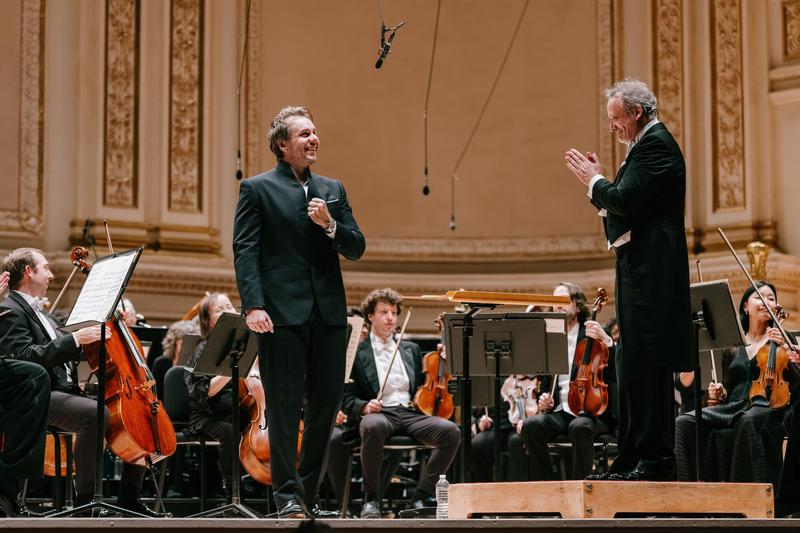
John Schaefer: Louis Langrée is asking the members of the Orchestra of St. Luke's, the OSL, to stand, and Benjamin Bernheim at center stage basking, and a very, very warm round of applause from the audience here at Carnegie Hall. Louis Langrée back on the podium, and it looks like we're going to get an encore.
[music] [applause]
John Schaefer: That is an encore from the tenor Benjamin Bernheim and the orchestra of St. Luke's, conducted by Louis Langrée, pretty well-known tenor aria from Jules Massenet’s opera Werther, the aria called Pourquoi me reveiller? (Why awaken me?) Or as my kids used to put it, why do I have to get up now?
Elliott Forrest: [laughs]
John Schaefer: Sounds better when it's said in French.
Elliott Forrest: In French, yes.
John Schaefer: A work not by Berlioz, but in keeping with the French theme of the program here at Carnegie Hall with Louis Langrée and Benjamin Bernheim, both French musicians leading the OSL in this concert tonight. This is Classical New York, WQXR. 105.9 FM and HD Newark, 90.3 FM, WQXW Ossining, and WNYC-FM HD2 New York.
Elliott Forrest: It is intermission at this concert featuring the orchestra of St. Luke's conducted by Louis Langrée. In just a few minutes, they'll be back on stage to perform Berlioz's most famous work, the Symphonie Fantastique. Right now, Benjamin Bernheim, our featured soloist singer back on stage accepting this warm applause from the audience here at Carnegie Hall. French Swiss tenor, born in Paris, no surprise, specializes in French music. I remember seeing him at the closing ceremony at the Paris 2024 Olympic Games.
John Schaefer: He apparently is recording or has recorded and is about to release a recording of a number of arias from this opera, including the one we just heard. That's Jules Massenet's opera, Werther. Louis Langrée back out on stage to join those who are showing their appreciation for the tenor, Benjamin Bernheim. That wraps up the first half of this all Berlioz, or I guess now we have to say-
Elliott Forrest: Mostly.
John Schaefer: -mostly Berlioz concert from Carnegie Hall live. Still to come, the musical fever dream that is the Symphonie Fantastique, a remarkable feat of orchestration. Berlioz, still 200 years later considered to be a master orchestrator. Les Nuits d'été, certainly another example of his skill at using the orchestra as a huge composite instrument. I mentioned earlier, Elliot, that the OSL is actually a chamber orchestra. To perform Symphonie Fantastique, it's going to be all hands on deck.
Elliott Forrest: More than that as well, the radio audience cannot, but we can see there's four harps on stage.
John Schaefer: Four harps.
Elliott Forrest: Right. That's a lot of harps.
John Schaefer: That's a lot. A call must have gone out around the city.
Elliott Forrest: We need a few more.
John Schaefer: Harpists. [laughs]
Elliott Forrest: Right. Wanted.
John Schaefer: We need you. [laughs]
Elliott Forrest: I'm really looking forward to hearing this. I'm told that Berlioz basically invented the musical autobiography, that no one had really put their personal, real storytelling. This was really true that Berlioz was in love with this woman. He was desperately in love with her. He was consumed in jealousy. He was overcome with opium.
John Schaefer: [laughs]
Elliott Forrest: All of that is in the symphony.
John Schaefer: Yes, it is truly a fantasmagorical piece. We are at intermission here at Carnegie Hall. I'm John Schaefer alongside Elliot Forrest. Joining us is one of the cellists of the OSL, Daire Fitzgerald. Welcome to the microphones, Daire.
Daire Fitzgerald: Thank you. Good to be here.
John Schaefer: How long have you been with the OSL?
Daire Fitzgerald: Ooh, more years than I would care to tell anybody.
Elliott Forrest: Long time.
Daire Fitzgerald: A very long time. I was actually at school, and I played with a few of the musicians in St. Luke's, and they told the executive director, "Get her for St. Luke's."
John Schaefer: Actually, back in the church, St. Luke's in the Fields? That far back?
Daire Fitzgerald: Not that far back.
John Schaefer: Okay.
Daire Fitzgerald: Yes.
John Schaefer: It is funny to think of the orchestra of St. Luke's getting started at a place like St. Luke's in the Fields. You think of the model being London's Academy of St. Martin in the Fields. If you ever go to St. Martin in the Fields, it's like right off to Trafalgar Square. There could not be a less pastoral, louder place [laughs] to have a band. My understanding is OSL, there's a core membership, but that you draw heavily from New York's vibrant freelance scene.
Daire Fitzgerald: Yes, very, very much so. We all rely on each other, not just in our music making, but in life too. We're very, very close. Even those that are not members of the core group, they're still very much an integral part of what we do.
John Schaefer: When you need to be more than a chamber orchestra-
Daire Fitzgerald: Absolutely.
John Schaefer: -as in the Symphonie Fantastique.
Daire Fitzgerald: We have some just amazing young musicians out there that play with us a lot, and it's great to see them and play with them. I just turned around to the cellos now, and I said, "You guys are awesome."
[laughter]
Elliott Forrest: Can you talk to us a little bit about what the DiMenna Center has meant to the OSL? You're housed there; you're really instrumental, if I can use that word, in creating the place. It is now the place to record for Broadway soundtracks. I was told by Marianne Lockwood, I think, who was instrumental obviously in making this happen, that before the DiMenna Center, there was not a dedicated place in New York City for orchestras to rehearse. People were in churches and places. What has it meant to you?
Daire Fitzgerald: Correct. Having a home. Anybody having a home, it means the world. You have a solid foundation in which you can reach out. We reach out to children. We work with children a lot. We have our own youth orchestras in St. Luke's, which has been going gangbusters. In fact, there's a whole bunch of them in the audience tonight, which is great. For all the other orchestras, there's that one place they can all go, they can rely on. It's really changed the outlook for all the orchestras in Broadway in New York.
John Schaefer: It's become a center.
Daire Fitzgerald: Yes.
John Schaefer: It's right there in the name, the DiMenna Center, but it has become a real focal point for the classical music scene here in New York.
Daire Fitzgerald: Oh, yes. You bump into everybody you know all the time there. Always open.
Elliott Forrest: This is an all-Berlioz program. We've, in our own minds and discussion, made up things that connect all these pieces other than the composer, but what is it that connects all these pieces for you tonight?
Daire Fitzgerald: I was thinking of what I was going to say to you today while we were rehearsing yesterday, and I spent part of my time writing down quotes from Louis. It's been such an intense time working with him on this Berlioz, which he knows so well. He kept telling us the story in that moment, what's happening in the story. He wanted us not just to play it and play what was on the page, but play what was not there, to feel every note. When you go from an A to a B-flat, it's a tiny amount of space, but you had to feel it. You have to feel that pain in there. It's like, "Wow," by the end of the rehearsal we were exhausted, but it was a totally different experience.
John Schaefer: Is this the first time that you've worked with Louis Langrée?
Daire Fitzgerald: No. I think this is our third time at Carnegie Hall with him. I do believe maybe we'll be working with him again next season, which is great. We've done Beethoven with him. We've done an All-American program last season. He's got a lot of variety.
John Schaefer: Yes. He's a man of many musical talents. Has he sung any French new wave rock music [crosstalk] during rehearsals?
Daire Fitzgerald: No.
John Schaefer: Because he has that in his locker as well. [laughs]
Daire Fitzgerald: Oh, he does? I look forward to that.
John Schaefer: Daire Fitzgerald, one of the cellists in the orchestra of St. Luke's. You've got a pretty busy journey ahead of you in the second half. Thank you for spending some time with us at Intermission here.
Daire Fitzgerald: You're very welcome. It's been a pleasure.
Elliott Forrest: Thank you for joining us.
Daire Fitzgerald: Thank you.
John Schaefer: It is Intermission here at Carnegie Hall. This is Carnegie Hall Live, and we will be hearing the Berlioz journey through the opium inspired fever dream that is the Symphonie Fantastique. Before we do that, let's hear a little more music from the OSL. They do spend a lot of time here at Carnegie Hall, and no orchestra has played more often on the stage here at Carnegie Hall than the OSL. In the summer, they are often found in residence at the Caramoor Center for Music and the Arts up in Westchester County in the town of Katonah. That is where we recorded this Tchaikovsky Symphony No. 5, performed by the Orchestra of St. Luke's, conducted by Anna Rakitina.
[music]
Elliott Forrest: Just a bit of Tchaikovsky Symphony No. 5 performed by the Orchestra of St. Luke's, conducted by Anna Rakitina. The Orchestra of St. Luke's will take the stage here at Carnegie Hall for the one piece left on the program, Hector Berlioz's Symphonie Fantastique. It's an iconic piece of programmatic music, meaning it has a bit of a story behind it, mirroring Berlioz's life. I'm Elliot Forrest, along with John Schaefer.
John Schaefer: That story that you referred to, Elliot, is one that these days has a little creepy aspect to it. Berlioz was obsessed with an actress by the name of Harriet Smithson. He wrote her love letters. He rented an apartment across the street from hers. I think we'd call that stalking these days. He did eventually marry her, but she left him a decade later. This piece, the Symphonie Fantastique, portrays an artist who longs for his beloved, and she is depicted by this recurring theme, the idée fixe, the fixed idea, as Berlioz referred to it. Louis Langrée, who will conduct the piece, told us a bit more about the story behind this great orchestral work.
Louis Langrée: Symphonie Fantastique doesn't mean it's fantastic. It's comes from fantaisie. It's a music of hallucination. It's the story of this young composer madly in love and totally desperate, so desperate that life is impossible, so he decide to kill himself, but the drug is a bit too weak, so he doesn't die, but he has hallucination. The second movement, which is a waltz in a ball, it is not a ball.
It is the hallucination to be in a ballroom, and suddenly you see your beloved, and then the basses and cellos make pop, pop, pop, pop, pop, which means he has a heart attack because he sees her. What is great with this symphony: bring your own imagination, create images, have visions. What is fabulous in a concert live experience, we'll all share the same music, but yet everyone will get it
through their own sensitivity and sensibility, and it will be completely different and yet collective together.
Elliott Forrest: Tonight's conductor, Louis Langrée, speaking about the piece we will hear in just a few moments. Hector Berlioz, Symphonie Fantastique. John, we were talking about the orchestration earlier. I'm just trying to pick it out here on the stage. We mentioned we can see four harps. Sometimes the orchestration calls for four bassoons, oftentimes four timpanis. This is a big orchestra.
John Schaefer: Yes, this is not a chamber orchestra piece. This will be an amped up version of the OSL performing it because they will have four harpists. Berlioz also called for a pair of ophicleides, which are instruments that kind of look like if you unfurled a tuba and then recurved it to look like a saxophone. It's an instrument that went out of fashion by the end of the 19th century. I'm expecting to see a couple of tuba players walk by because-- but this is New York. If you're going to find ophicleide players, it's going to be here.
Elliott Forrest: There's got to be somebody.
John Schaefer: We'll see what happens. The point is that this is a richly colored piece and that composers for generations after Berlioz would look at the score to this piece as a pinnacle of the art of orchestration. It is a wildly colorful piece. It has this idée fixe, this recurring motif that signifies the beloved. Even with all of the weird sounds that are happening, there's something that suggests a story that you can follow. Once you hear it, you keep hearing it in different forms throughout the piece.
Elliott Forrest: Can we talk through the movements and maybe get through this story here? It starts with a Rêveries, the passions, the artist falls in love. Then there's a ball scene, as we just heard. It's really a hallucination about a ball. He sees his beloved at a dance. Scene in the Fields, he finds himself alone in the countryside, then the march to the scaffold. He dreams he's murdered his beloved and is being led to execution because he---
John Schaefer: To his execution, yes.
Elliott Forrest: Yes. I think there's a guillotine involved in that. Then dream of witches, he imagines himself a grotesque gathering of witches and demons. You mentioned the idea theme. There's also the Dies irae, which people will know from Sweeney Todd.
John Schaefer: And many, many other works as well. Yes, it is a piece that has a lot going on. It's quite a ride. The orchestra of St. Luke's is on stage now, tuning up. Louis Langrée will be joining them momentarily to perform here on stage at Carnegie Hall.
Elliott Forrest: [laughs] Maestro Langrée is in front of us at this point.
John Schaefer: Yes, he is.
Elliott Forrest: Either doing the moonwalk or balancing his baton. I can't tell which.
John Schaefer: [laughs] I should also mention that the OSL, no stranger to this stage, [applause] also no stranger to the Grammy Awards. They have won four of them.
Elliott Forrest: Nice.
John Schaefer: This is an orchestra that rises to the occasion, and the occasion now is Louis Langrée asking them to rise on stage and accept the applause of the audience here at Carnegie Hall. Now, the Symphonie Fantastique by Hector Berlioz from Carnegie Hall Live.
[music] [applause]
Announcer: Live from Carnegie Hall, Hector Berlioz's programmatic masterpiece, the Symphonie fantastique, with the Orchestra of St. Luke's, led by French conductor Louis Langrée. Elliott Forrest backstage with John Schaefer, Louis Langrée not using a score at all tonight.
John Schaefer: No podium, no score. Conducted that whole thing from memory. To show off?
[laughter]
Elliott Forrest: A lot of percussion, a lot of timpani out there, some banging steel, I think.
John Schaefer: Some metal plates, four harps, not just trumpets, but cornets as well. You had a big brass section. It's just an enormous-- there is a muchness, and almost too muchness about the Symphonie fantastique that Berlioz clearly reveled in and which a good performance will revel in as well. As you can tell from the reaction here at Carnegie Hall, this audience really enjoyed the journey that we've just been taken on.
Elliott Forrest: The work premiered in December 5th, 1830, that's 196 years ago. Audiences then, as tonight, confronted by music that's emotional and disturbing and dramatic and often cinematic. I think often foreshadowing the idea of film music and using different themes to represent different characters.
John Schaefer: Just the idea of music telling a story, having a narrative built into it. Here the tale of an artist, clearly standing in for Berlioz himself, who is deeply and obsessively in love with someone who is distant and eventually unattainable. The conductor Louis Langrée is wandering out on stage amongst the different sections of the orchestra, asking the different musicians to rise. When you hear those bursts of cheers and applause, that's Louis asking yet another-
Elliott Forrest: Another section.
John Schaefer: -group of musicians to rise.
Elliott Forrest: It's nice, so it's not just a full stand, but--
John Schaefer: Right now, it's the trombonists, for example.
Elliott Forrest: Just the sections of the brass, and just giving everyone a moment.
John Schaefer: The audience clearly willing to go along with him, to applaud the Orchestra of St. Luke's in about as big a form as you will hear them. Because, as we've mentioned earlier in the broadcast, they are officially a chamber orchestra. You would expect to hear them playing a Mozart symphony, or a string ensemble piece. They also play a lot of chamber music. To have four harps, to have an expanded horn section, to have a big arsenal of percussion, this is the Orchestra of St. Luke's at its most orchestral.
Elliott Forrest: They have friends. They have other musicians in town that they can call on for just such an occasion. Except for a brief encore from Benjamin Bernheim, this was an all-Berlioz program. We started off with the Overture to Les francs-juges, an overture to an opera Berlioz never finished, which he actually ended up having bits and pieces that ended up in other works, including the Symphonie fantastique. Then we heard Summer Nights, Les Nuits d'été, sung by Benjamin Bernheim and the Orchestra of St. Luke's, conducted by Louis Langrée. Of course, we finished with the masterpiece, the Symphonie fantastique of Berlioz.
John Schaefer: Louis Langrée has one last time asked the entire orchestra to stand, and there's a lot of standing in the audience as well, an ovation for the Orchestra of St. Luke's. Louis Langrée now leaving the stage. This is Classical New York, WQXR 105.9 FM and HD Newark, 90.3 FM WQXW Ossining, and WNYC FM HD2 New York. That is a performance that I think people here at Carnegie Hall will not soon forget. Louis Langrée, well done. So good to see you.
Louis Langrée: I didn't produce one note, you know. [laughs]
John Schaefer: [laughs] We noted the lack of podium and score. The Symphonie fantastique, all from memory.
Louis Langrée: It's an old friend, so-- [laughs] Thank you.
John Schaefer: Thank you.
Louis Langrée: Either you conduct, or you read.
John Schaefer: [laughs]
Louis Langrée: You can't be immersed in your score and conduct this kind of symphony. It needs to be on the edge, always dangerous, like driving a car in the night without light and without seatbelts.
Elliott Forrest: How much are you involved in the musical aspects of it, and how much are you involved in the actual storytelling of it? Is it a mix of both in your head?
Louis Langrée: It's the same thing. There is not one note which is not related to the dramaturgy. When you play a tremolo even, is it a tremolo of fear? Is it a tremolo of anger? Is it a tremolo of excitement, pain, mesmerized that you have a vision that your beloved person is there? It can be hundreds of different things, but somehow everybody has to know and to play the same thing.
Elliott Forrest: Beautiful.
Louis Langrée: It's the same. It's absolutely the same. It's like an opera without words, without staging, without lighting, without set, just the notes, the music, which makes it much harder.
Elliott Forrest: I think we all have the story in our head as it goes along.
John Schaefer: [laughs] Louis, thank you--
Louis Langrée: One thing which worked very well was in the scaffold march at the end, when suddenly he sees his beloved, [hums tune] and then the guillotine [whoosh sound], this thing, and then the pits "pum pum pum," the heads--
Elliott Forrest: Falling and bouncing.
Louis Langrée: Yes. That went quite well.
Elliott Forrest: [laughs] How vivid.
Louis Langrée: Then, because it's music, anyone can invent their own story.
John Schaefer: Yes.
Louis Langrée: Actually, Berlioz himself, at the beginning, he wanted the story to be put in the program, always. Then he wrote four different-- not different stories, but sort of, not exactly the same. Then he thought, "Oh, no, no. Let the listener invent their own stories."
John Schaefer: There was one moment at the very end before the ovation began where, just for a moment, I thought you looked spent. Is it exhausting to take that ride?
Louis Langrée: Oh, my god, yes. It's so exhausting, but at the same time you have such an adrenaline shot. I will probably not be able to sleep before three, four, I don't know. I'll tell you next time.
John Schaefer: We'll let you go.
Elliott Forrest: Thank you for dropping by.
John Schaefer: Louis Langrée, well done.
Louis Langrée: Thank you.
John Schaefer: The Orchestra of St. Luke's conducted by Louis Langrée in an all-Berlioz performance, and that'll wrap things up for this broadcast of Carnegie Hall Live. Our thanks to Clive Gillinson and the staff of Carnegie Hall.
Elliott Forrest: WQXR's team includes engineers George Wellington, Ed Haber, Duke Markos, Neal Shaw. Our production team, Lauren Purcell-Joiner, Laura Boyman, Eileen Delahunty, Nicole Nelson, and Christine Herskovits. I'm Elliott Forrest. It's been so great, and I have to tell you, John, I love doing this with you. I love being just offstage right. If we were somewhere in the deep bowels of Carnegie, we would never have the conductor just walk offstage with water in hand and just talk to us. This was great fun. I love doing it.
John Schaefer: Great to have you here, Elliot. I'm John Schaefer. Carnegie Hall Live is a co-production of Carnegie Hall and WQXR in New York. We'll send you back now to the WQXR studio, where our colleague Miyan Levenson continues the music.
[02:31:34] [END OF AUDIO]
Copyright © 2026 New York Public Radio. All rights reserved. Visit our website terms of use at www.wqxr.org for further information.
New York Public Radio transcripts are created on a rush deadline, often by contractors. This text may not be in its final form and may be updated or revised in the future. Accuracy and availability may vary. The authoritative record of New York Public Radio’s programming is the audio record.