
Taxi Driver: Where to?
Passenger: Carnegie Hall, please. [car screeching]
[car honks]
[sirens]
[music]
[door opens]
Ticket Agent: Okay, here are your tickets. Enjoy the show.
Usher: Your tickets, please. Follow me.
[chatter]
[music]
Jeff Spurgeon: In New York City, there are lots of ways to get to Carnegie Hall, a subway, a taxi, a walk down 57th Street. You've just found another way to get to America's most famous home for classical music. Welcome to Carnegie Hall Live, the broadcast series that gives you a front row seat to concerts by some of the greatest artists in the world. You hear the performances exactly as they happen. You are part of the audience sharing the experience of music making at Carnegie Hall. I'm Jeff Spurgeon, backstage at Carnegie Hall, although it sounds like a cocktail party. By my side, as usual, is John Schaefer.
John Schaefer: Surrounded as we are by members of the Vienna Philharmonic Orchestra, always welcome visitors to the stage here at Carnegie Hall. At the helm tonight is the conductor, Andris Nelsons. Now, here in the States, Nelsons is probably best known as the music director of the Boston Symphony Orchestra. He also leads the Leipzig Gewandhausorchester in Germany. He's a Grammy winner. One of the interesting things about the Vienna Phil is that they do not have a music director. Jeff, every time that we have this orchestra on the series, we're always left wondering, who will the conductor be this time?
Jeff Spurgeon: Who's going to be the conductor? It is an interesting part of the Vienna Philharmonic atmosphere and the way that they make music. The collaboration with Andris Nelsons has been going on for a while. He and the Vienna Philharmonic are here tonight, part of a European and American tour that they've really just begun.
They started in their hometown on Valentine's Day, then they went to Frankfurt, Germany, and now they're in New York City for a couple of days, and headed to some other spots up and down the Eastern seaboard with a series of three different programs they're alternating throughout the tour, doing all three in New York over the next couple of days. Tonight is the first of those concerts.
John Schaefer: On that concert tonight, we have two works. One by Bartók, one by Mahler. In the first half, you'll hear Bartók's Piano Concerto No. 3, which will feature the superstar pianist Lang Lang as the soloist. Then in the second half of the program, it's Mahler's Symphony No. 1, familiar territory for this group of performers. After all, Vienna, Mahler's hometown orchestra, Nelsons and the Vienna Philharmonic actually embarked on an entire cycle of Mahler symphonies a couple of years ago and even paired Mahler's Fifth Symphony with a different Bartók Concerto.
Jeff Spurgeon: As for this particular concert, which begins in just a few minutes, we will hear Bartók's Piano Concerto No. 3. It's a wonderful work and it has a New York connection. The last years of Bartók's life, he lived here in New York City. In fact, there is a small half relief bust on the outside of a building about a block and a half from where John and I are sitting now offstage at Carnegie Hall, with a plaque that states that this is where Béla Bartók lived in the last years of his life.
There were a couple of pieces that he was working on at that time. One of them was the Viola Concerto, which he did not quite finish before he died, and the work that we'll hear tonight, the Piano Concerto No. 3. Only a few bars were left unorchestrated at Bartók's death. They were completed by one of his close colleagues. He wrote the Concerto No. 3 as a birthday present for his wife, who did eventually perform it about 25 years after his death.
John Schaefer: It's actually one of the gems in the New York Public Radio archives, is a recording from 1944 of Bela and his wife Ditta Bartók performing his music at the Brooklyn Museum.
Jeff Spurgeon: How about that?
John Schaefer: Now this piece has a kind of lyrical and peaceful quality that many people don't associate with Bartók. Some people have speculated that he wanted to give Ditta, his wife, a piece that would be a commercial success after he was gone and could no longer provide for her financially.
Jeff Spurgeon: You'll hear those qualities in the performance that will begin in just a few minutes. Here we are, all these years later, about to hear this work, written, at least in good portion here in New York City, performed on the stage at Carnegie Hall. The soloist tonight is Lang Lang, who gets around the world very quickly. He was in Milan earlier this month to open the Winter Olympics.
He's just become a great educator and an amazing philanthropist too, supporting music education in lots of places. Lang Lang made his Carnegie Hall debut and in 2003. He was 21 years old at the time. Since then he's been on the Carnegie Hall stages almost three dozen times and is now in his final year as a perspectives artist at Carnegie Hall. It's a situation where he is invited to help create the series of concert programs.
John Schaefer: In addition to all that work with Carnegie Hall, he is certainly no stranger to our radio studios downtown.
Jeff Spurgeon: Certainly.
John Schaefer: We're going to hear a little bit of a performance that Lang Lang gave us in the Greene Space, our ground floor performance studio after he released his album Piano Book 2. I think you'll perhaps recognize this famous tune by Beethoven.
[MUSIC - Lang Lang: Piano Book 2]
Some music from Beethoven, Für Elise, played live by Lang Lang in the Greene Space, our ground floor performance venue downtown in Soho back in April of 2019. Lang Lang will be joining us here at Carnegie Hall momentarily to perform the Béla Bartók Piano Concerto No. 3.
Jeff Spurgeon: Right now the stage is empty though the members of the Vienna Philharmon are all around us just backstage. The reason that they're doing this is that they're not going to do any late seating. Once the Bartók starts they're going to go with it. They're just holding the audience a little bit. The music's coming in just a couple of minutes. That's the reason for two or three more minutes delay before we start tonight. That gives us time to talk a little bit about what we're about to hear.
John Schaefer: Now Lang Lang loves to play music, but he loves to talk about playing music almost as much. We had a chance to ask him about playing the Bartók Piano Concerto No.3, which he learned for this tour.
Lang Lang: This was, I would say the most melodic, sensitive Bartók piano [unintelligible 00:08:33] I must say that I started really loving to play this piece. In the beginning, it was, I'm not so sure, because I was so into No. 2 and No. 1 in the past with a lot of rhythm and this Hungarian rock and roll thing. This one is very folky but very elegant in a way.
It's very different than the Bartók you know. The more I know about it, I still feel this is a true Bartók piece. You still feel there's a lot of Hungarian style with a folk dance combined with this elegancy with a very, very passionate percussive passages.
Jeff Spurgeon: That's Lang Lang talking about the Bartók Piano Concerto which will be the opening work on this concert by the Vienna Philharmonic that will begin in just a couple of minutes. I'll mention again that the stage is lit but empty. The audience is in darkness now. The stage doors have just opened. You're hearing the Vienna Philharmonic enter the stage to the applause of this Carnegie Hall audience.
We should mention the conductor tonight, he'll be appearing shortly too. It's the Latvian Andris Nelsons. He, Lang Lang, and the Vienna Philharmonic have done this program a couple of times in Vienna already. Lang Lang told us that he really appreciates working with Nelsons and this orchestra.
Lang Lang: Maestro Nelsons is so devoted with every detail and the attitude of working with this piece, it's just enormous, enormous. The heart, the passion, he really put everything into the rehearsal. Of course, Vienna Philharmonic sound, it's the most unique orchestra in the world, Mr. Viennese flair. From the very beginning of the first rehearsal, the first note, you already know they are Vienna Philharmonic. Somehow they just have that sound.
John Schaefer: That is Lang Lang, our pianist, talking about working with the Vienna Philharmonic and certainly, Jeff, Lang Lang is not the first one to note the distinct sound of this orchestra.
Jeff Spurgeon: Yes, great playing traditions and particularly traditions in instruments as well [crosstalk]
John Schaefer: Especially the wind instruments.
Jeff Spurgeon: That's right. That's part of their distinctive sound, but also a great tradition. The orchestra's on stage. You can hear them tuning now. Concert master for this particular performance is Volkhard Steude. He is out there. We only await the stage doors opening for the entrance of our conductor and our featured soloist tonight, a Mahler symphony in the second half of the program and a Bartók piano concerto that you're going to hear in just moments.
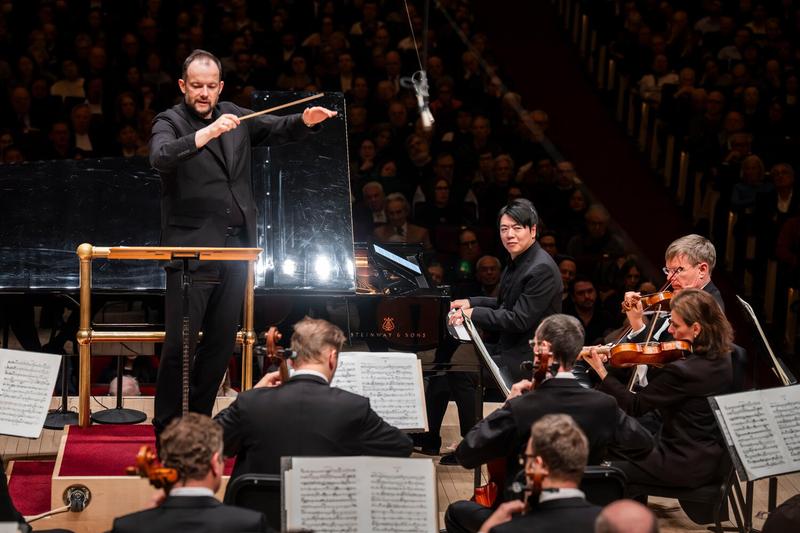
For out onto the Carnegie Hall stage walk pianist Lang Lang and conductor Andris Nelsons to join the Vienna Philharmonic for a performance of the Piano Concerto No. 3 of Béla Bartók. Bows to the audience with once again the Vienna Philharmonic on its feet, and conductor Nelson's deep bow from Lang Lang to the audience here. Now, the Bartók Piano Concerto No. 3 from Carnegie Hall Live.
[MUSIC - Béla Bartók: Piano Concerto No. 3]
[applause]
John Schaefer: The Piano Concerto No. 3 by Béla Bartók, a work written just a block or two from Carnegie Hall, where you've just heard Lang Lang, the superstar pianist at the keyboard with the Vienna Philharmonic conducted by Andris Nelsons. The Bartók Piano Concerto No. 3 finished in 1945. It's remarkable to think that Béla Bartók living just a block or two from here, he had been diagnosed with leukemia. He knew he was dying, he and his wife living in precarious financial circumstances as refugees from the war in Europe, and yet, Jeff, that music at the end is so full of life and motion, and energy.
Jeff Spurgeon: It's an amazing testament to the power of music and the power of a musical spirit. Because you're right, the Bartóks were not in good condition at that time at all, but the music is wonderful. Andris Nelsons and Lang Lang have come off stage and now Lang Lang returns. I think we can, with reasonable accuracy, expect an encore from Lang Lang for this sold out Carnegie Hall audience.
John Schaefer: It is Unlike a Carnegie Hall audience, to allow him to just play a piece and leave.
Jeff Spurgeon: Not going to happen. Not tonight.
John Schaefer: Lang Lang being the consummate showman that he is, is now taking his seat back at the piano. We will indeed have an encore from Carnegie Hall Live.
[MUSIC - Franz Liszt, Consolation No. 2]
[applause]
Jeff Spurgeon: Continuing the Hungarian theme in this concert. For his encore before this Carnegie Hall audience, pianist Lang Lang chose a work by Franz Liszt, his Consolation No.2, following the performance of the Bartók Piano Concerto No. 3.
John Schaefer: Interesting choice. Franz Liszt, we associate him with keyboard fireworks. Lang Lang, we certainly associate him with that as well. Yet this a very lyrical, elegant, perhaps even pensive work by Franz Liszt.
Jeff Spurgeon: He wrote three works that he called Consolations, and they are all in this same very intimate and comforting mood. Lang Lang, now back on stage. The performance that you heard just now of the Bartók Piano Concerto No. 3 took place 80 years and one day after the work was first performed in New York at Carnegie Hall by György Sándor, Hungarian pianist and a student of Béla Bartók, who gave the work its world premiere with Eugene Ormandy in February of 1946, first in Philadelphia and then a couple of weeks later, as I say in Carnegie Hall.
John Schaefer: Lang Lang getting applause on both sides from the audience and from the members of the Vienna Philharmonic, who sat respectfully at a rapt attention during the encore, the Liszt Consolation No. 2 in E major. The stage door opens one and outruns Lang Lang and literally ran right past us.
Jeff Spurgeon: I think he was ready, but the audience did not quite want to let this great artist go, who just about three weeks ago was helping to open the Olympic ceremonies in Milano, and is as peripatetic a musician as you are likely to find on a concert stage anywhere, and in great demand on all of them. As we mentioned, almost three dozen performances here at Carnegie Hall.
John Schaefer: Many of them broadcast as part of Carnegie Hall Live.
Jeff Spurgeon: It seems. Indeed. Now the lights are back on in the house. The members of the Vienna Philharmonic are rising up, stage doors opening. You're hearing that sound, you'll hear the players pass by. Very shortly we'll have the piano brought off stage to get ready for the second part of this concert tonight, which is Mahler's Symphony No. 1. This is Classical New York, WQXR 105.9 FM and HD Newark, 90.3 FM WQXW Ossining and WNYC FM HD2 New York. Backstage at Carnegie Hall, I'm Jeff Spurgeon alongside John Schaefer.
John Schaefer: We are broadcasting tonight from the main stage here at Carnegie Carnegie Hall. Always a great treat to have the musicians of the orchestra surrounding us. We'll actually get a chance to speak with a gentleman who has become a regular on these broadcasts.
Jeff Spurgeon: Yes, indeed. Daniel Froschauer is the chairman of the board of directors of the Vienna Philharmonic Orchestra, which is an institution that governs itself. As John mentioned earlier on, they don't choose a music director, a primary chief conductor.
John Schaefer: They are in so many ways a unique organization in classical music. It's not just that they don't have a steady music director, or that they're self governing because there are other self governing orchestras, famously the London Symphony Orchestra. To become a member of the Vienna Phil, you must first be a member of the Vienna State Opera Orchestra.
Jeff Spurgeon: That's how it starts.
John Schaefer: You have to play at least three years in the opera orchestra before you can be considered in the Vienna Philharmonic. It is in just so many ways unlike any other orchestra in the world. Yes, here is Daniel Froschauer once again to join us at the microphones as he does, it seems, each season of broadcasts from Carnegie Hall Live. Daniel, good to have you back.
Daniel Froschauer: Thank you for having me back.
Jeff Spurgeon: You've started this particular American tour. Where is the orchestra going this time around? You're here at Carnegie Hall now.
Daniel Froschauer: We started in Frankfurt, as a matter of fact. Then we play at Carnegie, Carnegie, Carnegie, and we go and play in Boston, in Washington. We play Naples, Florida, Naples, Florida. Then we play in West Palm Beach, West Palm Beach, and then Orlando, Orlando. [crosstalk]
Jeff Spurgeon: In late February and early March, I'm sure those were the only places you could find a venue open at this time of year. Good choice by the Vienna Philharmonic.
John Schaefer: We've been talking about some of the things that make the Vienna Philharmonic so unusual. You're the chairman of the orchestra in addition to being violinist. How are the decisions made about who is going to come with you when you take a tour like this?
Daniel Froschauer: Let me first of all explain, we're self governing and that's one of our DNA. We don't have a chief conductor. That's one of our DNA. We are an opera orchestra. We are employed by the Vienna State Opera. That's all also part of our DNA. All these factors make us unique and our decision making is made-- It's always democratic votes.
If you ask who is going on a tour, of course, we're 148 members in the orchestra. There are 22 first violins, and we have a rotations system to go on tour. Of course, if somebody wants to stay in Vienna, they can stay and somebody else will go on tour.
John Schaefer: I was asking specifically about the decision of which conductors you're going--
Daniel Froschauer: Oh. The conductors from America tour would be something very important, and then Andris Nelsons, we have a lot of experience with him. He's conducting the New Year's concert, the Summer Night concert. Since 2010, we've been a match, so to speak. He comes from the opera. He's a great conductor, also a great human being, I have to say. We are very happy that he's with us in America.
Jeff Spurgeon: How do you decide both repertoire and conductor? Did you decide the pieces you're going to play, and then say who would be good conducting these, or do you pick the conductor first? How does it work?
Daniel Froschauer: With Andris actually, at the moment we're doing a Mahler cycle, so it would be clear that we would want to play some Mahler with him. Mahler, First Symphony, we played for the very first time in 1900 with Gustav Mahler conducting. As a matter of fact, we still play out of the same parts because I was practicing this afternoon, and the part I'm practicing out of, I have a copy of my iPad and it says at the bottom, 18th of November, I think 1900. That would fit the picture.
Jeff Spurgeon: I was going to say you're not using the actual part because that paper is falling apart.
Daniel Froschauer: No, it's not.
Jeff Spurgeon: Oh really? It's out there. How about that?
Daniel Froschauer: Go and have a look.
John Schaefer: That's amazing.
Daniel Froschauer: To get back to the question, I think we are planning three years ahead of time so we know who we go next year, the year after. Now this time we're Andris.
John Schaefer: You already know who you're coming back with next year?
Daniel Froschauer: Yes.
John Schaefer: Who are you coming back with next year?
Daniel Froschauer: I can't really say this because-
[laughter]
-that's-- presenter Carnegie Hall, it's their job to do that.
Jeff Spurgeon: That's fair. We have to ask--
Daniel Froschauer: It's a nice try, guys.
Jeff Spurgeon: Daniel, do you come back to New York except with the orchestra, because you spent time here as a student. You studied at Juilliard with Dorothy Delay.
Daniel Froschauer: That's right. From 1982, I started studying one year in pre-college and then I stayed until '94. Basically affiliated with the Juilliard School. There were a special Delay program for people who wanted to study more. I actually wanted to do q DHM, a doctoral studies, but it was too academic for me. I'm not the academic type.
Jeff Spurgeon: Needed your hands on the instrument.
John Schaefer: A final question before we let you go, because you do have to rest. You have a big musical journey in the second half. What is the job of the chairman of the orchestra?
Daniel Froschauer: I represent the orchestra outward. My responsibility is the programming and conductor for the New Year's concert and the Summer Night concert. It's actually very good that this is their own job within a job, so to speak, because [unintelligible 00:53:29] the managing director, that would be too much for his position. Of course, I don't make the sole decision. I will talk to him about who we want to have for the New Year's concert. It's always interesting. Right now we have a changing generation of conductors. We have to look at 10 years ahead of time in the [inaudible 00:53:52]
Jeff Spurgeon: You had Yannick Nézet-Séguin for the first time this past year.
Daniel Froschauer: With Yannick-- Actually, as a matter of fact, when I come to Carnegie Hall these days, of course I remember performance I heard as a student. I heard Horowitz here, how great performance like Isaac Stern, Henryk Szeryng, the giants. I also have the memory from 2022, where we came on a Wednesday, we arrived in New York on Thursday morning, we didn't have a conductor for Friday, Saturday, and Sunday. This is when Yannick stepped in and helped us out, and then he consequently conducted the Summer Night concert, consequently the New Year's concert.
John Schaefer: My suspicion is that there's a closet in which they keep Yannick here in Carnegie.
Jeff Spurgeon: I think that's right.
John Schaefer: That is a story I've heard several times.
Jeff Spurgeon: Daniel Froschauer, it's a privilege to talk to you always, and of course to hear you and your colleagues in the Vienna Philharmonic. Thanks for talking with us.
Daniel Froschauer: Thank you.
Jeff Spurgeon: We look forward to the Mahler in just a few minutes.
Daniel Froschauer: Thank you.
Jeff Spurgeon: Daniel Froschauer, chairman of the Vienna Philharmonic. You'll see him right at the front of the first violin section as well as this concert continues from Carnegie Hall Live. It's intermission. In the first half, we heard Lang Lang and the Bartók Piano Concerto No. 3, along with the Vienna Philharmonic. We have enjoyed performances by Lang Lang through the years, not only here at Carnegie Hall, but also at the studios that we have in Lower Manhattan.
John Schaefer: We can hear one of those performances now, selections from the Bach Goldberg Variations. Once again, we'll take you to WQXR's ground floor performance venue known as the Greene Space. This time, a 2021 performance by Lang Lang, doing the 1st, the 25th, and the 30th variations, for those of you scoring at home, played by Lang Lang.
[MUSIC - Lang Lang: Goldberg Variations]
Jeff Spurgeon: There we have some excerpts from the Goldberg Variations, a performance by Lang Lang at the studios of WQXR in New York City in 2021. That was the year that Lang Lang released simultaneous versions of the Goldberg Variations. One recording made in a studio and another captured live. He put them both out at the same time. It was an interesting way to offer another look at the Goldberg Variations. Well, we heard Lang Lang in the first half of this concert broadcast featuring the Vienna Philharmonic playing Bartók's Piano Concerto No. 3. The second half will belong exclusively to the Vienna Philharmonic and conductor Andris Nelsons.
John Schaefer: It was a pretty crowded stage when they were playing the Bartók Piano Concerto No. 3. Now--
Jeff Spurgeon: You just wait.
John Schaefer: Now it's going to be the Lexington Avenue line at rush hour because it's the Mahler Symphony No. 1, like most Mahler symphonies, is for a huge ensemble. It'll be all hands on deck, or on stage, as the case may be, for Mahler's Symphony No. 1, which was briefly known as the Titan.
Jeff Spurgeon: It's a real vexing problem talking about Mahler symphonies because he told you what it was about, and then he said, "Don't pay any attention to that." He called it the Titan, this symphony for a couple of performances, and then withdrew that name. It's never going to go away.
John Schaefer: It's also a piece that went through many revisions. Famously, there is a fifth movement, the Blumine movement, that was extracted from the piece and which Mahler completists will occasionally hear separately. We are going to hear the work in its four-movement format, as Mahler eventually settled upon it. It was very interesting to hear Daniel Froschauer of the Vienna Phil talking about playing from the original parts from the year 1900-
Jeff Spurgeon: That is really something.
John Schaefer: -because this is-- We mentioned earlier in the broadcast, this is very much Mahler's home orchestra, the Vienna Philharmonic. The idea that those original parts are still in the possession of the players and that they use them just shows you how steeped in tradition this orchestra is.
Jeff Spurgeon: How powerful this music continues to be across, well, decades and decades. The piece went through a lot of revisions, and so tonight we look forward to the work in which Mahler offers a lot of musical quotations, including of his own work. He used themes from his Songs of a Wayfarer in the first and third movements. There's even a quotation from Handel's Messiah tucked into the finale. For more, let's turn now to one of our colleagues, New York Public Radio's Aaron Cohen, who has created a really marvelous podcast called Embrace Everything - The World of Gustav Mahler. This is a clip from the first season series, which focused completely on that first symphony of Mahler.
Aaron Cohen: The third movement of Mahler's first Symphony begins with the beat of a funeral march. Mahler paints the picture for us.
Gustav Mahler: For this movement, the following explanation will help. The basic inspiration for it was found in a humorous engraving well known to all Austrian children. The Huntsman's Funeral. From an old book of fairy tales.
Aaron Cohen: The engraving is by Moritz von Schwind, a popular Austrian painter who lived in the first half of the 19th century.
Gustav Mahler: The forest animals accompany the dead hunter's coffin to the grave. Hares carry the banner. In front of them march a group of bohemian musicians accompanied by singing cats, toads, crows, et cetera.
Aaron Cohen: The hunter's casket is carried by all the animals he would have killed in his lifetime.
Gustav Mahler: Stags, deer, foxes, and other four-legged and feathered animals follow the funeral procession in all kinds of farcical positions. The mood expressed is sometimes ironic and merry, sometimes gloomy and uncanny.
Aaron Cohen: The movement kicks off with a melody played by the solo double bass.
[MUSIC - Solo Double Bass: Mahler Symphony No. 1]
Aaron Cohen: This might sound somewhat familiar because Mahler adapts the famous children's tune Frere Jacques, but with a slight adjustment, he changes it to a minor key. Music Professor Marilyn McCoy.
Professor Marilyn McCoy: When this piece is performed, people start to laugh. People smile, they look around, and they go, "Is this a mistake?"
Aaron Cohen: Here's Dominic Seldis, principal bass of the Royal Concertgebouw Orchestra of Amsterdam.
Dominic Seldis: It's just one of those things that's just so exposed and just so naughty. Then how do you play it? Do you play it like a funeral? Do you play it as somebody singing? Is it meant to be sad? Is it meant to start a parade?
Aaron Cohen: Natalie Bauer-Lechner remembered how the composer himself felt about the melody.
Natalie Bauer-Lechner: Mahler said that even as a child, he had never thought of Frere Jacques as cheerful, the way it is always sung, but rather profoundly tragic. Even then, he could hear in it what he developed from it later.
Aaron Cohen: Mahler said this Funeral March was inspired by a band of lousy amateur musicians. Should it be played badly? Bassist Dominic Seldis.
Bassist Dominic Seldis: I play it as a melancholic, beautiful tune, which starts this parade of more melancholic, beautiful tunes. Then for me, it should sound nice.
Aaron Cohen: In order to paint this ironic picture and sound, Mahler needed to figure out how to use the orchestra in paradoxical ways.
Gustav Mahler: If I want to produce a soft, subdued sound, I don't give it to an instrument which produces it easily, but rather to one which can get it only with effort and under pressure, often only by forcing itself and exceeding its natural range. I often make the basses and bassoons squeak on the highest notes while my flute huffs and puffs down below.
Aaron Cohen: After this very strange opening, a completely different kind of music begins. Music that sounds Jewish. Marilyn McCoy.
Professor Marilyn McCoy: It's like, "What the heck is this?" It sounds like you've walked into a party somewhere.
Aaron Cohen: Within this movement, each new section is a surprise. After a funeral march, you wouldn't expect party music. It's even been suggested this is a wedding party.
Professor Marilyn McCoy: The trumpets really sound like they're intoxicated, like they're drunk. They're really not playing in tempo with the others. It is composed that way. I think in performance, that's something a conductor can really push or pull. I actually like when they push it because I think it's meant to be kind of nutty and kind of crazy.
Aaron Cohen: Bill Hudgins, principal clarinet of the Boston Symphony Orchestra.
Bill Hudgins: Clearly, he heard these kind of folk bands, and especially the Jewish ones, when he was growing up, and he was used to this kind of music.
Aaron Cohen: This particular flavor of folk music was new to the symphonic repertoire.
Bill Hudgins: That's actually an easy thing to do, because the clarinet naturally wants to go that way. In the classical playing, we're actually reining it in, so it doesn't a lot of the time.
Jeff Spurgeon: An excerpt from the podcast Embrace Everything - The World of Gustav Mahler, produced by a colleague of John's and mine at our parent company, New York Public Radio, Aaron Cohen. Five seasons of that program are in progress now, four have been completed, and as you hear, it's a wonderful way to learn about Mahler symphonies.
John Schaefer: Each season for one of those Mahler symphonies. Yes, he's up to Symphony No. 5, and those are available wherever you get podcasts. In just a moment, we're going to hear the whole thing, the whole first Symphony, which does have an all-encompassing sound to it.
Jeff Spurgeon: As he said, the Symphony should be about everything, embracing everything. It starts out in nature, too, in a really wonderful way. You heard Frere Jacques and other tunes. You're going to hear some bird song in the first movement. If you're longing for spring at this particular season of the year, it'll be provided for you by Gustav Mahler and the Vienna Philharmonic.
John Schaefer: Star Trek fans will get a little shock of recognition at the very beginning of the piece.
Jeff Spurgeon: Yes, indeed, we won't spoil that surprise for you. As the orchestra is on stage, all seated and tuned, and we are now awaiting the entrance of conductor Andris Nelsons, when the stage door opens at Carnegie Hall. Then we'll have that great symphony unfold before us.
John Schaefer: Symphony No. 1 by Gustav Mahler, played by the orchestra that still owns the parts that it was first performed on, The Vienna Philharmonic, Andris Nelsons at center stage here at Carnegie Hall up on the podium to begin this musical journey through the Mahler Symphony No. 1 from Carnegie Hall live.
[MUSIC - The Vienna Philharmonic: Mahler Symphony No. 1] [applause]
Jeff Spurgeon: "A symphony must be like the world, it must embrace everything," so said Gustav Mahler. You've just heard Mahler's Symphony No. 1, a performance from Carnegie Hall live by the Vienna Philharmonic and Conductor Andris Nelsons, and a rousing ovation from a sold-out Carnegie Hall audience. Backstage at Carnegie Hall, I'm Jeff Spurgeon alongside John Schaefer.
John Schaefer: It's true that Mahler said that a symphony should contain a whole universe. That finale contains a whole symphony as Mahler begins to weave in echoes and fragments of things that have come earlier in the earlier movies of the symphony. That finale in itself contains so much.
Jeff Spurgeon: It's amazing that Mahler, even though this was the first of his nine, or if you'd like to count 10 symphonies, there's so much of his mature style already present here. In many ways, he was quite fully formed even in this first symphony, which embraces a little bit of darkness, but not very much. It has a youthful buoyancy to it, an optimistic attitude that pervades almost all of it.
John Schaefer: Even the darkness in the third movement is more of a spooky darkness as opposed to the despair that you hear in the later symphonies. No despair here, though. You can hear the response of the Carnegie Hall audience applauding Andris Nelsons and the Vienna Philharmonic, and Maestro Nelsons, with his back to the audience.
Jeff Spurgeon: Using particular hand signals to--
John Schaefer: To have different members of the Orchestra rise. This may take a while because it's a big ensemble, and everybody at some point has a very exposed part to play in this piece. Concert master standing, Andris Nelsons.
Jeff Spurgeon: Cheers for Volkhard Steude, one of the four concert masters, but he's leading the performance tonight in that role. Now the entire Vienna Philharmonic on its feet. Handshakes for some section leaders from Andris Nelsons. We mentioned earlier because we heard from Daniel Froschauer, one of the first violinists and chairman of the Vienna Philharmonic, that they're using original parts. The Vienna Philharmonic, part of their great tradition. I'll tell you something about this Mahler symphony and its traditions here at Carnegie Hall. It was first performed on this stage in 1909 by the New York Philharmonic, and the conductor was Gustav Mahler.
John Schaefer: In the New York Philharmonic Archives is the complete score. Now they have the parts, so the violins, see the violin part, the flutist has the flute part. The conductor has the full score. The New York Philharmonic, to this day, I've seen the score to Mahler's First Symphony. It is an amazing historical document because you can see all the little edits and amendments that Mahler made in pencil, and then Bruno Walter's edits and amendments in green pencil, and then Leonard Bernstein's in red pencil. It's really quite an amazing thing.
Jeff Spurgeon: It's something that you can view as well because the New York Philharmonic has digitized all of its archives, so it's available. Now, Maestro Nelsons is back on the podium. We're going to have an encore tonight from the Vienna Philharmonic.
MUSIC- Vienna Philharmonic: Suppé- Overture to Light Cavalry (encore)
[applause]
John Schaefer: The Light Cavalry, old overture, a familiar piece by Franz von Suppé. After the four-course meal that was the Symphony No. 1 by Mahler, a little light Viennese pastry there from the Vienna Philharmonic and Conductor Andris Nelsons. Familiar music from an operetta called The Light Cavalry. We don't really know much about that operetta these days except for this overture.
Jeff Spurgeon: Suppé wrote so many works, four dozen operettas in his life. There are two versions of the story of The Light Cavalry. One involves hussars, and the other involves a ballet company. The piece was rewritten a couple of times. That's where The Light Cavalry comes from. Suppé's music used to be a lot more ubiquitous on concert programs. Less popular today. Really a wonderful treat. As you mentioned, the Vienna Philharmonic offering something from an Austrian composer as an encore. Typical kind of offering from the Vienna Philharmonic, showing what they do so well.
John Schaefer: Andris Nelsons back out center stage to ask the orchestra to rise and accept the applause of this sold-out crowd here at Carnegie Hall. He now turns to face the audience. A deep bow from the podium. Jeff, really, a concert that has burnished the reputation of this combination of conductor and orchestra.
Jeff Spurgeon: Yes, it's true.
John Schaefer: As we've mentioned, they do not have a steady music director, never have, but working with Andris Nelsons seems to bring out the best in them.
Jeff Spurgeon: They've had a successful Mahler cycle, and so they've taken that show on the road here in New York. Also, earlier in Frankfurt. The tour began in their hometown of Vienna with additional concerts in Florida in late February and March. Good artistic planning by the Vienna Philharmonic authorities. Thus concludes this concert. The stage doors open. You're going to hear the orchestra members pass us by right now as we begin to conclude this broadcast of Carnegie Hall Live. With thanks to Clive Gillinson and the staff of Carnegie Hall.
John Schaefer: WQXR's team includes engineers George Wellington, Duke Marcos, Bill Sigmund, and Neal Shaw. Our production team, Laura Boyman, Lauren Purcell-Joiner, Eileen Delahunty, and Christine Herskovits. I'm John Schaefer.
Jeff Spurgeon: I'm Jeff Spurgeon. Carnegie Hall Live is a co-production of Carnegie Hall and WQXR in New York.
[pause 02:21:53]
[02:26:28] [END OF AUDIO]
Copyright © 2026 New York Public Radio. All rights reserved. Visit our website terms of use at www.wqxr.org for further information.
New York Public Radio transcripts are created on a rush deadline, often by contractors. This text may not be in its final form and may be updated or revised in the future. Accuracy and availability may vary. The authoritative record of New York Public Radio’s programming is the audio record.