
Taxi Driver: Where to?
Passenger: Carnegie Hall, please.
[music]
[tires screech]
[car honks]
Ticketing Agent: Okay, here are your tickets. Enjoy the show.
Usher: Your tickets, please. Follow me.
Jeff Spurgeon: In New York City, there are lots of ways to get to Carnegie Hall. Subway, a taxi, a walk down 57th Street. You've just found another way to get to America's most famous home for classical music. Welcome to Carnegie Hall Live, the broadcast series that gives you a front row seat to concerts by some of the greatest artists in the world, and you hear the performances exactly as they happen. You are part of the audience, sharing the experience of music making at Carnegie Hall. Just off stage, a few feet from the stage door at Carnegie Hall, I'm Jeff Spurgeon alongside Paul Cavalconte.
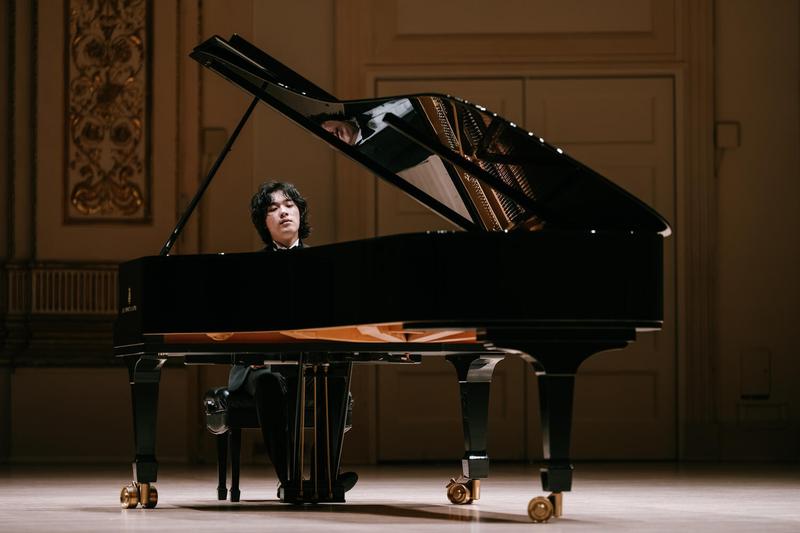
Paul Cavalconte: Hello, Jeff. And as you listen to our broadcast and our stock introduction, which has all kinds of effects of the orchestra tuning in the background and all, it's a little deceiving about tonight's concert because there will be only one performer this evening in the middle of the stage here at Carnegie Hall as a Steinway waiting for the young Korean pianist, Yunchan Lim to take the stage for his third solo recital here at Carnegie Hall.
And a little bit about our soloist tonight. Lim was the youngest person to win gold at the Van Cliburn International Piano Competition in 2022. He was 18 years old at the time. Since then, he has become an international star. He's been called one-in-a-million talent by the Dallas Morning News.
Jeff: He was born in 2004 in South Korea City in the northwest part of the country, started playing the piano at age seven, taking lessons. Studied at the Academy of the Seoul Arts Center there. Later moved to the Korean National Institute for the Gifted in Arts at the ripe old age of 13, where he met his teacher and mentor, Minsoo Sohn.
Paul Cavalconte: We mentioned that Lim was a Van Cliburn winner, but he has many other trophies on his mantle, including the Cleveland International Piano Competition for Young Artists and Korea's ISANGYUN International Competition at the age of 15.
Jeff: In the past few years, Lim has made orchestral debuts with the New York and Los Angeles Philharmonics, the Chicago and Boston symphonies, and has worked with orchestras in Munich and in Tokyo and with Radio France, and in Lucerne in Switzerland and in Seoul, South Korea. So at the age of 22, this young musician has already made his mark in the classical universe.
Paul Cavalconte: And there are four works on this concert, a sonata by Schubert and three sonatas by the Russian composer Alexander Scriabin. It will be Schubert who begins the program. And sadly for Schubert, so much of his work was published after his death. Only three of his piano sonatas were published during his lifetime. We're going to hear one of those, the Sonata in D major, number 850 in the Deutsch catalogue of Schubert's works.
It was written in May of 1825, just three years before the composer's death. The piece was written when Schubert was recovering from an illness, and he had left Vienna for a few spa towns in Austria, particularly Bad Gastein or Bad Gastein, and that is why the sonata has a unique nickname.
Jeff: Yes, it is the Gasteiner Sonata. The scenery and fresh air in that area really fueled Schubert's creativity. He loved being out in nature, so he wrote not only this sonata, but-but also started work on a C major symphony on that particular vacation.
The sonata that we're going to hear tonight is in four movements. You can certainly hear the influence of Beethoven, whose piano works had already pushed the instrument, the piano, into new territory. But we are going to hear it played on this concert by Yunchan Lim on stage at Carnegie Hall. And this is not a recital that has what you would call, I would guess, the-the front side of the piano repertoire. No Chopin, no Beethoven, no Mozart tonight, but, uh, but some really wonderful repertoire by two great composers.
Paul Cavalconte: And Scriabin, deep dive and an arc of his very interesting life and career. And to begin, the-the composer, I think, that we associate with sort of like, you know, youth frozen in time, Franz Schubert. Even if Schubert had lived to 80, I think that he would have been writing with a very young heart.
Jeff: Yeah.
Paul Cavalconte: And so for this young man to, uh, bring the-the Schubert music to the stage, as he will right now.
Jeff: Yunchan Lim, to begin his recital from Carnegie Hall Live.
[music] [music] [music] [music] [music]
[applause]
Jeff: From Carnegie Hall Live, a performance of Schubert's Piano Sonata in D by the young Korean star, Yunchan Lim. A capacity crowd at Carnegie Hall tonight, a quick offstage turn by Yunchan Lim and then back on stage to receive the applause you're hearing now. And just offstage at Carnegie Hall, I'm Jeff Spurgeon alongside Paul Cavalconte. It's such a big work, this sonata, Paul. One of the longest of the piano sonatas that-that Schubert had written up to this point in his life. Filled with all kinds of ambition and that endless supply of melody that Schubert never fell short of.
Paul Cavalconte: It-it-it contains multitudes. It's like all these songs are in there just dying to get out.
Jeff: Mm-hmm.
Paul Cavalconte: And there's- there's albums worth of pop songs that were never born. Yeah. But this is-- the thing about Schubert and-and the comments about his, uh, melodicism and lyricism, so much other music is just kind of a, you know, motif lost in a sea of abstraction.
Jeff: Mm-hmm.
Paul Cavalconte: Or it's- it's themes and variations that go round and round and round. And all of these beautiful human moments, I have a hunch that he was hanging out in the pubs when he was on that long summer vacation soaking up some of the pub songs. They're in-- they're baked in there.
Jeff: You bet. You bet. That's the only work on the first half of this program, uh, the third solo recital at Carnegie Hall by the young South Korean pianist, Yunchan Lim. And so we are at intermission of this particular performance at, uh, Carnegie Hall. Uh, we mentioned this is his third recital. Uh, rare indeed for an artist to make their debut on the Perelman stage in Stern Auditorium at Carnegie Hall by age 22. It's been done before. But to perform three times in such a short time, um, in-in '24 he made his debut, in '25 came back, and now this 2026 recital of Schubert, and in the second half, uh, Scriabin.
The, uh, 2025 recital featured the complete Goldberg Variations of J.S. Bach. It was recorded and has been, uh, now offered as a Live at Carnegie Hall album on Decca, uh, just released in early 2026. Um, a concert which, by the way, was also filmed, and you can watch it on Carnegie Hall's special video channel, Carnegie Hall+.
Paul Cavalconte: So it is intermission here at Carnegie Hall, and while we wait for the second half of the program to begin, we're gonna look back on one of our previous concerts in this Carnegie Hall Live series. Here is the Pittsburgh Symphony with conductor Manfred Honeck and a performance of Dmitri Shostakovich, Symphony No 5.
[music]
Jeff Spurgeon: A portion of Dmitri Shostakovich's which is Symphony No. 5, a performance by the Pittsburgh Symphony and their music director, Manfred Honeck, a performance that is part of this Carnegie Hall Live series. And in just a moment, the second half of this Carnegie Hall recital by the young Korean pianist, Yunchan Lim, featuring music by Alexander Scriabin. I'm Jeff Spurgeon, and this is Carnegie Hall Live.
[music]
Jeff Spurgeon: We are at intermission of a solo recital by pianist Yunchan Lim. And backstage at Carnegie Hall, I'm Jeff Spurgeon alongside Paul Cavalconte.
Paul Cavalconte: And the remaining works on Yunchan Lim's recital are three piano sonatas by the Russian composer Alexander Scriabin. And Lim has chosen to take these three and present them in a continuous performance. The three, which we'll break down one by one, kind of are an arc in the long story of Alexander Scriabin's creative career. There are programmatic associations and an advancement in his own transition from the end of the romantic to this whole new, uncharted territory that he helped to develop.
Now, he wrote five symphonic works, including one that he sometimes called his Fourth Symphony. We know it as The Poem of Ecstasy, and the novelist Henry Miller wrote about that work, describing it as having that "Far-off cosmic itch, divinely fouled up." [laughs] And that is not a, uh, thorough description of all of Scriabin's music, but it's a useful idea to hold onto when you hear his works, especially because there is a mystical element to Scriabin as well.
Jeff Spurgeon: That is for sure. Scriabin was born in 1872 into a noble family in Moscow. His mother was a concert pianist. Young Sasha, as he was called, was very attracted to music. He actually built little pianos. He loved the mechanism of-of pianos, and then later learned to play the instrument from, among others, Rachmaninoff's teacher. His early piano pieces show how much Chopin's music influenced Scriabin. We're hearing some of his earlier works on this concert, so you'll get that very romantic, Chopinesque Liszt-y sound along with Scriabin's ideas, which take influence from Wagner and Debussy as well in an expanded harmonic color palette.
Paul Cavalconte: And there's a wink to Beethoven as we begin this, uh, adventure in Scriabin curated by Yunchan Lim. Uh, he will perform first his Piano Sonata No. 2. It was written over a five-year period, published in 1898. Here is how Scriabin described this work that Yunchan Lim is about to play, saying, "The first movement represents the quiet of a night on the seashore. The development is the dark agitations of the deep, deep sea. The middle section shows caressing moonlight coming after the first darkness of the night. The second movement represents the vast expanse of ocean, stormily agitated." So we're gonna get moonlight and water music.
Jeff Spurgeon: And then following that work, we'll hear the Piano Sonata No. 3. Has four movements. Remember, we told you that Scriabin was a mystic. He called his Third Sonata States of the Soul with references to a soul thrown into life at rest after experiencing suffering, feeling tenderness and love and sorrow, and restlessness. And then in the fourth movement, the resurgence of the life force. But in Scriabin's words, "The soul is too weak yet to reach its acme, and so it plunges temporarily defeated into the abyss of non-being."
[laughs]
Jeff Spurgeon: There you go.
Paul Cavalconte: Heavy duty.
Jeff Spurgeon: Scriabin the mystic again.
Paul Cavalconte: [laughs] But we're gonna start, uh, grounded a little bit more so in, uh, the piece described before as the Sonata Fantasy, Alexander Scriabin, Piano Sonata No. 2, the first, again, of three that will be performed consecutively without a break. And next in Scriabin's Sonata No. 4, the last program worked on Yunchan Lim's recital. We're gonna go much further into Scriabin's own sound world, less concerned with keys and harmonic structure. Just two movements here. Everything feels less anchored, more improvisational, and it's a much greater musical expression of Scriabin's mystical meditations.
This is a man who once wrote, "I am God." And it's a line that has been misinterpreted as egotism, but it's more accurate to say that Scriabin believed in the unity of all creation. If we are all part of God's creation, then we are as much God as anything else.
Jeff Spurgeon: And so, as you hear, the lights are down, the crowd is silenced, and the anticipation grows. Yunchan Lim is just a few feet away from the stage door at Carnegie Hall, and as soon as it opens, he will begin a great adventure in the music of Alexander Scriabin. We will hear three of his piano sonatas, the second, third, and fourth. They will be played, we understand, without interruption.
[applause]
Jeff Spurgeon: Stage door opens. And out goes this young South Korean star, Yunchan Lim, to bring you three piano sonatas by Scriabin from Carnegie Hall Live.
[music] [music] [music] [music] [music]
[applause]
Jeff Spurgeon: What you've just heard from Carnegie Hall Live, a fascinating exploration of three of the early piano sonatas of Alexander Scriabin. We knew that these works were going to be played on this recital by Yunchan Lim, but we didn't know until just a few minutes ago, was that he would perform all three of those sonatas, the second, third, and fourth of Scriabin's piano sonatas, attacca as they say, without interruption. And so this-- these three sonatas, in a way, became one. And I think, as you heard, Paul Cavalconte, the audience ate it up. They were wrapped from start to finish, and that is a part of the explanation of this incredible applause that Yunchan Lim is getting.
And as you hear the audience continues to appreciate the work of this amazing young South Korean musician who played these sets of pieces by this Russian composer is eccentric and unkind word, maybe it is, but that's what Alexander Scriabin was, a mystic exploring ideas of-of philosophy and religion in his music and-and in his life. And he had huge ambition, Scriabin.
Paul Cavalconte: He really did. Um, he didn't get to finish it, but Scriabin had begun work on a piece called Mysterium, and it would involve not just music, but talk about being ahead of his time, lighting effects, incense. So he was bringing all of the senses in. There would be dancers changing sets, and he was planning to have the work actually in a carnival like way, last for seven days. He wanted to have it performed somewhere in the Himalayan Mountains. The Beatles didn't even do stuff like this. Scriabin's ambition for the work was to have it bring about just a little-a little trifle, the end of the world, a thing these days, and cause a transformation of humanity into a race of higher beings. Give this guy a podcast.
Jeff Spurgeon: [laughs] That's really true. Scriabin, a man of incredible emotion, very intense experience, and in his music, and you got to hear a little bit of that progression. There's more of Scriabin's world to explore. We got three sonatas in a row on this recital by Yunchan Lim. And as you might anticipate, it appears that we're going to get an encore from Yunchan Lim.
[music] [music]
[applause]
Jeff Spurgeon: An encore from pianist Yunchan Lim on this Carnegie Hall Live recital. A nod to the other Russian content of this program, that was a transcription of the Rachmaninoff Vocalise. A transcription made by a Soviet pianist, a Russian pianist of the 20th century, a man named Yakov Zak. And it's that rendition that Yunchan Lim just brought this audience, and you hear their incredible pleasure at having gotten a little more music from this young South Korean phenomenon. Backstage at Carnegie Hall, I'm Jeff Spurgeon. Paul Cavalconte is here. We have been noting Yunchan Lim's very quiet, personal presence. The personality appears at the keyboard.
Paul Cavalconte: Exactly. He-he is, uh, uh, I was gonna say, standing next to us. He's just scooted back on stage to take curtain call after curtain call, and no small wonder. When an artist can get over a million views on the NPR Tiny Desk Concert that he did in 2024, performing Liszt and Tchaikovsky, he most certainly has arrived in the rest of the media world. But on an old-fashioned radio show, it sure is wonderful to bring the energy of Carnegie Hall Live and vibrant with all of this love and cheering focused on one little guy.
[applause]
Jeff Spurgeon: The 22-year-old from South Korea in his third solo recital at Carnegie Hall. And the audience will not let him go.
Paul Cavalconte: [laughs] I can't imagine a second encore is gonna happen on the fly, but--
Jeff Spurgeon: Well, the lights haven't come up yet.
Paul Cavalconte: Right.
Jeff Spurgeon: So we don't know what's going to happen.
Paul Cavalconte: He's taking his bows with tremendous reverence for this audience.
Jeff Spurgeon: Yeah, very.
Paul Cavalconte: There's-there's dignity back and forth.
Jeff Spurgeon: Yeah, very quiet poise. Very quiet poise. All right. And that seems to be the conclusion of a wonderful, uh, piano recital by Yunchan Lim. The great big Schubert sonata in the first half, Deutsch 580 in D, and then three sonatas by Alexander Scriabin, the second, third, and fourth. Which were unusually performed without interruption, without even an acknowledgement. So in a way, it was eight movements of a sonata instead of three, two, four, and two.
Paul Cavalconte: Making a suite out of the composing life of this very singular [laughs] and eclectic composer.
Jeff Spurgeon: It's true. It's true. And that is going to wrap up this broadcast of Carnegie Hall Live. With our thanks to Clive Gillinson and the staff of Carnegie Hall.
Paul Cavalconte: WQXR's team includes engineers George Wellington, Bill Siegmund, Neil Shaw, Kelvin Grant, and Noriko Okabe. Our production team, Eileen Delahunty, Laura Boyman, and Christine Herskovits. I'm Paul Cavalconte.
Jeff Spurgeon: And I'm Jeff Spurgeon. Carnegie Hall Live is a co-production of Carnegie Hall and WQXR in New York.
[music]
[01:58:19] [END OF AUDIO]
Copyright © 2026 New York Public Radio. All rights reserved. Visit our website terms of use at www.wqxr.org for further information.
New York Public Radio transcripts are created on a rush deadline, often by contractors. This text may not be in its final form and may be updated or revised in the future. Accuracy and availability may vary. The authoritative record of New York Public Radio’s programming is the audio record.